Ask your projects data anything. Get answers in seconds. Plexa MCP Connector is live. See it in action
Safety Data Sheet
Also known as: SDS, formerly MSDS (material safety data sheet)
Definition
A safety data sheet (SDS) is a document prepared by the manufacturer or importer of a hazardous chemical that describes its hazards, safe handling and storage, required PPE, and first aid and emergency measures. Australian WHS laws require businesses using hazardous chemicals to have the current SDS readily accessible.
SDS Meaning and Where It Comes From
SDS stands for safety data sheet. It replaced the older material safety data sheet (MSDS) when Australia moved to the Globally Harmonised System of Classification and Labelling of Chemicals (GHS) under the model WHS laws.
The manufacturer or importer of a hazardous chemical must prepare the SDS, and review it at least every 5 years. Suppliers must provide it when they first supply the chemical to a workplace, and the business using the chemical must obtain the current version and keep it where workers can get to it.
On a construction site, common products with an SDS include concrete additives, form oil, sealants, adhesives, solvents, paints, fuels, LPG and acetylene, cleaning chemicals and some cement products.
What an SDS Includes
Safe Work Australia's Code of Practice for preparing safety data sheets sets out 16 standard headings, so every SDS reads in the same order. The sections people use most on site are:
Identification. Product name, supplier details and an Australian emergency phone number.
Hazard identification. The GHS classification, pictograms, signal word and hazard statements.
First aid measures. What to do for skin or eye contact, inhalation or swallowing.
Firefighting and accidental release. Suitable extinguishers and how to contain a spill.
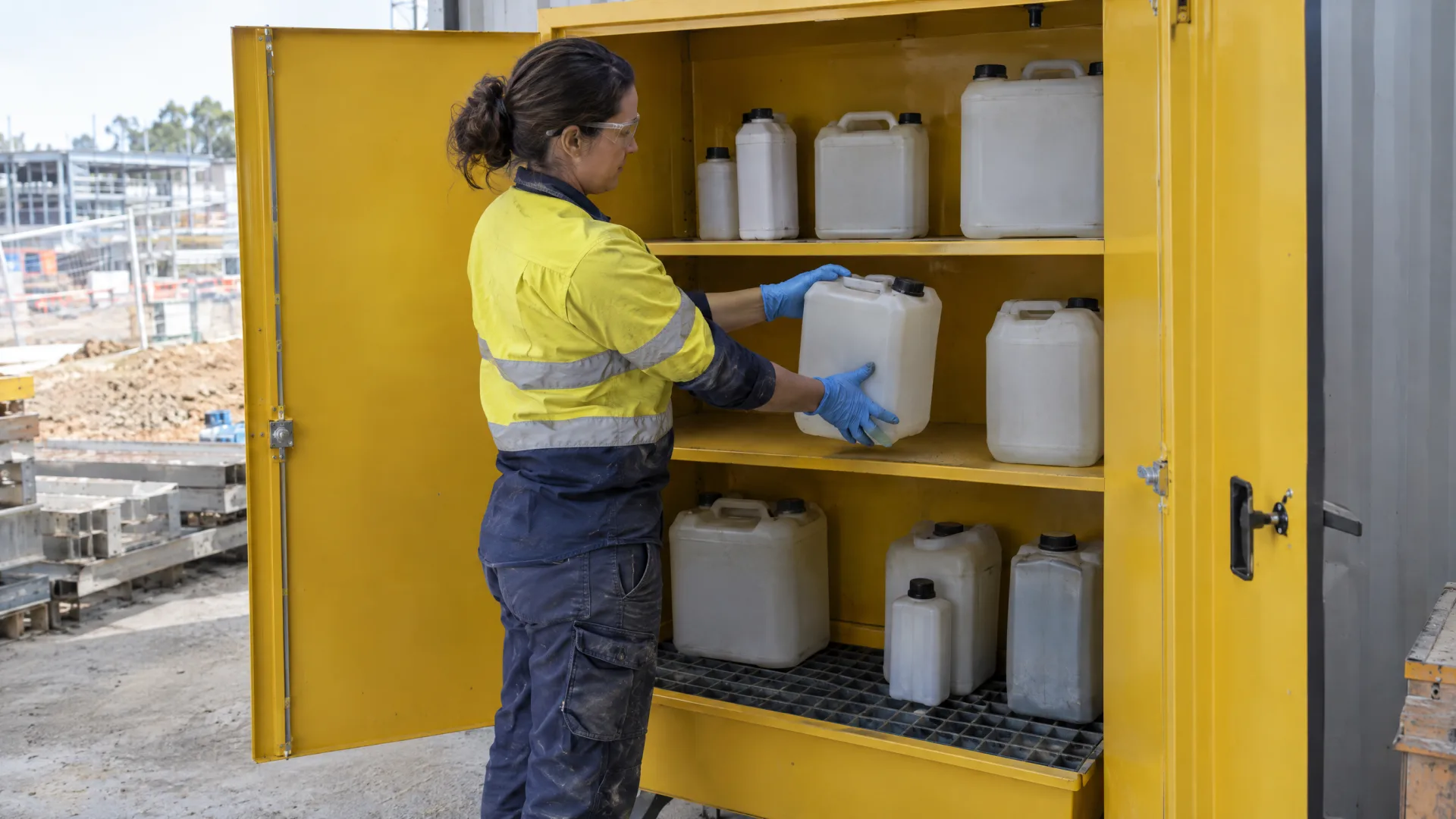
Handling and storage. Ventilation, incompatible materials and storage conditions.
Exposure controls and PPE. Exposure standards, plus the gloves, eyewear or respiratory protection needed.
The remaining headings cover composition, physical and chemical properties, stability, toxicology, ecology, disposal, transport, regulatory information and other details such as the date of last revision.
SDS Duties on a Construction Site
A PCBU (person conducting a business or undertaking) that uses, handles or stores a hazardous chemical must obtain the current SDS and make sure it is readily accessible to workers and to emergency services. It must also keep a register of hazardous chemicals, which lists the chemicals on site with their SDS.
The SDS should feed straight into the risk assessment, the SWMS (Safe Work Method Statement) for any high risk work involving the chemical, and the induction for workers who use it. Bigger quantities of some chemicals trigger further duties, such as a manifest and placarding.
In Victoria the same principles apply under the Occupational Health and Safety Regulations 2017 and the Dangerous Goods legislation, but the regulation numbers and some thresholds differ.
Common SDS Mistakes
Out-of-date sheets. An SDS older than 5 years, or from a previous formulation, may not match the product on site.
Wrong supplier's SDS. Two products with similar names can have very different hazards. Match the SDS to the product and supplier on the label.
Filed, not used. An SDS sitting in a folder in the site office does nothing if the controls in it aren't in the SWMS.
No register. Many sites have a stack of SDSs but no hazardous chemicals register linking them to what is actually stored.
Frequently asked questions
What does SDS stand for in construction?
−
SDS stands for safety data sheet. It is the document that describes a hazardous chemical's hazards, how to handle and store it safely, the PPE required, and the first aid and emergency steps if something goes wrong.
What is the difference between an SDS and an MSDS?
−
They do the same job. MSDS (material safety data sheet) is the older name. Australia moved to the SDS format, with 16 standard headings based on the Globally Harmonised System, when the model WHS laws were introduced.
How often does an SDS need to be updated?
−
Under the model WHS Regulations, the manufacturer or importer must review and, if needed, update the SDS at least once every 5 years. Sites should check the revision date and replace any sheet that is out of date.
Where should safety data sheets be kept on site?
−
Somewhere readily accessible to the workers who use the chemical and to emergency services. That can be a folder near the storage area or a digital register, as long as workers can reach it quickly when they need it.

Free Playbook
The Missing AI Playbook for Construction Safety
Learn practical AI workflows for incident reports, SWMS, compliance checks, safety data and training, with real prompts you can use and review yourself.
Related terms
Browse the glossary

The AI Construction Operating System
One platform, one data model, every project. Built in Australia, for the world.
YOUR DATA, PROTECTED
Hosted on AWS Sydney with Australian data residency.


GET THE MOBILE APP
Platform
Solutions
© 2026 Plexa Pro Pty Ltd. ABN 63 668 433 136