Ask your projects data anything. Get answers in seconds. Plexa MCP Connector is live. See it in action
Permit to work
Also known as: PTW, work permit
Definition
A permit to work is a written authorisation, issued by a competent person, that must be in place before a specific high risk task such as hot work, confined space entry, excavation or electrical isolation starts. It confirms the hazards have been checked, controls are in place and who is allowed to do the work.
How a Permit to Work System Works
A permit to work (PTW) system is a formal process for controlling tasks where a mistake could be fatal or affect other trades. The usual steps are:
Request. The person in charge of the task applies for the permit, with the SWMS (Safe Work Method Statement) and method attached.
Check. An authorised issuer, usually from the principal contractor, inspects the area and confirms isolations, gas testing, fire watch or other controls are in place.
Issue. The permit is signed, with a defined scope, location, time limit and named workers.
Work. The permit is displayed at the work area and conditions are maintained throughout.
Close-out. When the work is finished, the area is inspected and the permit is signed off and cancelled.
If conditions change or the permit expires, work stops until a new permit is issued.
For a deeper look, read Permits to Work: The Control That Sits Above the SWMS.
When a Permit to Work Is Required
Under the model Work Health and Safety Regulations, a confined space entry permit is a legal requirement before a worker enters a confined space. Most other permits are not named in the regulations, but they are a common way for a principal contractor to control high risk work and meet its duty to manage risks so far as is reasonably practicable. Typical permits on Australian commercial sites include:
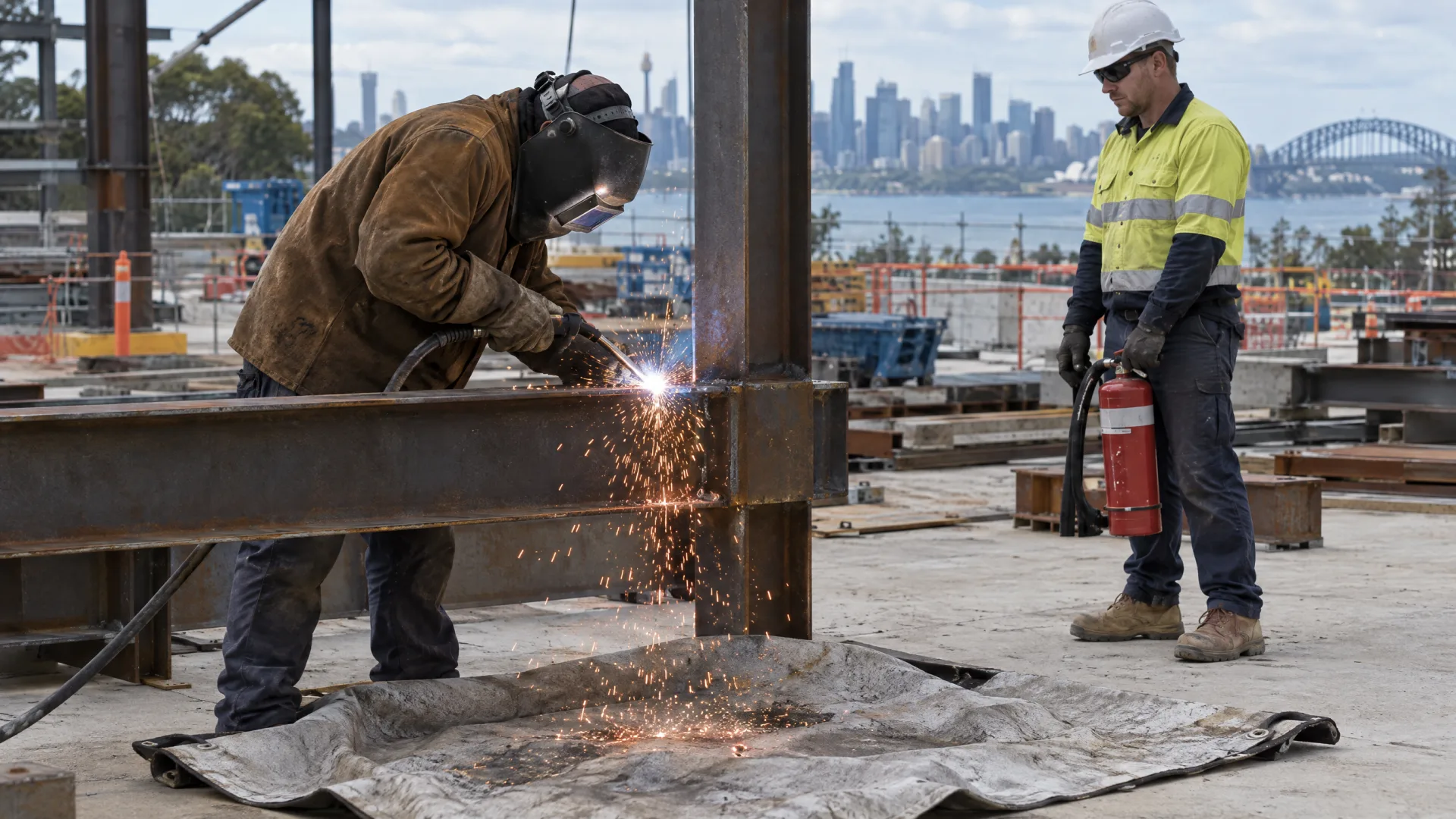
Hot work. Welding, grinding, cutting or anything that creates sparks or heat outside a designated area.
Confined space entry. Pits, tanks, ducts, voids and other confined spaces.
Excavation and penetration. Digging, core drilling or cutting into slabs and walls where services may be hidden.
Electrical and services isolation. Work on or near live electrical, gas, fire or hydraulic systems.
Work at height and roof access. Access to roofs, edges or areas without fixed protection.
Crane lifts. Critical or non-routine lifts.
Victoria's Occupational Health and Safety Regulations 2017 also require an entry permit for confined spaces. Site and client rules often add more.
Permit to Work vs SWMS
A SWMS describes how a type of high risk work will be done safely. It is prepared by the business doing the work and covers the whole task.
A permit to work authorises a specific job, at a specific place and time, after someone has checked that conditions on the day are safe. The permit usually references the SWMS. One does not replace the other: a hot works permit still needs a SWMS behind it if the task is high risk construction work.
Common Permit to Work Mistakes
Signing without inspecting. A permit issued from the site office, without anyone looking at the work area, is just paperwork.
Open-ended permits. Permits need a clear start and finish time, and must be closed out when the job is done.
No fire watch after hot work. Fires can start well after the welder has packed up. Most hot work permits require a fire watch for a set period after work stops.
Losing track of live permits. Without a register, two crews can work under conflicting permits in the same area.
Frequently asked questions
Is a permit to work a legal requirement in Australia?
−
For confined space entry, yes: both the model WHS Regulations and Victoria's OHS Regulations 2017 require an entry permit. For other tasks, such as hot work, permits are not named in the law but are a common control that principal contractors require through site rules.
Who can issue a permit to work?
−
A competent person authorised under the site's permit system, usually a supervisor or safety advisor from the principal contractor. They must understand the hazards, inspect the work area and confirm controls are in place before signing.
What is a hot work permit?
−
A hot work permit authorises welding, cutting, grinding or other spark-producing work outside a designated area. It confirms combustibles have been removed or protected, fire extinguishers are on hand, detectors are managed and a fire watch is in place.
How long is a permit to work valid for?
−
Only for the time stated on it, which is often one shift or one day. If the work runs over, the conditions change or the crew changes, the permit should be reissued after a fresh check.

Free Playbook
The Missing AI Playbook for Construction Safety
Learn practical AI workflows for incident reports, SWMS, compliance checks, safety data and training, with real prompts you can use and review yourself.
Related terms
Browse the glossary
Free tools
All free resources

The AI Construction Operating System
One platform, one data model, every project. Built in Australia, for the world.
YOUR DATA, PROTECTED
Hosted on AWS Sydney with Australian data residency.


GET THE MOBILE APP
Platform
Solutions
© 2026 Plexa Pro Pty Ltd. ABN 63 668 433 136