Ask your projects data anything. Get answers in seconds. Plexa MCP Connector is live. See it in action
Fatigue management
Also known as: Fatigue risk management, worker fatigue, fatigue policy
Definition
Fatigue management is how a business controls the risk created by tired workers. On construction projects the controls sit in rosters, shift length, overtime, night work, travel and task allocation, and fatigue is treated as a work health and safety hazard like any other.
Why Fatigue Is Treated as a WHS Hazard
Fatigue reduces reaction time, attention and judgement, and it does so without the worker reliably noticing. That combination is what makes it a work health and safety problem rather than a personal one: the people most affected are the least able to assess themselves.
On a construction site the consequences attach to high risk activities. A fatigued crane operator, excavator operator, rigger, traffic controller or truck driver carries a risk that is not confined to themselves.
There is no model work health and safety regulation that prescribes maximum working hours for general construction work. The duty comes from the primary duty of care, which requires a person conducting a business or undertaking to eliminate or minimise risks to health and safety so far as is reasonably practicable. Where fatigue is a foreseeable risk, which on a programme driven construction site it almost always is, managing it falls inside that duty. Safe Work Australia publishes guidance on managing fatigue at work and regulators work from it.
Fatigue also interacts with other duties. It is a factor in psychosocial risk, in the fitness for work requirements that sit behind high risk work licences and verification of competency, and in the heavy vehicle rules described below.
What Causes Fatigue on Construction Projects
Fatigue on a construction project is usually structural rather than personal, which is why individual willpower is a poor control.
Shift length and consecutive days. Long shifts, six day weeks and extended runs without a full rest day accumulate a deficit that a single day off does not clear.
Programme pressure and overtime. Catch up periods after delay are the highest risk windows on most projects, because the hours increase exactly when the pressure to perform is greatest.
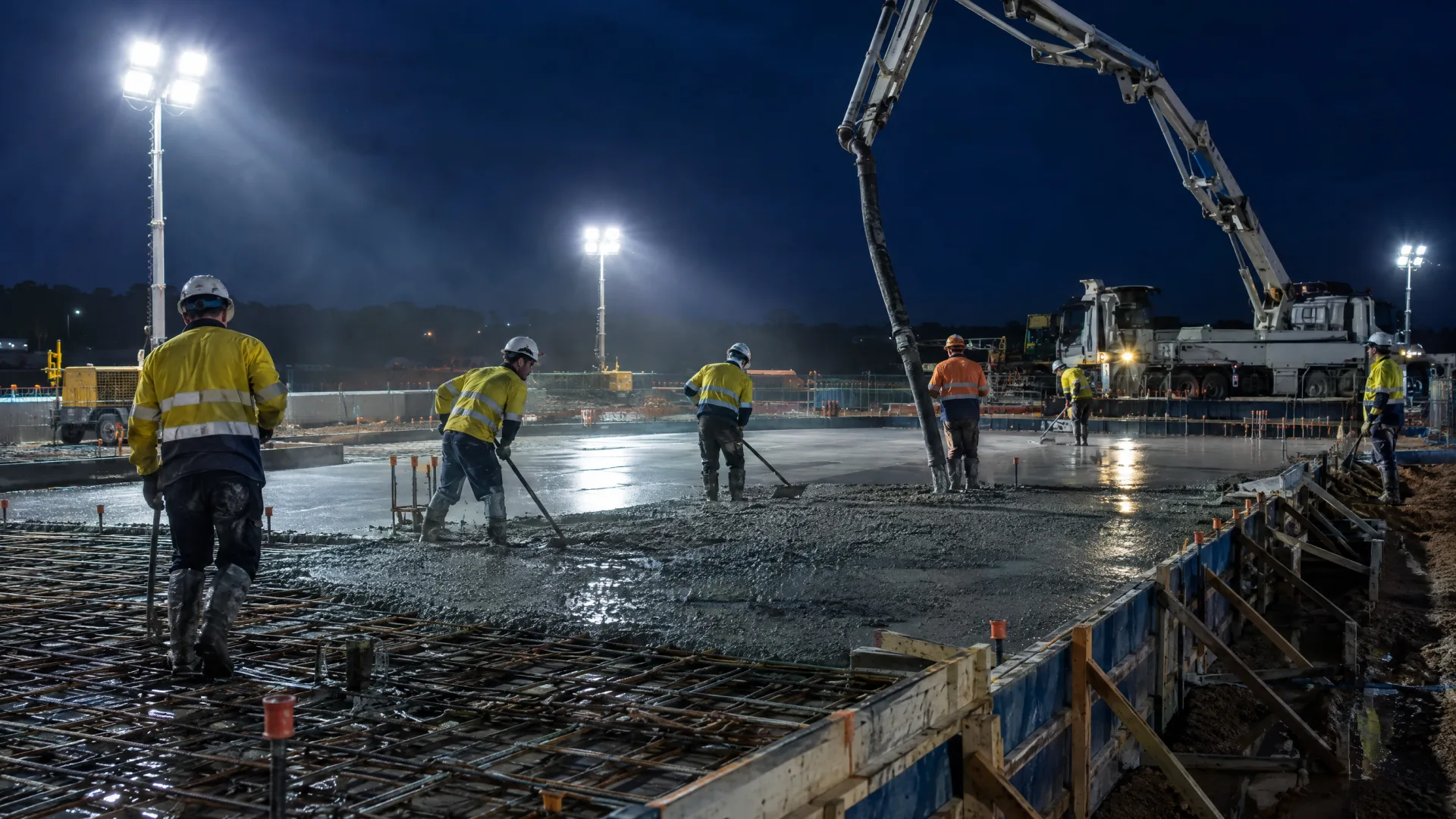
Night and early starts. Work scheduled against the body clock, including rail and road possessions, shutdowns and concrete pours starting before dawn.
Commuting and travel. Time behind the wheel either side of a shift is part of the working day in practical terms, even where it is not paid, and long commutes are common on regional projects.
Task type. Monotonous or repetitive tasks and sustained vigilance work, such as spotting or traffic control, show fatigue effects earlier than varied physical work.
Heat and physical load. Hot conditions and heavy manual work increase fatigue, and the two peak together in Australian summers.
Second jobs and life outside work. Not controllable by the business, but relevant to what the business can reasonably ask of people.
Controls for Managing Fatigue
Fatigue controls work best at the roster and planning level, and least well as a personal instruction.
Set hours limits and stick to them. Maximum shift lengths, maximum consecutive days, minimum breaks between shifts, and a cap on overtime, written down and applied rather than negotiated per crisis.
Plan the programme with fatigue in it. Build sequences that do not rely on sustained overtime, and treat a catch up period as a change that needs its own risk assessment.
Match tasks to risk. Avoid scheduling the highest consequence work, such as critical lifts, at the end of long shifts or late in a run of consecutive days.
Manage travel. Consider travel time in shift planning, provide accommodation for long commutes on remote work, and prohibit driving after extended shifts.
Use prestart as a checkpoint. Fatigue is one of the few hazards a supervisor can usually see. Make it a standing prestart item, and give supervisors authority to reassign someone without a penalty attached.
Make reporting safe. A worker who says they are too tired for a task has to be reassigned, not sent home unpaid or marked down. If reporting costs money or standing, nobody reports.
Record hours. Site access and sign on records are what tell you whether the roster on paper matches the hours people actually worked.
Fatigue Rules for Heavy Vehicle Drivers
Drivers are the one group with prescriptive legal limits rather than a general duty, and construction businesses running trucks are caught by them.
Under the Heavy Vehicle National Law, which applies in most Australian states and territories but not Western Australia or the Northern Territory, drivers of fatigue regulated heavy vehicles are subject to prescribed maximum work times and minimum rest times, and must keep records of their work and rest. Western Australia and the Northern Territory operate their own arrangements.
The obligations are not limited to the driver. The law imposes duties across the chain, which can include the operator, the scheduler, the consignor and the consignee. A builder that books a delivery window which can only be met by a driver exceeding their hours is part of that chain, and so is a site that leaves a truck queuing for hours.
The practical implications for a site are concrete. Delivery scheduling and site queuing affect a driver's available hours. Site access arrangements that strand drivers consume their rest. Insisting on a delivery time that requires a breach is a problem for the person insisting, not only for the driver.
These rules sit alongside the general duty rather than replacing it. A plant operator who is not driving a fatigue regulated vehicle has no prescribed hours limit, and the general duty still applies to them in full.
Frequently asked questions
Is there a legal limit on working hours in construction in Australia?
−
Not for general construction work. There is no model work health and safety regulation setting maximum hours, so the obligation comes from the general duty to manage risks so far as is reasonably practicable. Heavy vehicle drivers do have prescribed limits.
Who is responsible for managing worker fatigue?
−
The person conducting the business or undertaking, as part of the primary duty of care. Workers have a duty to take reasonable care and to follow the arrangements, but rosters, shift lengths, programme pressure and travel are controlled by the business.
What are the main causes of fatigue on a construction site?
−
Long shifts and consecutive days without a full rest, overtime during catch up periods, night work and early starts, long commutes, sustained vigilance tasks like traffic control, and heat combined with heavy physical work.
Do heavy vehicle fatigue rules apply to construction trucks?
−
Yes, where the vehicle is a fatigue regulated heavy vehicle. The Heavy Vehicle National Law sets maximum work and minimum rest times and record keeping, and imposes duties across the chain, which can include the site booking the delivery.
How should a site handle a worker who reports being too fatigued to work?
−
Reassign them to lower risk work or stand them down without financial penalty. If reporting fatigue costs a worker pay or standing, reporting stops and the hazard becomes invisible to the people who could manage it.

Free Playbook
The Missing AI Playbook for Construction Safety
Learn practical AI workflows for incident reports, SWMS, compliance checks, safety data and training, with real prompts you can use and review yourself.
Related terms
Browse the glossary
Free tools
All free resources

The AI Construction Operating System
One platform, one data model, every project. Built in Australia, for the world.
YOUR DATA, PROTECTED
Hosted on AWS Sydney with Australian data residency.


GET THE MOBILE APP
Platform
Solutions
© 2026 Plexa Pro Pty Ltd. ABN 63 668 433 136