Ask your projects data anything. Get answers in seconds. Plexa MCP Connector is live. See it in action
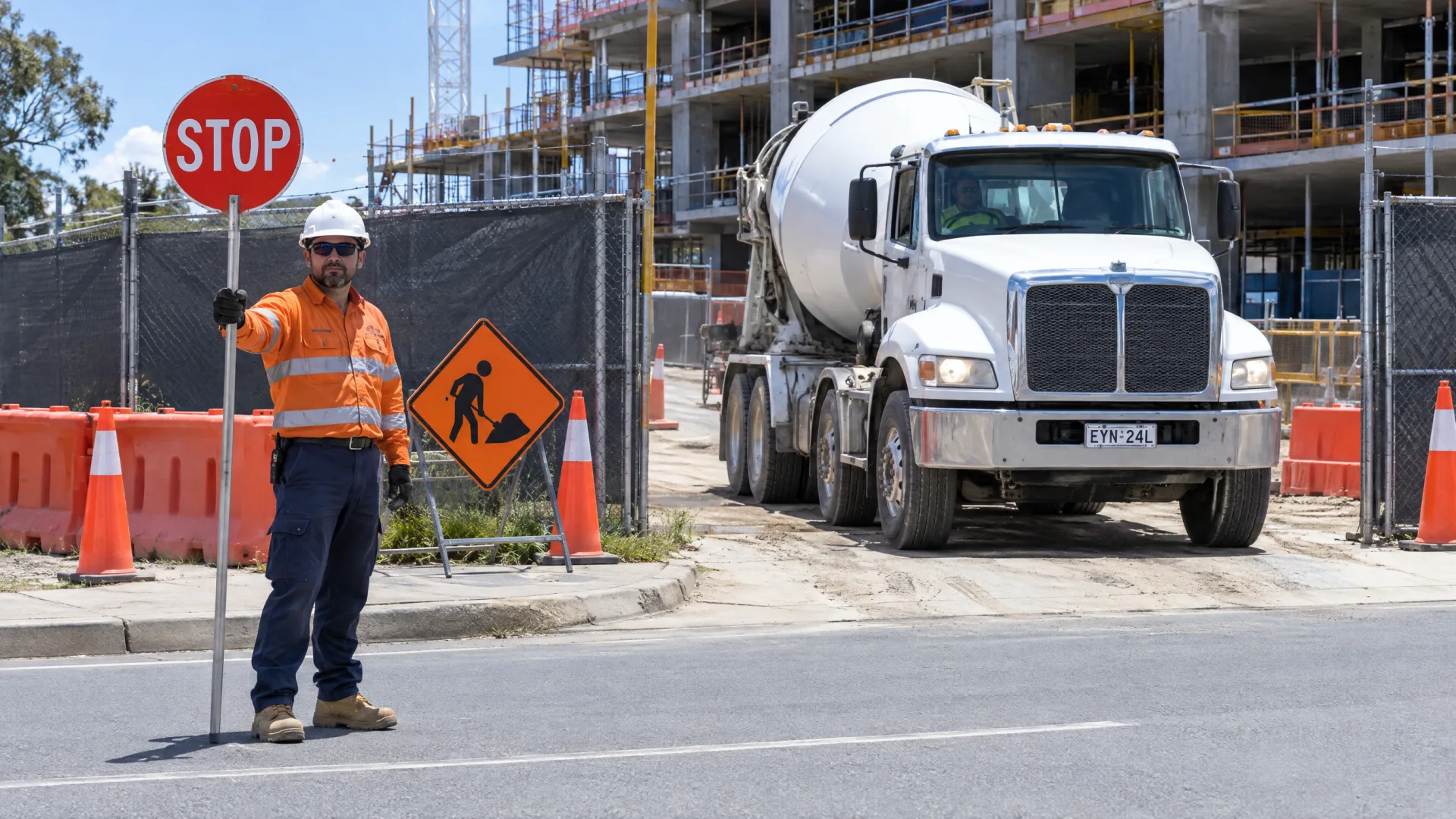
Traffic management plan
Also known as: TMP, site traffic management plan
Definition
A traffic management plan sets out how vehicles, mobile plant and people are kept apart on and around a construction site. It covers access points, haul routes, pedestrian separation, deliveries, exclusion zones and who directs traffic. On a construction project it forms part of the WHS management plan.
What a Traffic Management Plan Covers
Vehicles and people sharing ground is one of the few hazards on a construction site that reliably produces fatalities, and a traffic management plan is the document that separates them. It should describe the site as it will actually operate, not as the tender drawing imagined it.
A workable plan covers the following.
Entry and exit. Where vehicles enter and leave, sight lines, gate control, and how the public footpath and road are managed at the crossing.
Internal routes. Haul roads, one way circulation, turning and standing areas, grades, surface condition and speed limits.
Pedestrian separation. Walkways physically separated from vehicle routes, designated crossing points, and how people move from the gate to the amenities and the work face without crossing a haul road.
Deliveries. Booking arrangements, where trucks wait, how they are unloaded, and what happens when a vehicle arrives unannounced.
Exclusion zones. Zones around operating plant, lifting areas, concrete pumps and reversing vehicles, and how they are marked and enforced.
Reversing. Where reversing cannot be eliminated by circulation design, the controls that apply, including spotters, cameras and alarms.
Plant and public interface. Crane and pump setups, scaffold loading, hoardings, and protection of pedestrians passing the site.
Roles. Who controls traffic, who holds the relevant competence, and who updates the plan.
Emergency access. Routes kept clear for emergency vehicles, which is the first thing a congested site loses.
For a deeper look, read Traffic Management Plans: The Document Approved Months Ago That Your Site Has to Live With Today. Try the free Traffic Management Plan Builder.
Traffic Management Plan vs Traffic Control Plan
The two are routinely confused, and on a job involving public roads the distinction is important.
A traffic management plan is the site wide strategy. It is a document, usually with supporting sketches, describing how traffic and pedestrians are managed across the whole site for the duration of the works.
A traffic control plan is a specific drawing for a specific activity on or beside a road. It shows signs, cones, barriers, taper lengths and the position of traffic controllers for that activity, and in Australia it is prepared by a person holding the relevant qualification and is based on AS 1742.3 and the Austroads Guide to Temporary Traffic Management.
The practical relationship is that the traffic management plan is the parent document, and traffic control plans sit underneath it for the activities that touch the road network. Work on a public road almost always also needs a permit or approval from the road authority or council, which is separate again from both documents.
For a builder the test is simple. If the activity affects a public road, footpath or traffic lane, expect a traffic control plan prepared by a qualified person and an approval from the authority, not just a line in the site plan.
When a Traffic Management Plan Is Required
There is no single regulation that says the words traffic management plan and requires one by name. The obligation is assembled from several places, which is why the question comes up so often.
The general duty applies always. A person conducting a business or undertaking must eliminate or minimise risks so far as is reasonably practicable, and on a site with moving plant that duty cannot be discharged without planning how traffic and people are separated.
On a construction project, meaning construction work costing $250,000 or more, the principal contractor must prepare a WHS management plan. Traffic management arrangements are part of what that plan has to deal with, and in practice the traffic management plan is either included in it or attached to it.
Work on or next to a road or other traffic corridor in use by vehicles is high risk construction work under the model regulations, so a safe work method statement is required for it as well. The SWMS and the traffic management plan do different jobs and are both expected.
Safe Work Australia publishes a traffic management guide for construction work, and most regulators work from it. Several states add their own codes of practice, and the road authorities have their own requirements for works on roads.
The short answer for a commercial builder is that a traffic management plan is effectively mandatory on any site with vehicle movements, whatever the project value.
Common Mistakes With Traffic Management Plans
Drawing it once at mobilisation. A site's traffic arrangement changes with every stage: the gate moves, the crane arrives, the slab becomes a hardstand, the hoarding changes the footpath. A plan that still shows the establishment layout is describing a site that no longer exists.
Relying on spotters as the primary control. A spotter is an administrative control sitting near the bottom of the hierarchy. The plan should first try to eliminate reversing and separate people from vehicles by design, and use spotters where that cannot be achieved.
No pedestrian route that people will actually use. If the compliant walkway is twice as long as cutting across the hardstand, the hardstand becomes the walkway. Design the route people would choose anyway.
Ignoring the neighbours and the timing. Deliveries scheduled across school drop off, peak traffic or a neighbouring business's loading window generate complaints, queued trucks on the street, and pressure on the crew to wave vehicles in.
Not briefing it. A plan nobody has seen is paperwork. It belongs in the site induction, in the prestart when it changes, and in the delivery booking information sent to suppliers.
Forgetting the approvals. Occupying a footpath or lane, or placing a crane over a road, needs the authority's approval and usually a traffic control plan. These take time and are a programme item, not an afterthought.
Frequently asked questions
What is a traffic management plan on a construction site?
−
A document setting out how vehicles, mobile plant and people are kept apart on and around the site. It covers entry and exit, internal routes, pedestrian separation, deliveries, exclusion zones, reversing controls and who directs traffic.
What is the difference between a traffic management plan and a traffic control plan?
−
The traffic management plan is the site wide strategy. A traffic control plan is a specific drawing for an activity on or beside a road, showing signs, cones, barriers and traffic controller positions, prepared by a qualified person.
Is a traffic management plan a legal requirement in Australia?
−
No single regulation requires one by that name, but the general duty to manage risks and the WHS management plan required on construction projects of $250,000 or more make it effectively mandatory on any site with vehicle movements.
Who prepares a traffic management plan?
−
The principal contractor, usually with input from the site team and sometimes a traffic management specialist. Traffic control plans for work on roads must be prepared by someone holding the relevant qualification for that work.
How often should a traffic management plan be updated?
−
Whenever the site layout or the works change the way traffic moves, which on an active project means repeatedly. New gates, crane setups, hoarding changes and new stages all need the plan revisited and rebriefed.

Free Playbook
The Missing AI Playbook for Construction Safety
Learn practical AI workflows for incident reports, SWMS, compliance checks, safety data and training, with real prompts you can use and review yourself.
Related terms
Browse the glossary

The AI Construction Operating System
One platform, one data model, every project. Built in Australia, for the world.
YOUR DATA, PROTECTED
Hosted on AWS Sydney with Australian data residency.


GET THE MOBILE APP
Platform
Solutions
© 2026 Plexa Pro Pty Ltd. ABN 63 668 433 136