Ask your projects data anything. Get answers in seconds. Plexa MCP Connector is live. See it in action


The Variation That Started as a Conversation (And Ended as a Dispute)
A verbal "yes, go ahead" on site is where most variation disputes begin. Here is why undocumented variations turn into contested progress claims, what the data says about who wins, and how Australian builders are closing the gap.
Select Hub
Finance & Administration
It is 7:40am and the site supervisor is already three conversations behind. A subcontractor flags an unforeseen conduit clash, asks if they should reroute it now while the slab is open, and the supervisor says "yeah, go ahead, we'll sort the paperwork later." Nobody writes it down. Everyone moves on. Six weeks later that conversation is a progress claim line item worth $18,000, the principal contractor says they never approved it, and both sides are reaching for lawyers instead of tools.
This is not a rare failure of communication. It is the default outcome of a system where scope changes travel by voice and memory, and the paperwork is treated as an afterthought instead of the thing that actually protects the claim.
Why a verbal "yes" is not a variation
A variation only exists, in any way that matters commercially, once it is documented: what changed, who approved it, what it costs, and why it sits outside the original scope. Until then it is a conversation that two people remember differently. Under the Building and Construction Industry Security of Payment Act, which now operates in every Australian state and territory, variations are legitimate claimable items in a progress payment. But the NSW Government's Security of Payment guidance is explicit that a payment claim only succeeds if it gives the recipient enough information to actually assess it. An undocumented variation fails that test before it even reaches adjudication.
8.6% of all payment disputes lodged under the NSW Security of Payment Act are variation disputes, and the average project value in a variation dispute is 103% higher than in non-variation cases. Analysis of NSW Security of Payment Act adjudication data, Contracts Administrator, 2026
Why this happens on every busy site
Nobody sets out to skip the paperwork. A foreman managing four trades and a moving programme is not going to stop the pour to draft a change order. The problem is structural: variation approvals live in group chats, verbal instructions, and someone's memory of a Tuesday morning, while the progress claim that eventually has to justify the cost is assembled weeks later by someone who was not on site when the decision was made. By the time the claim is served, the trail of who approved what has already gone cold.
The Security of Payment framework was built around monthly claim cycles specifically because cost information decays fast on a live site. A variation agreed verbally in week two is, by week six, a disputed line item nobody can fully substantiate.
The cost of an undocumented variation
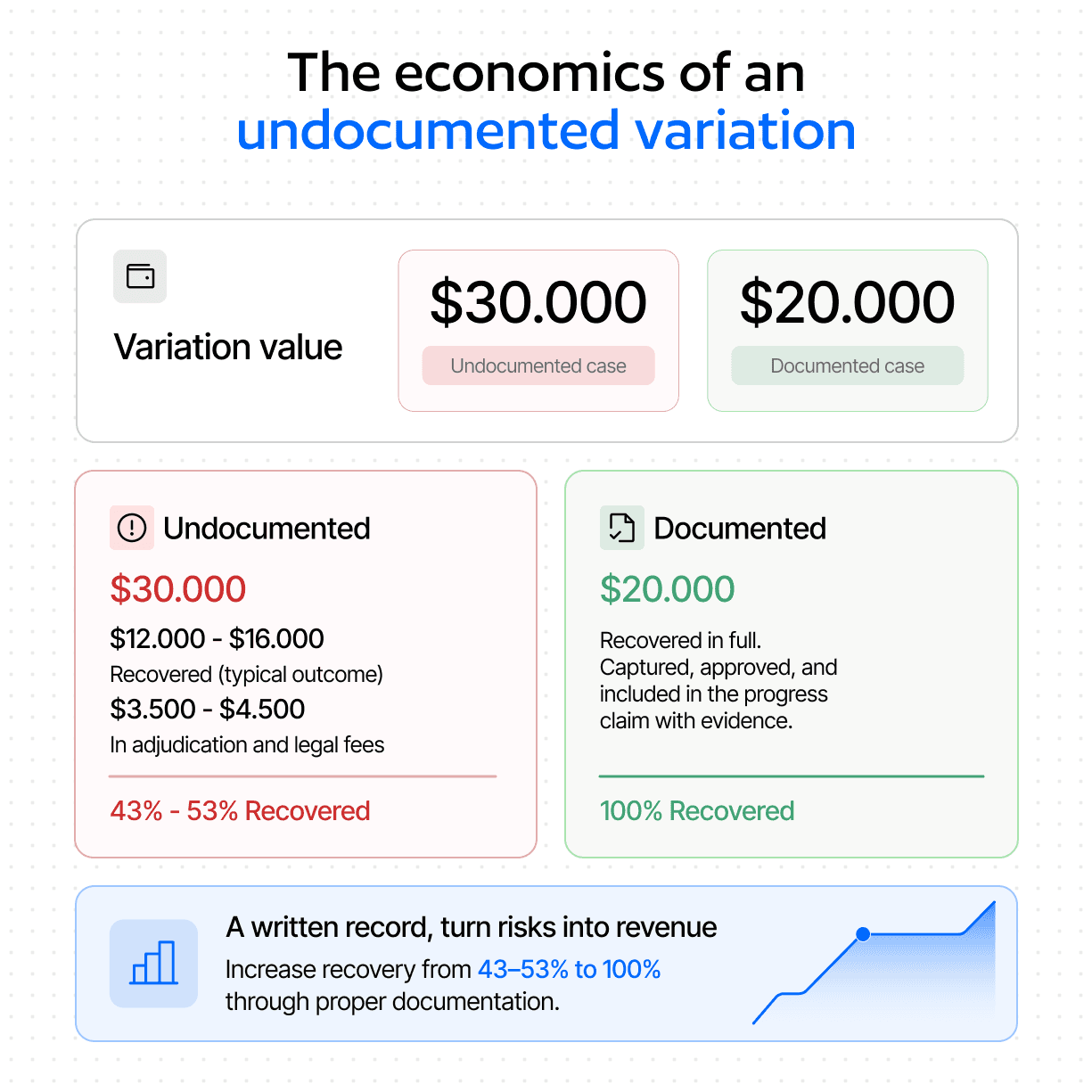
The numbers on undocumented variations are stark. Analysis of NSW Civil and Administrative Tribunal outcomes shows variations without written approval are rejected or heavily discounted in roughly 70% of disputes. A documented $20,000 variation is typically paid in full. An undocumented one can cost $3,500 to $4,500 in adjudication and legal fees, while recovering only $12,000 to $16,000 of the original claim, a net loss that can run past $10,000 on a single scope change.
68.7% of NSW construction variation disputes involve multiple adjudication proceedings, and those multi-proceeding disputes average claims 1,034% larger than single-proceeding cases. NSW Security of Payment Act variation dispute analysis, Contracts Administrator, 2026
What a defensible variation actually looks like
The gap closes when the approval, the scope, and the cost are captured at the moment the decision is made, not reconstructed afterward. That means a written record tied to the person who authorised it, a clear description of what sits outside the original contract, and a cost basis the recipient can actually check against contract rates. None of that needs to slow the site down. It needs to happen in the same motion as the decision itself, on the device already in the supervisor's hand.
When that discipline holds:
A variation is logged with approval and scope the same day it is agreed, not reconstructed from memory before a progress claim is due.
Progress claims include variations with enough detail to be assessed, not disputed, on first reading.
A rejected payment schedule points to a specific gap in the file, not a wholesale rejection of the claim.
Subcontractors and principal contractors are working from the same variation record, not two separate memories of a site conversation.
Adjudication becomes the exception, not the default path to getting paid for legitimate extra work.
The Australian context
Security of payment legislation has existed in NSW since 1999 and now covers every state and territory, precisely because the industry could not be trusted to self-resolve payment and variation disputes fast enough to protect cash flow. With tighter margins and rising input costs across Australian construction, a single disputed $20,000 to $60,000 variation is no longer an inconvenience, it is the difference between a project that holds its margin and one that does not, a dynamic we cover in our piece on why construction profit margins are tighter than they should be. The same coordination gap that produces undocumented variations is also the one that erodes trust between builders and their subcontractors, which we explore in our piece on the real cost of subcontractor management failure.
Where Plexa fits
Plexa's Finance and Correspondence modules exist to close the exact gap that turns a site conversation into a dispute. A variation raised on site is logged against the relevant scope item immediately, routed for approval to the right person, and carried automatically into the next progress claim with its supporting evidence attached, photos, approval, cost breakdown, all in one record instead of scattered across texts and memory. The variation that started as a conversation at the gate still gets resolved as a conversation. It just does not have to become a six-week-old dispute to get paid for it.
Variations do not travel alone. A disputed scope change is often tangled up with a slow information request in the first place, which is why we cover what a good RFI process actually looks like as the companion piece to this one.
If you want to see how Plexa keeps variations, approvals, and progress claims in one connected record, book a 30-minute demo with the Plexa team.
Sources
NSW Government, Security of Payment, Building Commission NSW. https://www.nsw.gov.au/housing-and-construction/compliance-and-regulation/security-of-payment/about
NSW Legislation, Building and Construction Industry Security of Payment Act 1999 (NSW). https://legislation.nsw.gov.au/view/whole/html/inforce/current/act-1999-046
Contracts Specialist, Variation Claims in Payment Claims NSW, 2026. https://www.contractsspecialist.com.au/variation-claims-payment-claim-nsw/
Contracts Administrator, Variation Disputes NSW: Data-Driven Insights on Multi-Proceeding Outcomes & ROI, 2026. https://contractsadministrator.com.au/blogs/variation-dispute-strategies-nsw-security-of-payments-analysis
Related Articles


The AI Construction Operating System
One platform, one data model, every project. Built in Australia, for the world.
YOUR DATA, PROTECTED
Hosted on AWS Sydney with Australian data residency.


GET THE MOBILE APP
Platform
Solutions
© 2026 Plexa Pro Pty Ltd. ABN 63 668 433 136