Ask your projects data anything. Get answers in seconds. Plexa MCP Connector is live. See it in action


The Real Cost of Subcontractor Management Failure on Construction Sites
Subcontractor management is not one problem. On an active commercial site it is twenty problems running at the same time, across trades, across systems, and across the gaps where nobody is looking.
Site Management
Construction Management
By the time the site manager arrives at 7am, twelve subcontractor trades are already active. The framers started at six. The concreters are waiting on a hold-point sign-off. The electricals crew has a new employee who completed their induction last week on a different site, not this one. The scaffold company sent a plant operator whose ticket has not been verified. And somewhere in a shared drive, there is an expired public liability certificate for a subcontractor who has been on site for three months.
Nobody made a bad call. There is just too much to track, across too many people, with too many separate systems.
That is the core problem in subcontractor management on construction projects. It is not one gap. It is twenty gaps, running simultaneously, across every active trade.
Why Subcontractor Management Matters
Construction projects depend on subcontractors for specialised expertise that no single firm holds in-house. Structural steel, electrical systems, mechanical services, facade installation: each trade requires a depth of specialisation that makes subcontracting not just practical but essential. The head contractor's job is not to do that work. It is to coordinate it, and to do so well enough that the project benefits from each trade's expertise without being exposed by the gaps between them.
Done well, subcontractor management gives a project scalability and flexibility. Trades are engaged at the right phase, at competitive pricing, and released when their scope is complete. Clear scope documentation and thorough tendering keeps costs honest and prevents the variation creep that quietly inflates budgets across the life of the project.
Risk mitigation is the third reason it matters. Subcontractor management is where licensing, insurance, safety compliance, and quality standards are either enforced or ignored. Effective management means pre-qualifying subcontractors properly, maintaining oversight during construction, and resolving issues early before they become incidents or claims.
That is the theory. The practice, across twenty-five active trades, changing crews, expiring certificates, and verbal instructions on busy sites, is where it gets hard.
The Scale Is the Problem
A residential build might involve eight to twelve subcontractor trades. A mid-size commercial project regularly runs twenty-five to thirty-five. On larger civil and infrastructure projects, the number reaches into the hundreds across the full programme.
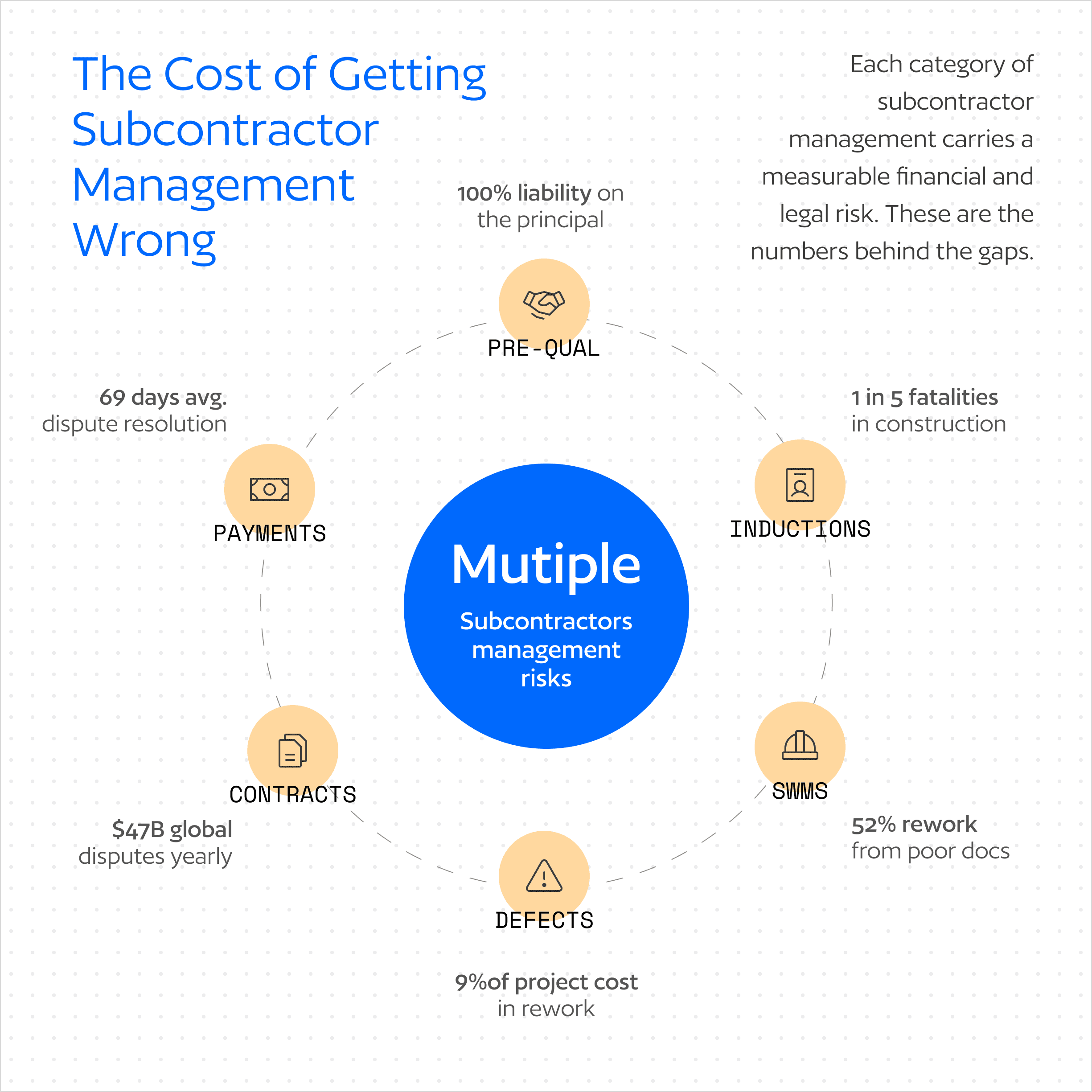
Subcontractor management at that scale is not a people problem. It is a systems problem. Each trade brings its own licence requirements, insurance obligations, induction needs, safe work method statements, plant and equipment records, scope documentation, variation history, and payment schedule. Multiply any one of those categories by thirty subcontractors and the manual workload becomes impossible to run reliably.
McKinsey's analysis of construction productivity consistently identifies information fragmentation as a core reason the construction industry underperforms other sectors. The cost shows up in disputes, in rework, in safety incidents that could have been caught earlier, and in payment claims that take weeks to resolve because the documentation is not there.
$47 billion in construction disputes filed globally each year, with subcontractor payment and scope disagreements among the most frequent triggers. Arcadis Global Construction Disputes Report, 2024
Where Subcontractor Management Breaks Down
The failure points in subcontractor management are consistent across project types and sizes. They appear in pre-qualification, in contracts, in compliance, in day-to-day communication, and in payment. On any given project, several of these will be running simultaneously.
Pre-Qualification and Compliance Records
Every subcontractor working on a construction project carries obligations: current licences, valid insurances, site inductions, and in many jurisdictions, registration with a relevant industry body. As principal contractor, the head contractor is responsible for ensuring those obligations are met across all trades.
The problem is not that nobody checks. It is that the check happens once, at onboarding, and is never reviewed again. A public liability policy that lapses mid-project creates exposure from the day it expires. A licence that is not renewed transfers risk to the principal. When pre-qualification records live in a spreadsheet that was last updated at tender, there is no mechanism to catch what has changed since.
Multiply this by twenty-five active subcontractors. Some have monthly insurance renewals. Some have licences that expire mid-project. Some bring labour-hire workers whose individual credentials need tracking separately from the company record. Without automated monitoring, something lapses on almost every project. The only question is whether anyone notices before it becomes an incident or a claim.
Induction Management
Site inductions are mandatory for every person entering a construction site. But induction management goes well beyond the site gate check. On most commercial projects there are multiple induction requirements running in parallel: the site induction, trade-specific inductions, plant and equipment operator qualifications, and in some cases client or principal-required inductions that go beyond the contractor's standard process.
The volume creates the risk. A subcontractor sends three workers on Monday and adds two more on Thursday. Are the Thursday additions inducted? Which of the five is cleared to operate the scissor lift? Who has completed the hazardous materials awareness module that the site safety plan requires for anyone working in the affected zone?
When induction records live in a sign-in sheet, a spreadsheet, or a separate safety app that is not connected to site access, the answer to any of those questions requires someone to physically find the record. In the time it takes to do that, the uninducted worker is already on the floor.
Safety Method Statements
Every subcontractor trade performing high-risk construction work is required to prepare a Safe Work Method Statement before work commences. The head contractor is responsible for ensuring those documents are received, reviewed, and compliant before the relevant work starts.
On a project with twenty active trades, that is twenty method statements to receive, twenty to review, and twenty to keep current as scope changes during the project. When a subcontractor changes their method or brings new plant onto site, the documentation needs to be updated and re-approved. When a new employee joins a subcontractor team mid-project, their induction to the method statement needs to be recorded.
The documentation gap is also a legal gap. A method statement that was submitted but not reviewed, or reviewed but not kept current, creates an exposure the head contractor may not know they carry until it surfaces in an incident investigation.
Defect Attribution and Quality
Defects are a fact of construction. The question that turns a manageable defect into a project dispute is: which subcontractor is responsible?
On a project where multiple trades have worked in the same area across several weeks, a defect in a finished surface can be genuinely difficult to attribute without a clear record of who did what, when, and to what standard. Without that record, defect management becomes a negotiation between subcontractors rather than a factual resolution.
The Inspection and Test Checklist process exists precisely to create that record. Each trade's work is inspected against a documented standard, signed off by the relevant party, and stored as evidence. When a defect appears, the ITC history shows who last worked in that area and whether the work was accepted at the relevant hold point.
When quality records are managed separately from subcontractor management, the link between a defect and the responsible trade is broken before anyone needs to use it.
Contract and Variation Management
Scope gaps in subcontractor agreements are the most common source of variation claims on construction projects. A subcontractor who quotes on "formwork to level 3" and disputes whether that includes stairwells is not being unreasonable. They are pointing to language that was not resolved when the contract was executed.
52% of construction rework and disputes trace back to poor documentation and miscommunication between project parties. PlanRadar QA/QC Impact Report, 2025
The problem compounds when contract documentation is managed separately from site instructions and correspondence. A variation is agreed verbally on site, the subcontractor acts on it, and later disputes it because no written record connects the instruction to an approved variation order. By the time it surfaces, it is memory against memory.
In most jurisdictions, a submitted progress claim moves quickly through formal dispute processes when responses are not issued on time. A head contractor without a documented variation register, signed scope, and complete correspondence trail is immediately exposed.
"Construction projects typically involve a web of contractual relationships and complex, time-limited work sequences. Poor information flow between these parties is consistently identified as a leading cause of project delay and cost overrun."
FMI Corporation, Construction Industry Research and Benchmarking
Payment Management
Payment disputes with subcontractors are rarely just about the money. They are about the absence of records that should have resolved the question before it became a dispute. A variation that should take one conversation to close instead escalates to formal proceedings because neither party has the same documentation.
Beyond the legal exposure, delayed or contested payment damages the subcontractor relationships that make project delivery work. The best trade contractors choose their clients carefully. A reputation for payment disputes shrinks the pool of quality subcontractors available on the next project, and on every project after that.
9% of total project cost is lost to rework on average, much of it traceable to subcontractor scope and coordination failures. Construction Industry Institute, Costs of Quality Deviations in Design and Construction
Key Components of Effective Subcontractor Management
The projects where subcontractor management works are not run by better people. They are run with better information, and that information is in one place.
Effective subcontractor management starts before anyone sets foot on site. A thorough pre-qualification process, covering licences, insurance, past performance, and financial stability, determines which subcontractors are eligible before competitive pricing is ever evaluated. Clear and comprehensive contracts follow: scope of work, deliverables, timelines, payment terms, variation procedures, and dispute resolution provisions all documented before work begins.
On site, the priorities are communication and visibility. Clearly defined roles and responsibilities for each trade reduce coordination failures and scope overlap. Established communication channels, with written records of instructions, changes, and approvals, mean that what was agreed on Monday is still provable on Friday. Regular site inspections against the agreed scope, linked to the quality register, create an ongoing record rather than a single snapshot.
Performance monitoring runs across the project lifecycle, not just at handover. Subcontractors who are falling behind schedule or producing non-conforming work are identified early, when correction is still possible, rather than late, when the cost of rework has already compounded.
Timely and accurate payment ties everything together. Prompt payment maintains subcontractor motivation and preserves the working relationships that good projects depend on. It also reflects the discipline of a head contractor who has the documentation in order: variation register reconciled, claims reviewed, and schedules issued on time.
Where Plexa Fits
Plexa connects every layer of subcontractor management into a single platform. Pre-qualification records are stored against each subcontractor profile with automated expiry alerts, so the check that happened at onboarding stays current for the life of the project. Induction records are captured digitally on site, linked to individual workers and plant qualifications, and visible in real time across all active trades.
Method statement documents are reviewed and approved within the platform, with version control so changes to scope or method are tracked. Defects are attributed to the trade responsible, linked to the ITC history for that scope of work, and tracked through to close-out. Variation instructions are captured as formal correspondence, linked to the relevant contract, and carried through to the payment register.
When a progress claim arrives, the commercial team has the documented variation register, the signed scope, and the full correspondence trail in one place. There is nothing to reconstruct under time pressure.
For head contractors managing multiple active projects, Plexa gives portfolio-level visibility over subcontractor compliance status across every site. Lapsing certificates, uninducted workers, and open defects are visible before they become incidents, not after.
The site manager who arrived at 7am to a site full of trades in motion? With Plexa, the platform has already flagged the expired insurance, confirmed who is inducted for the scissor lift, and logged the new method statement version the electricals submitted the day before. The complexity is still there. It is just visible.
For more on the compliance and safety documentation framework that governs head contractors, read our guide to What HSEQ Actually Means on a Construction Site. If you want to understand how quality inspections connect to subcontractor accountability, our post on Inspection and Test Plans and Checklists covers that in depth.
See how Plexa manages subcontractor coordination across the full project lifecycle. Book a demo.
Sources
McKinsey Global Institute. (2017). Reinventing Construction: A Route to Higher Productivity. mckinsey.com/capabilities/operations/our-insights/reinventing-construction-through-a-productivity-revolution
Arcadis. (2024). Global Construction Disputes Report. arcadis.com/en/knowledge-hub/perspectives/global/2024/global-construction-disputes-report
PlanRadar. (2025). Cost of Rework in Construction: Causes, Data and Prevention. planradar.com/us/cost-of-rework-construction/
Construction Industry Institute. Costs of Quality Deviations in Design and Construction. construction-institute.org
FMI Corporation. Construction Industry Research and Benchmarking. fmicorp.com/insights/
Related Articles


The AI Construction Operating System
One platform, one data model, every project. Built in Australia, for the world.
YOUR DATA, PROTECTED
Hosted on AWS Sydney with Australian data residency.


GET THE MOBILE APP
Platform
Solutions
© 2026 Plexa Pro Pty Ltd. ABN 63 668 433 136