Ask your projects data anything. Get answers in seconds. Plexa MCP Connector is live. See it in action


The Hidden Cost of Getting Defects Wrong at Handover
A handover defect list rarely explodes because the work was bad. It explodes because nobody tracked the close-outs in real time. By practical completion, the spreadsheet is already out of date and the retention is already at risk.
The site supervisor thought the job was finished. Then the client's representative arrived for the practical completion inspection with a clipboard and a good eye. By lunchtime the defect list had gone from the eleven items the team expected to forty-three. By the end of the week it was past ninety, scattered across three different spreadsheets, a WhatsApp group, and a folder of photos nobody had labelled. This is where construction defect management stops being a tidy register and becomes a scramble.
None of those ninety items are surprising on their own. A scuffed architrave. A tap that drips. A fire door that does not latch. The problem is not the defects. The problem is that nobody can say, with confidence, which ones are closed, which ones are open, and who is responsible for the rest.
That uncertainty is what turns a normal snag list into a handover that drags for weeks past the date everyone agreed to.
Why handover defects balloon when nobody is watching
A defect list does not explode because the building work was bad. It explodes because the system tracking the work was never built to handle the volume that arrives at the end.
For most of a project, defects trickle in. A few items per inspection, easy to hold in a spreadsheet, easy to remember. Then practical completion arrives, the client walks the whole building with fresh eyes, and the consultants do the same. Hundreds of items land in a few days. The spreadsheet that coped with a trickle cannot cope with a flood.
This is the same structural failure that shows up across construction: the tool was accurate when conditions were simple, and it quietly stops being accurate the moment conditions change. The villain is not the supervisor or the trades. It is the spreadsheet defect register, the photos saved to a phone instead of the item, and the close-out that lives in someone's memory instead of an audit trail.
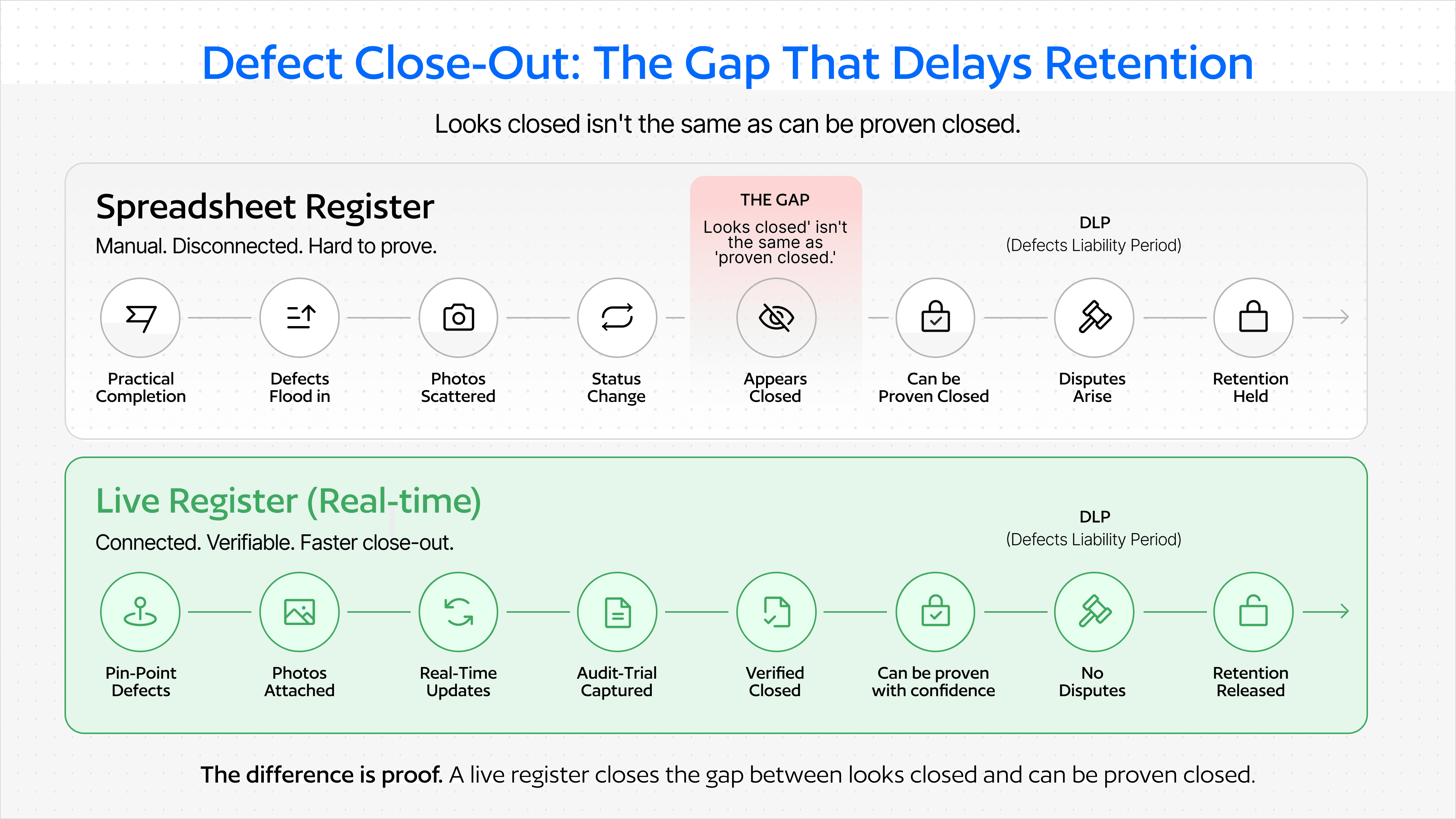
Quality control in construction is meant to be a system. At handover, a spreadsheet is not a system. It is a snapshot, already out of date by the time it is emailed.
6.4% The mean direct cost of rework as a proportion of contract value on Australian construction projects, with a further 5.9% in indirect costs. Love & Edwards, Calculating Total Rework Costs in Australian Construction Projects, 2005
The real cost of spreadsheet-based defect tracking
The spreadsheet feels free. It is sitting on every laptop, everyone knows how to use it, and it costs nothing to start. The cost shows up later, and it shows up in places that do not look like a spreadsheet problem.
The first cost is lost evidence. A defect raised without a photo attached to the item, or with a photo sitting in a separate folder, is a defect that cannot be proven closed. When the subcontractor disputes it, or the client asks why an item was signed off, there is no timestamped record connecting the defect, the rectification, and the verification. The argument is now a matter of memory, and memory does not hold a retention.
The second cost is no audit trail. On a spreadsheet, a status changes from "open" to "closed" with no record of who changed it, when, or on what evidence. During the defects liability period (DLP), when an item the client thought was fixed reappears, there is no way to show what was actually done. The whole register becomes contestable.
The third cost is the one that hits the bank account. Retentions, often 5% of the contract value reducing to 2.5% at practical completion, stay held until defects are closed to the client's satisfaction. A defect list that cannot be proven closed is a retention that cannot be released. On a $10 million project, that is real money sitting in someone else's account because the tracking could not keep up.
Why this is worse in Australia right now
Defect close-out is not a paperwork formality in the current Australian market. It is a financial and reputational exposure that has grown sharply, especially in apartment and multi-residential work.
Equity Economics estimated the cost of remediating structural and safety defects in Australian apartment buildings constructed in the previous decade at around $6.2 billion. That figure is about water leaks, fire safety, cladding, and structural failure, the serious end of the defect spectrum, but it sets the tone for how clients, certifiers, and insurers now treat handover.
The mood has shifted. Clients are more cautious, building inspectors are more thorough, and the consequences of a defect that should have been caught are more severe than they were a decade ago. A builder who cannot demonstrate a rigorous, traceable close-out process is now carrying a commercial risk, not just an administrative one.
In that environment, "we think it is fixed" is not good enough. The client wants to see that it is fixed, and they want the record to prove it.
"Direct field rework averages around five percent of total project cost, with indirect costs running several times higher than the direct cost alone."
Construction Industry Institute, IR-153, An Investigation of Field Rework in Industrial Construction
What a real-time defect register changes
The fix is not more discipline applied to the same broken tool. It is a different tool: a live defect register that every party works from, updated as the work happens rather than reconstructed after it.
The change starts with where a defect is raised. Instead of a row in a spreadsheet, the defect is pinned to a location on the drawing or floor plan, with a photo attached to the item itself. Anyone can see exactly where it is, what it looks like, and what state it is in. The evidence and the defect are the same record.
From there, the register does the work the spreadsheet could not. Each item carries an owner, a status, and a full history. When a trade marks an item rectified, the verifier sees it, inspects it, and closes it, and every one of those steps is timestamped against the item. The register is no longer a snapshot. It is a living record of the building's quality, accurate the moment you open it.
Good quality control in construction depends on plans that are followed and verified, not just written. The same logic that governs inspection test plans and inspection test checklists at the start of a build governs defect close-out at the end: the inspection only counts if the evidence is captured and the close-out is recorded.
When defects do cluster around a recurring fault, a live register makes the pattern visible early, which is exactly where a structured response belongs. We cover that discipline in our post on corrective action plans, and the connection to defects is direct: a corrective action that is logged and verified stops the same defect appearing on the next floor, or the next project.
When the register is live, handover stops being a scramble:
Every defect is pinned to a location, with photos attached to the item, not a folder
Status is current the moment anyone opens the register, not five days old
Each close-out carries a timestamped record of who verified it and on what evidence
Recurring faults surface as patterns, not as one-off surprises
The client sees the same register the site team does, in real time
Retention release is backed by an audit trail, not a verbal assurance
The handover documentation pack is already built, because it was captured as the work happened
Where Plexa fits
Plexa's Quality and Defects module replaces the standalone spreadsheet with a live register the whole project works from. Defects are created with pin-drop accuracy on the drawing, photos attach directly to the item, and assignment, status, and verification are tracked in real time with a full audit trail from creation through to close-out.
Because the module connects to Document Control, the evidence for every closed item is stored against the project, and the handover pack exports without anyone rebuilding it from scratch. The same register that managed the defect is the register that proves it was closed, which is what gets the retention released on time.
The defect list that ballooned at handover does not have to be a scramble. The work behind those ninety items might be sound. What protects the project, the relationship, and the retention is being able to prove it, item by item, when the client asks. The pressure that builds at practical completion is real on every project. It is much easier to absorb when the close-out keeps pace with the work, rather than chasing it.
The same reporting lag that quietly undoes a programme undoes a defect list too. If you want the full picture of how that lag compounds across delivery, our post on why construction schedules slip covers it from the programme side.
Sources
Love, P.E.D. & Edwards, D.J. (2005). Calculating Total Rework Costs in Australian Construction Projects. Civil Engineering and Environmental Systems, 22(1), 11-27. ro.ecu.edu.au/ecuworks/2401
Equity Economics. (2019). The Cost of Building Defects: Economic Modeling of the Cost of Building Defects in Apartments Across Australia. equityeconomics.com.au
Construction Industry Institute. IR-153, An Investigation of Field Rework in Industrial Construction. University of Texas at Austin. construction-institute.org
Related Articles


The AI Construction Operating System
One platform, one data model, every project. Built in Australia, for the world.
YOUR DATA, PROTECTED
Hosted on AWS Sydney with Australian data residency.


GET THE MOBILE APP
Platform
Solutions
© 2026 Plexa Pro Pty Ltd. ABN 63 668 433 136