Ask your projects data anything. Get answers in seconds. Plexa MCP Connector is live. See it in action


Why Australian Construction Schedules Fail (And How to Stop It)
Most Australian construction schedules fail for the same structural reason. The programme is updated weekly. The site moves daily. By the time the slip shows up in the report, the window to fix it has already closed.
The project manager walks into the site office on a Thursday morning. The programme says he is four days ahead. Outside, the concreters are sitting in their utes waiting on a hold-point sign-off that was supposed to happen yesterday. The framers are gone. They moved to another job because the slab was not ready on Tuesday. The Thursday construction schedule does not know any of this yet.
This is not an unusual morning. It is a normal one. The programme is not wrong because the project manager failed to update it. It is wrong because the programme and the site are running on different clocks, updated at different speeds, maintained in different places.
The gap between them is not just an inconvenience. It is the structural reason why Australian construction schedules fail, quietly, at scale, on projects run by experienced teams who are doing the right things.
Why Australian construction schedules fail more than most
The numbers are not abstract. QBE’s 2024 Australian Construction Sector Outlook found that 74% of Australian builders and 62% of developers experienced project delays in the preceding year.[1] That is not a fringe problem affecting poorly managed projects. It is a majority outcome across the sector.
The Australian Bureau of Statistics data tells the same story in time. The average house completion time increased by 50%, from 6.6 months in September 2019 to 9.9 months by June 2024.[2] That is not a pandemic blip. That is a structural shift in how long it takes to deliver a project from approval to handover.
The pressure has compounded from multiple directions: labour costs up, long-lead materials still disrupted, approval processes adding months. The teams experiencing these delays are not inexperienced. They are highly competent, running programmes that were accurate when they were built. The problem is that the programme stops being accurate the moment site conditions change, and site conditions change every day.
The industry has more tools than it has ever had. The delays have still increased. That points to one thing: the tools are not solving the right problem.
The three things that actually cause schedule drift
Most construction schedule failures trace back to three inter-related causes, none of which show up clearly in a programme until the damage is already done.
Trade sequencing and subcontractor availability is the real driver on most Australian builds. Construction programmes are built on the assumption that trades will be available when their sequence arrives. On a competitive labour market, that assumption fails regularly. When one trade slips, the cascade effect is immediate: a 4-day delay to the concreters becomes 10 days by the time it reaches the electricals, because the framers moved to another job in the gap between the delayed slab and the point when the sequence was ready for them.
That cascade runs through every project. The subcontractor coordination problem is covered in depth in our post on subcontractor management, but from a scheduling perspective the core issue is this: the programme treats subcontractor availability as fixed. The site treats it as negotiated daily.
Hold-point and approval delays are the second driver. ITPs, engineering sign-offs, and council inspections sit on the critical path of almost every Australian construction project. Any one of them can stop the whole site while downstream trades sit idle. The delay is often short, one or two days. But when it occurs mid-sequence, it pushes every following trade by more than the original hold-point delay, because the recovery window for re-booking compressed schedules is narrow and competitive.
Materials procurement lag is the third. Long-lead items that are not tracked against the live programme create schedule surprises that cannot be recovered once they land. Post-2020, supply chains in Australia changed permanently for a range of structural materials. A programme that does not connect procurement delivery dates to critical path milestones is carrying risk that is invisible until the delivery is late and the sequence has already stalled.
Why the programme usually lies
Schedules are updated weekly at best, and on many projects monthly. The baseline reflects the plan that was built before site conditions existed. Once the project is moving, the reporting lag between what is happening on site and what appears in the programme can easily reach five to eight working days.
That lag is not a minor inconvenience. On a commercial build, five days is the difference between catching a drift before it compounds and discovering a two-week blowout after the recovery window has closed. The project manager who updates the schedule on Thursday is making decisions based on Monday’s site. The problem that started on Tuesday is already four days old.
$15 billion 7% of Australia’s $213 billion public infrastructure pipeline is hampered by project delays. 80% of respondents agree large projects are typically delivered over budget and behind schedule. Infrastructure Australia, 2024 Infrastructure Market Capacity Report [3]
This is not a project management failure. It is an information architecture failure. The programme is a tool that only works if it reflects reality in near-real-time. A weekly update cycle on a daily-moving site is not a programme. It is a historical record dressed up as a plan.
As our post on construction profit margins covers, the gap between what a project should cost and what it actually costs is often explained not by a single bad decision, but by dozens of small decisions made on outdated information.
What schedule recovery actually requires
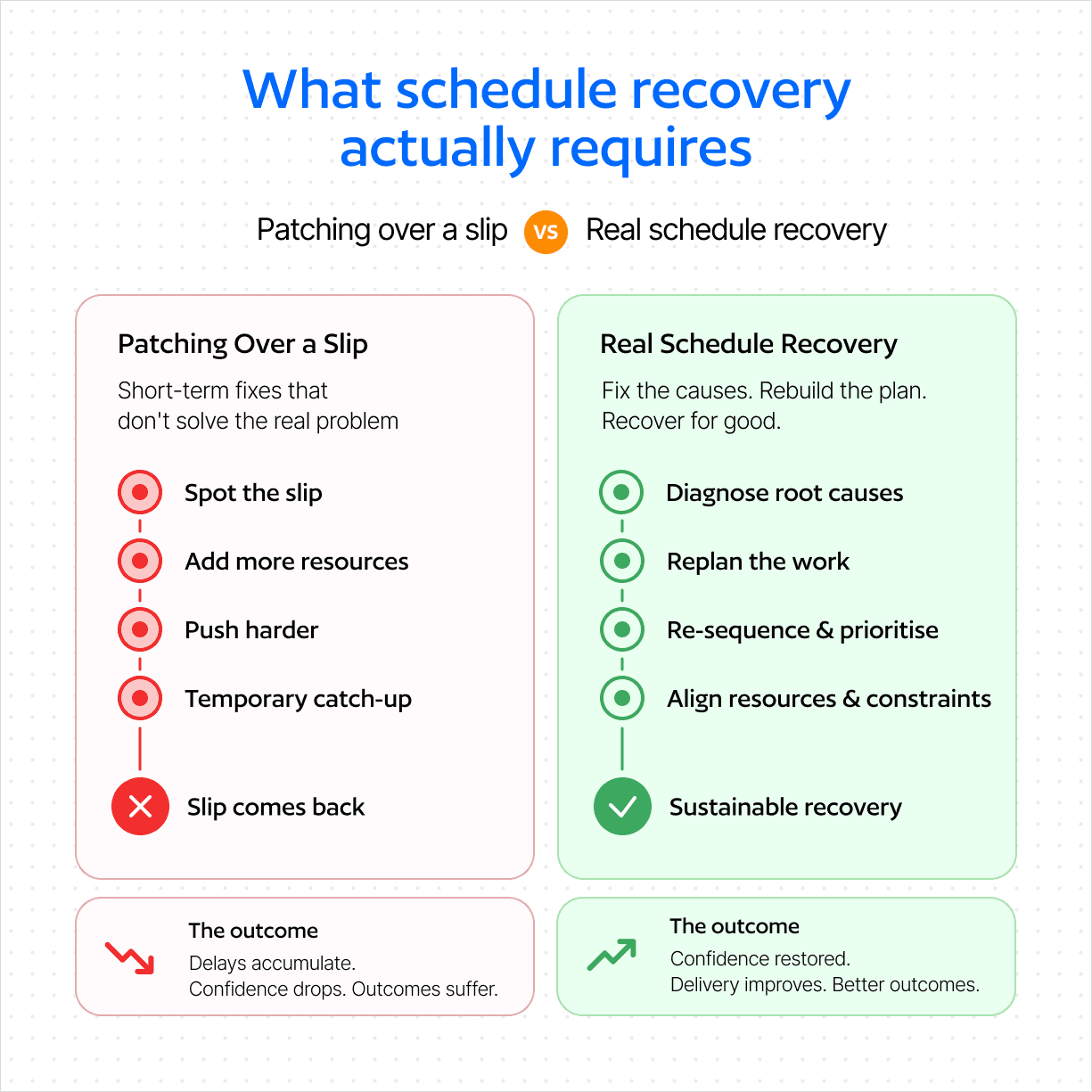
For the project manager who is already behind, what matters is the recovery toolkit and the window in which it works.
Fast-tracking means running activities in parallel that were planned sequentially, accepting the coordination risk in exchange for compressing the timeline. Crashing means adding resources to critical path items, accepting the cost premium in exchange for recovering programme days. Both have limits, and both get more expensive as the project progresses.
On most Australian commercial builds, the practical recovery window closes around 30 to 35% through the project. After that, the cost of catching up typically exceeds the cost of negotiating a revised end date. Acting on a 2-day drift in week 3 is a scheduling problem. Discovering a 2-week blowout in week 7 is a commercial problem.
Documentation runs through all of it. Extensions of Time claims under AS 4000 or NEC contract conditions require a contemporaneous record of the delay cause, notification, and programme impact. If the delay is not logged when it happens, the claim is harder to defend. A programme that captures delay events as they occur is not just a scheduling tool. It is a legal record in the making.
What good programme management looks like in practice
The projects where schedules hold are not run by better people. They are run with better information, updated faster, visible to the right people at the right time.
Live updates from site close the most significant gap. When progress is recorded daily, a 2-day drift in week 3 is visible as a 2-day drift. The project manager acts on a scheduling problem rather than inheriting a commercial one.
Trade milestones connected to procurement and delivery bookings is the second shift. A programme that shows “framers start Monday” but does not check whether the framing materials have arrived carries a risk it cannot see. Linking delivery confirmations to programme milestones means the early warning arrives before the sequence does.
Hold-point status connected to the live programme is the third. When a sign-off is delayed, downstream trades need to see it the same day, not at the next update. That single change is enough to break the cascade failure described in the opening section.
“Eighty percent of infrastructure industry respondents agree that large projects are typically delivered over budget and behind schedule in Australia.”
Infrastructure Australia, 2024 Infrastructure Market Capacity Report
Predictive scheduling is a legitimate tool for construction programme management, and AI is beginning to surface early warning patterns that experienced schedulers recognise but cannot always act on fast enough. Our post on AI and construction data covers where that technology is and is not yet reliable. The key point: predictive scheduling is only as good as the data feeding it. A programme updated weekly gives a prediction engine one week of resolution. A programme updated daily gives it seven times the signal.
Where Plexa fits
Plexa’s Programme and Scheduling module connects the live programme to site diary records, subcontractor milestones, procurement deliveries, and hold-point sign-off status. When a hold-point is delayed, downstream trades see it the same day, not next Thursday. When a delivery is confirmed, the milestone it feeds updates automatically.
The recovery window that closes at 30 to 35% through the project stays open longer when the programme reflects what is actually happening. The EOT claim that requires contemporaneous records has those records, because the programme captured the delay when it occurred.
Return to that Thursday morning. With live site data connected to the programme, the hold-point delay was flagged on Tuesday afternoon. The framers had not yet moved to another job. The recovery option was still available. The Thursday programme did not need to catch up to Tuesday’s site, because Tuesday’s site had already updated it.
That is what happens when the programme and the site run on the same clock.
For more on how trade coordination connects to schedule performance, read our post on subcontractor management.
Sources
QBE. (2024). Australian Construction Sector Outlook 2024. qbe.com/au
Australian Bureau of Statistics. (2024). Building Activity, Australia. abs.gov.au
Infrastructure Australia. (2024). 2024 Infrastructure Market Capacity Report. infrastructureaustralia.gov.au
Related Articles


The AI Construction Operating System
One platform, one data model, every project. Built in Australia, for the world.
YOUR DATA, PROTECTED
Hosted on AWS Sydney with Australian data residency.


GET THE MOBILE APP
Platform
Solutions
© 2026 Plexa Pro Pty Ltd. ABN 63 668 433 136