Ask your projects data anything. Get answers in seconds. Plexa MCP Connector is live. See it in action


What is an ITP and ITC in Construction? A Complete Quality Control Guide
Get construction quality right with ITPs and ITCs. This guide covers what each term means, how they differ, and how to apply them on every project.
HSEQ
Site Safety & Quality
What is an ITP in Construction?
ITP stands for Inspection and Test Plan. It is a structured quality control document that outlines what needs to be inspected or tested, when, by whom, and to what standard, before construction work begins.
Think of an ITP as the master roadmap for quality on a project or trade package. It does not record results (that is the job of the ITC); instead, it defines the framework that makes every inspection consistent, complete, and compliant. ITPs align directly with ISO 9001:2015 Clause 8.5 (Production and Service Provision), the international standard for quality management in construction.
What does an ITP typically include?
A well-structured ITP in construction will define:
The scope of work being inspected (e.g., concrete pours, structural steel, electrical rough-in)
The specific inspection or test activities required at each stage
The acceptance criteria, meaning what "pass" looks like
Who is responsible for each activity (contractor, subcontractor, third-party inspector, or client representative)
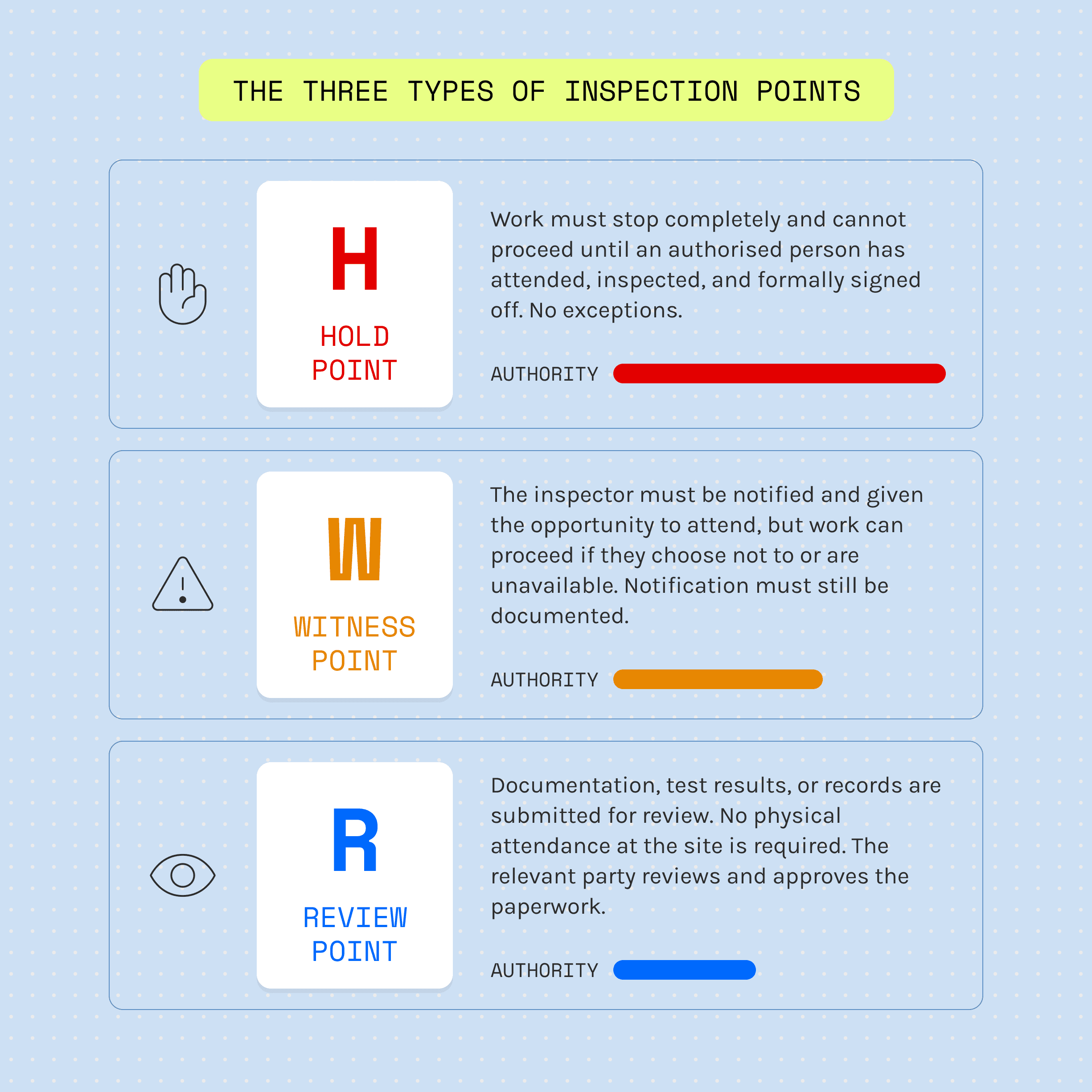
The type of inspection point: Hold Point (work cannot proceed without sign-off), Witness Point (inspector is notified and should attend), or Review Point (documentation is checked)
Reference documents: standards, specifications, drawings, and codes
Why ITPs matter for construction quality
Without an ITP, inspections happen inconsistently. Some stages get checked, others get skipped, and nobody is sure who is responsible for what. An approved ITP ensures that quality checks are built into the construction process rather than bolted on at the end.
From a risk management perspective, ITPs also create a paper trail. If a defect surfaces later, the ITP shows whether the right inspections were planned and carried out. That documentation is critical for managing liability, satisfying regulators, and protecting the business.
"Rework accounts for an average of 9% of total project cost when direct and indirect factors are combined. The majority of it is preventable with consistent quality controls."
Construction Industry Institute, Costs of Quality Deviations in Design and Construction
What is an ITC in Construction?
ITC stands for Inspection Test Checklist (sometimes also called an Inspection Test Certificate or Inspection Test Record, depending on the organisation). In the context of construction quality assurance, an ITC is the document used to record the outcome of an inspection or test that was defined in the ITP.
Where the ITP says "inspect this, at this stage, to this standard," the ITC is where your team records: "We inspected it. Here is what we found. It passed / failed / requires rework."
What does an ITC include?
A typical construction ITC will capture:
The inspection or test activity being recorded (referenced from the ITP)
The date, time, and location of the inspection
The name and signature of the inspector or responsible party
Actual measurements or observations against the acceptance criteria
Pass/fail outcome, or details of any non-conformance
Corrective actions required (if applicable) and sign-off once resolved
ITCs as your audit trail
ITCs are the evidence. When a client, certifier, or regulator asks "was this work inspected?", the ITC is what you show them. Without completed ITCs, even the best-planned ITP becomes just a document with good intentions.
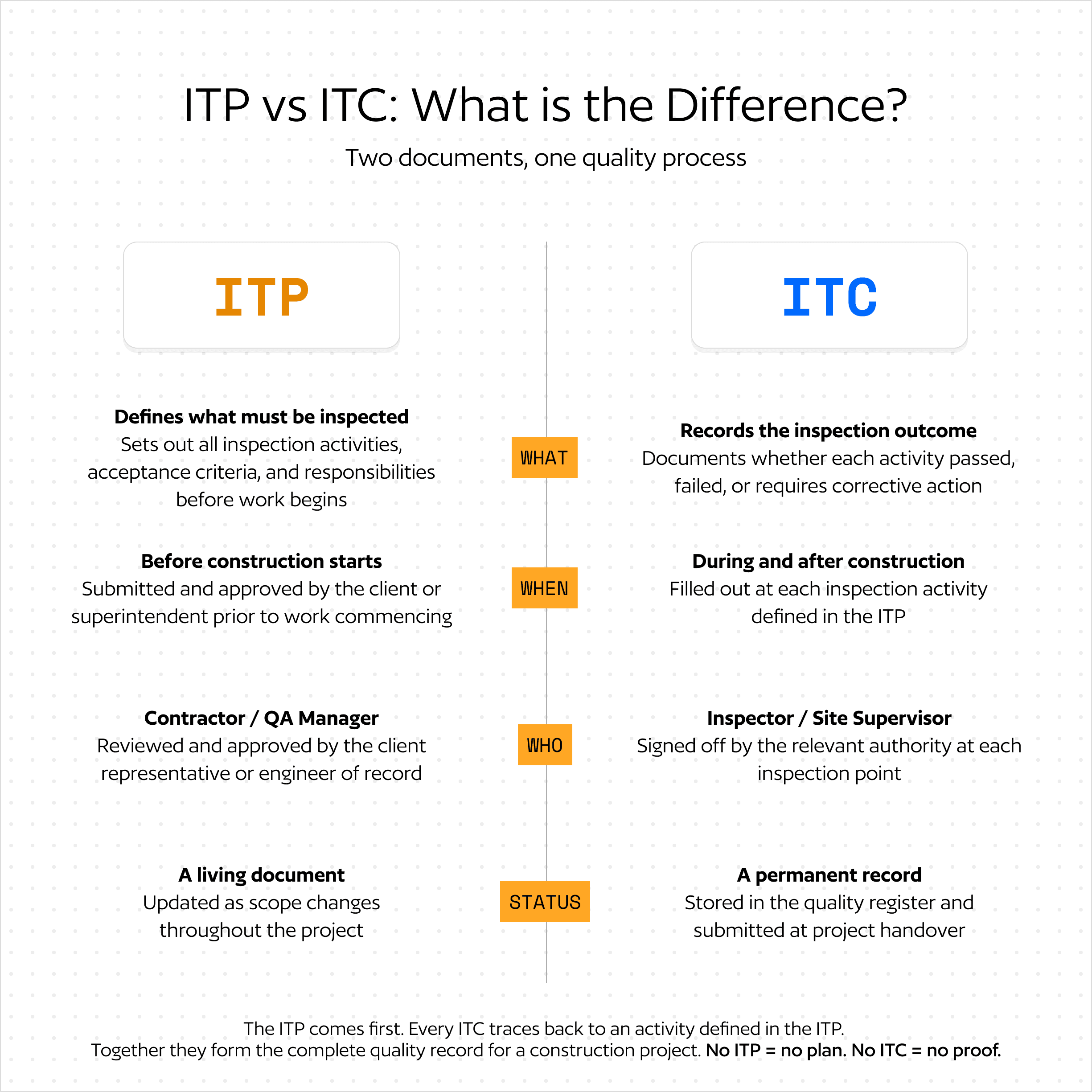
ITP vs ITC: What is the Difference?
This is one of the most searched questions in construction quality management, so here is a clean summary:
ITP (Inspection and Test Plan) | ITC (Inspection Test Checklist) | |
|---|---|---|
Purpose | Plans and defines what inspections are required | Records the results of those inspections |
When used | Created and approved before work starts | Completed during and after construction activities |
Who creates it | Contractor / QA manager | Inspector / site supervisor |
Status | A living plan, updated as scope changes | A completed record, stored for auditing |
Key function | Sets the standard | Proves the standard was met |
Put simply: the ITP is the plan, the ITC is the proof.
How ITP and ITC Work Together on a Construction Project
Understanding them individually is useful, but the real value comes from understanding how ITPs and ITCs operate as part of a continuous quality loop across the project lifecycle.
1. Planning Phase: Build the ITP
Before any physical work begins, the contractor or QA team develops the ITP in consultation with the client and relevant consultants. It gets submitted for review and approval, often by the superintendent, engineer of record, or client representative. No work on the relevant trade or stage should commence without an approved ITP in place.
2. Construction Phase: Execute Against the ITP
As work progresses, the team carries out inspections and tests at each stage defined in the ITP. For every Hold Point, the relevant party is notified, attends, and signs off before work continues. Witness Points and Review Points are managed according to the plan. Each completed inspection generates a filled-out ITC.
Any non-conformances identified during this phase are documented, investigated, and resolved through a formal corrective action process, with sign-off recorded in the ITC before work proceeds.
3. Completion Phase: Close Out the ITCs
By the time a trade package or project stage is complete, every ITP activity should have a corresponding, signed ITC. Gaps in the ITC register are a red flag. They indicate either uninspected work or incomplete documentation, both of which create risk at handover.
4. Handover Phase: Submit the Quality Register
At project handover, the full set of ITPs and completed ITCs forms a key part of the quality register delivered to the client or owner. This documentation demonstrates that construction was carried out in accordance with approved plans, specifications, and relevant standards, which is a critical requirement for regulatory sign-off, defects liability, and long-term asset management.
52% of construction rework is caused by poor project data and miscommunication, both of which a well-managed ITP and ITC process directly addresses. PlanRadar QA/QC Impact Report, 2025
Why Construction Teams Are Going Digital with ITPs and ITCs
Managing ITPs and ITCs on paper or across disconnected spreadsheets creates real problems: lost checklists, missed Hold Points, illegible sign-offs, and no real-time visibility for project managers or clients. On larger projects with hundreds of ITC activities across multiple trade packages, the volume of documentation alone becomes a risk.
The numbers back this up. According to PlanRadar's 2025 QA/QC Impact Report, companies with strong quality assurance standards are 25 to 28% more likely to achieve profit margins above 3%, and firms without consistent QA/QC processes are 21% more likely to experience avoidable rework. Across the UK construction industry alone, the Get It Right Initiative estimates that avoidable errors cost the sector over £5 billion every year.
Digital inspection management addresses this directly by:
Giving site teams access to the current, approved ITP on any device, with no version confusion
Enabling ITCs to be completed on-site in real time, with photos, signatures, and GPS stamps
Automatically flagging upcoming Hold Points so nothing gets skipped
Creating a centralised, searchable register of all inspection records
Providing project managers and clients with live dashboards showing inspection progress and open non-conformances
Plexa is built for exactly this. Plexa's construction quality management platform lets your team create and manage ITPs digitally, assign inspection activities to the right people, and complete ITCs from the field, all in one place. Non-conformances are tracked through to close-out, and the full audit trail is always available for client reporting or regulatory review.
For construction companies ready to move beyond clipboards and shared drives, Plexa makes the ITP/ITC process faster, more accurate, and genuinely inspection-ready at every stage.
Frequently Asked Questions
What does ITP stand for in construction? ITP stands for Inspection and Test Plan. It is a quality control document that outlines the inspections and tests required for a specific scope of construction work, including who is responsible, when they occur, and what the acceptance criteria are.
What does ITC stand for in construction? ITC stands for Inspection Test Checklist. It is the document used to record the results of inspections and tests defined in the ITP. Completed ITCs form the audit trail that demonstrates compliance with quality standards.
What is the difference between an ITP and an ITC? An ITP plans what needs to be inspected. An ITC records the outcome of those inspections. The ITP comes first (planning), and ITCs are generated as work is executed.
What is a Hold Point in an ITP? A Hold Point is a mandatory stop in the construction process where work cannot continue until an authorised person has inspected the work and signed off on the ITC. Hold Points are defined in the ITP and are critical for high-risk or quality-sensitive activities.
What is a Witness Point in an ITP? A Witness Point requires that an inspector is notified and given the opportunity to attend an inspection, but work may proceed if the inspector does not attend. This differs from a Hold Point, which requires attendance and sign-off before work proceeds.
Are ITPs required on all construction projects? Most commercial, civil, and infrastructure contracts require an approved ITP for each trade package or major scope of work. Even on smaller projects, having an ITP is considered best practice for quality assurance and risk management.
Summary
ITPs and ITCs are two sides of the same quality coin in construction. The ITP is your plan. It defines what gets inspected, by whom, and to what standard. The ITC is your proof. It records what was actually inspected and whether it passed. Together, they form the backbone of a robust quality assurance process that protects your business, satisfies your clients, and keeps your projects on the right side of compliance.
If your team is still managing these documents manually, it is worth exploring what a digital platform like Plexa can do to streamline the process from planning through to handover.
For more on the broader compliance framework that ITPs and ITCs sit within, read our guide to What HSEQ Actually Means on a Construction Site. If non-conformances are a recurring issue on your projects, our post on Corrective Action Plans in Construction covers how to close them out effectively.
See how Plexa manages ITPs and ITCs in one place. Book a demo.
Sources
Construction Industry Institute. Costs of Quality Deviations in Design and Construction. construction-institute.org/costs-of-quality-deviations-in-design-and-construction
PlanRadar. (2025). Cost of Rework in Construction: Causes, Data and Prevention. planradar.com/us/cost-of-rework-construction/
Get It Right Initiative. Improving Value by Eliminating Error. getitright.uk.com
International Organization for Standardization. ISO 9001 Quality Management. iso.org/iso-9001-quality-management.html
Related Articles


The AI Construction Operating System
One platform, one data model, every project. Built in Australia, for the world.
YOUR DATA, PROTECTED
Hosted on AWS Sydney with Australian data residency.


GET THE MOBILE APP
Platform
Solutions
© 2026 Plexa Pro Pty Ltd. ABN 63 668 433 136