Ask your projects data anything. Get answers in seconds. Plexa MCP Connector is live. See it in action


AI Is Coming to Construction. Is Your Data Ready for It?
AI is the most talked-about shift in construction right now. Most firms believe in it. Very few are getting value from it. Here is why that gap exists and what closes it.
Select Hub
Construction Management
Something is shifting in how construction firms think about technology.
For years, the conversation was about whether digital tools belonged on a building site at all. Now it is about something much more specific: what artificial intelligence can actually do for a project, and how quickly it can be made to work.
The industry is paying attention. The question is whether the optimism is translating into real results.
AI and construction: the industry moment
The RICS AI in Construction Report 2025 surveyed more than 2,200 professionals globally on where AI stands in the sector today.
The findings are striking. Seventy percent of project managers and quantity surveyors believe AI can help deliver greater value in projects. Optimism is highest in three areas: scheduling, risk management, and cost control.
These are not peripheral functions. They are the core of what project delivery depends on.
The reasons for optimism make sense when you look at what AI is already doing in adjacent industries. Pattern recognition across large data sets. Early warning signals in complex systems. Forecasting that updates in real time rather than waiting for a monthly report.
Applied to construction, those capabilities point to something genuinely valuable: a project team that knows earlier, acts faster, and spends less time chasing information that should already be in front of them.
70%
of project managers and quantity surveyors believe AI can help deliver greater project value - RICS AI in Construction Report, 2025
What AI can actually do on a construction project
The clearest use cases for AI in construction are not speculative. They are grounded in problems the industry already understands.
Scheduling optimisation is one. AI can identify where programme pressure is building before it becomes a delay, flagging dependencies at risk based on live site progress rather than last week's update.
Cost forecasting is another. AI can surface variations trending over budget earlier than any manual reporting cycle would catch them. It can compare procurement outcomes across multiple projects to identify patterns in subcontractor pricing that a single commercial manager would never see at scale.
Risk management is the third. AI can cross-reference site activity, weather data, trade sequences, and contractual obligations to flag risk before it becomes a claim.
These are not theoretical possibilities. They are capabilities that exist today, being applied in the most digitally mature firms in the sector.
"Optimism remains high about AI's potential in scheduling, risk management and cost control. The challenge is bridging the gap between that optimism and implementation."RICS, Artificial Intelligence in Construction Report, 2025
The gap between optimism and reality
Given the level of enthusiasm, the adoption numbers are sobering.
According to the same RICS research, nearly half of construction firms have no AI implementation at all. Only 1.5% are using it across multiple processes. Less than 1% have it embedded organisation-wide.
The industry believes in AI. It is just not getting value from it yet.
The report identifies why. The top barriers to AI adoption are not about the AI itself. They are about what sits underneath it. System integration challenges are cited by 37% of firms. Poor data quality by 30%. Two of the top three barriers are data problems.
That is the part of the conversation the industry tends to skip over.
45%
of construction firms currently have no AI implementation at all - RICS AI in Construction Report, 2025
Why disconnected data limits AI value
Here is the core problem. AI is not magic. It is pattern recognition applied to data.
The quality, completeness, and connectivity of that data determines everything about the quality of the output. Ask a well-trained AI model a question about your project and it will give you a confident answer. The question is whether that answer reflects the full picture.
In most construction businesses, the full picture is scattered. The budget lives in one system. The programme is in another. Procurement is managed in a third. Safety sits in a fourth. Correspondence and RFIs are in an email thread nobody fully owns.
Research shows that 76% of project teams use five or more tools for a single project. Professionals lose up to 23% of their working week simply switching between them.
That fragmentation is not just a productivity problem. It is an AI problem.
An AI that can only see part of your project data cannot give you a complete answer. It gives you a confident-sounding partial one. In construction, where a wrong forecast or a missed risk can mean six-figure consequences, that is often worse than no answer at all.
Consider a commercial manager who wants to know which subcontractors are trending over budget. To answer accurately, the AI needs contract values from the procurement system, approved variations from the contract admin tool, progress claims from the payment platform, and the latest forecast from the cost spreadsheet.
Those four data sources are in four different places, updated at different times, using different naming conventions for the same cost codes.
The AI either refuses to answer, approximates, or produces something that looks authoritative but is not.
37%
of construction firms cite system integration as their top barrier to AI adoption - RICS AI in Construction Report, 2025
What AI in construction actually looks like when data is connected
When all project data lives in one place, AI stops being a party trick and starts being a genuine decision-support tool.
The commercial manager's question gets answered in seconds. Contract values, approved variations, progress claims, and forecasts are in the same system, updated in real time, using the same cost codes. The AI does not have to guess or approximate. It has the full picture.
The schedule risk question gets answered with confidence. Because the programme is connected to site diary records, subcontractor milestones, bookings, and deliveries, the AI can see a delay forming before it shows up in a report.
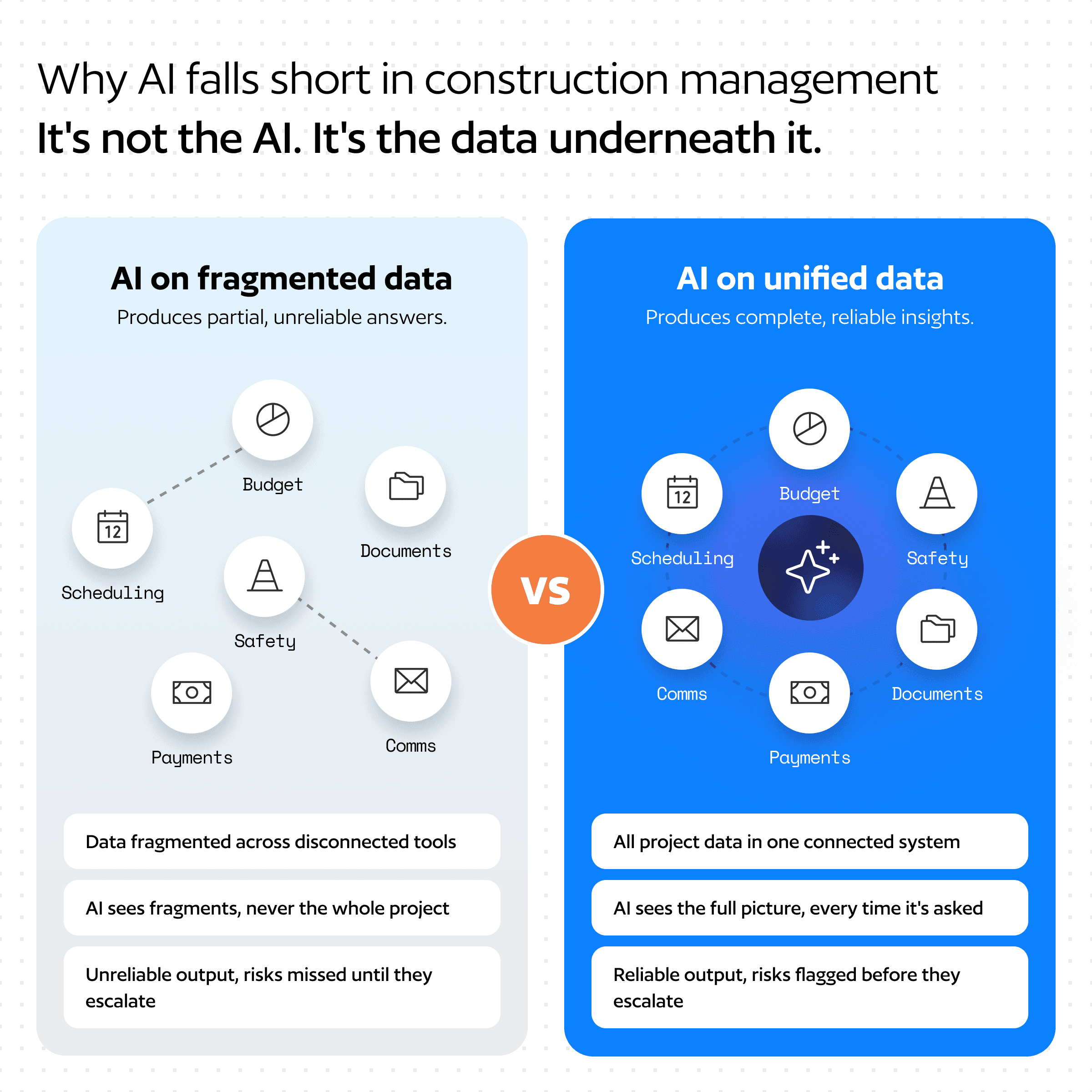
This is what the RICS report points to when it identifies scheduling, risk, and cost control as AI's highest-value applications in construction. Those applications only work when the data feeding them is complete.
The firms that will close the gap between AI optimism and AI value are not the ones who adopt the most AI tools. They are the ones with the most connected underlying data.
Where Plexa fits
Plexa was not built as an AI platform. It was built as a construction operating system, connecting documents, procurement, finance, site management, safety, scheduling, and correspondence into a single source of truth.
That architecture turns out to be exactly what AI requires to work properly in construction.
When Plexa's AI features surface insights, flag risks, or generate forecasts, they are drawing on complete, real-time project data. Not a slice of it updated on Thursday. All of it, always current, from the same place it was always stored.
The context is already there. That is what makes the difference.
The firms asking the hardest questions about their projects deserve complete answers. That starts with the data, not the tool.
See how Plexa connects your project data and where AI fits in. Book a demo →
Related Articles


The AI Construction Operating System
One platform, one data model, every project. Built in Australia, for the world.
YOUR DATA, PROTECTED
Hosted on AWS Sydney with Australian data residency.


GET THE MOBILE APP
Platform
Solutions
© 2026 Plexa Pro Pty Ltd. ABN 63 668 433 136