Ask your projects data anything. Get answers in seconds. Plexa MCP Connector is live. See it in action

What HSEQ Actually Means on a Construction Site
HSEQ stands for Health, Safety, Environment and Quality. Here is what each pillar actually covers, why they belong together, and how they show up on a real construction site.
HSEQ
Safety & Quality
A project engineer opens a tender document on a Tuesday morning. Three sections in, the requirement is plain: "HSEQ compliance evidence required at submission." She knows what most of those letters mean. There are ISO certificates on the wall behind her. What the client is actually asking for, in this submission, in this format, by Friday, is harder to pin down than it should be.
That small everyday moment is why HSEQ has become one of the most quietly important acronyms in construction. It looks like jargon. It is shorthand for the four disciplines a modern build is judged on, by the regulator, by the client, and by the people doing the work.
What HSEQ stands for
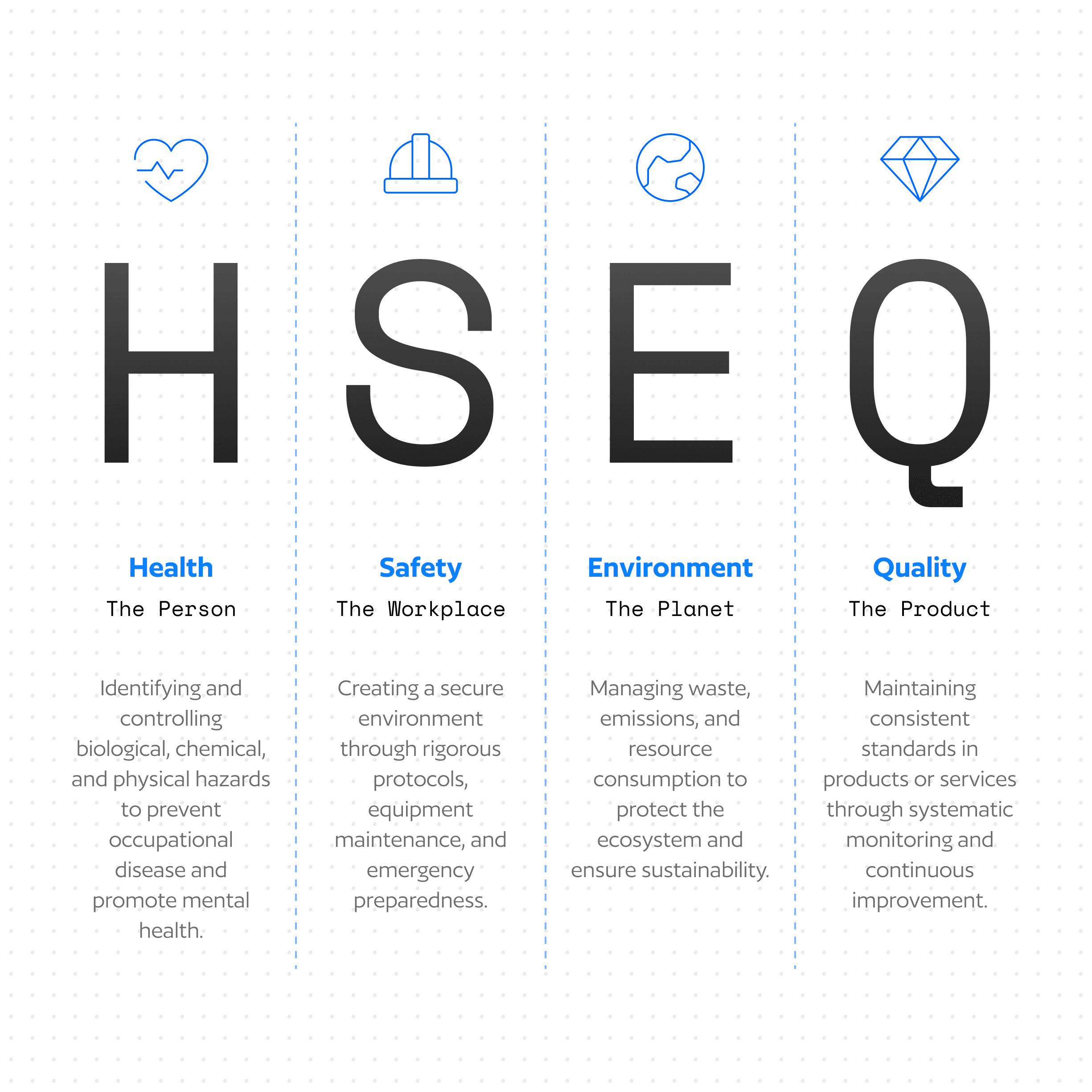
HSEQ stands for Health, Safety, Environment, and Quality. Four words, four bodies of practice, one integrated way of running a project.
The acronym became standard in construction and engineering once teams realised the underlying records were the same across all four. An induction sits inside Health and Safety. A spill response sits inside Environment and Safety. An Inspection and Test Plan sits inside Quality and affects Safety. Treating the four as separate functions duplicated the paperwork and missed the connections. Treating them as one discipline gave teams a single management system, one audit, one source of truth.
Most large contractors today align HSEQ with three international standards: ISO 45001 for occupational health and safety, ISO 14001 for environmental management, and ISO 9001 for quality. Together they form the management system an HSEQ Manager runs.
1 in 6 fatal workplace accidents globally occur in construction, despite the sector employing only around 7% of the workforce. That is roughly 60,000 deaths every year.
International Labour Organization
What each letter actually covers on site
H is Health. Beyond first aid and injury response, this covers worker wellbeing, fatigue management, exposure to hazardous substances, mental health, and long-term occupational risks like silica dust, noise, and vibration.
S is Safety. The day-to-day discipline of preventing harm. Inductions, permits to work, toolbox talks, safe work method statements, hazard registers, PPE compliance, plant inspections, emergency response and evacuation, and incident reporting. On a tunnelling project, that means gas monitoring before every shift, confined space permits for each entry, and a safety briefing the crew actually attends.
E is Environment. Waste management, emissions, spill prevention, water and noise impact, biodiversity controls, Environmental Impact Assessments, and the regulatory reporting that comes with each one. On a build next to a protected wetland, that means erosion controls, water quality testing, and scheduling work around the ecosystem instead of through it.
Q is Quality. Inspection and Test Plans, Inspection and Test Checklists, defect close-out, non-conformance reports, materials traceability and batch control, and the records that prove the building meets specification. On a bridge build, that means every concrete pour is tested, signed off, and traceable to the batch before the next pour begins. Quality is the letter that most directly determines whether a project passes handover.
The four pillars share more than they look like they do. The same induction record proves training (Q), competency to access site (S), and exposure tracking (H). The same incident report feeds safety statistics (S), environmental notification thresholds (E), and quality non-conformance if rework is required (Q). The same corrective action workflow closes them all out.
"Health, safety, environment and quality are not four separate management systems. They are four lenses on the same set of decisions made at the same time on the same job."
Construction Industry Institute, Integrated HSE Management Systems
Why HSEQ exists as one discipline, not four
If you were starting from scratch, you would not invent four parallel systems for managing the same project. You would build one and report through four lenses.
That is the case for HSEQ. When the four are run as separate systems, the same event gets logged three times, in three formats, with three audit trails. Safety counts the incident. Environment notifies the regulator. Quality raises the non-conformance. Three workflows, one event, three sets of evidence to reconcile.
When they run as one system, the workload halves and the gaps close. The incident report routes to all three reviewers automatically. The investigation produces a single corrective action. The audit pack assembles itself.
This is why standards bodies have spent the last decade pushing toward Integrated Management Systems that fold ISO 45001, 14001 and 9001 together. The structural argument is simple: the cost of running them separately is not paperwork, it is the missed connections between them.
Up to 40% reduction in audit and reporting workload reported by organisations adopting integrated HSE and Quality management systems.
BSI Group, Integrated Management Systems research
Why most teams still struggle with HSEQ in practice
The theory is clean. The reality is that HSEQ on most projects still runs across a patchwork of tools.
A sign-on platform handles inductions. A spreadsheet tracks permits. A third system records incidents. Safety Data Sheets live in a shared drive. Quality records sit in a different module bolted onto document control. Each was bought for the right reason. The result is what auditors quietly call evidence fragmentation: the records exist, but pulling them together for a client report, an audit, or an incident investigation takes days.
The HSEQ Manager spends most of their week reconciling those tools. Not coaching crews. Not walking the site. Not closing out actions. Reconciling.
The cost of that fragmentation is rarely a single dramatic failure. It is the steady erosion of evidence quality: the induction that expired three weeks ago and nobody noticed, the SDS that was superseded but is still being referenced, the ITP signed off retrospectively because the inspection record cannot be found. Each one a small gap. Together, they are the difference between a project that passes audit and one that does not.
£21B+ estimated annual cost of avoidable error in UK construction alone, much of it traceable to gaps in quality assurance and HSEQ close-out.
Get It Right Initiative
What good HSEQ looks like in practice
A working HSEQ system is not a thicker binder. It is a thinner one, because the evidence assembles itself from records the team is already producing. The shift is from a compliance archive to a single source of truth the project actually runs from.
Inductions, sign-ins, permits, observations, incidents, SDS, ITPs, and corrective actions all live in one place. The HSEQ Manager opens a dashboard and sees what is current, what has expired, what is outstanding, and what needs a signature, across every project they are responsible for. The audit pack becomes a filter, not a writing exercise.
The role of the HSEQ Manager changes most visibly. Time on site goes up. Time at a keyboard goes down. Leading indicators (observations raised, corrective actions closed on time, induction currency, near-miss reports) become the conversation, not the lagging incident counts that dominate fragmented systems.
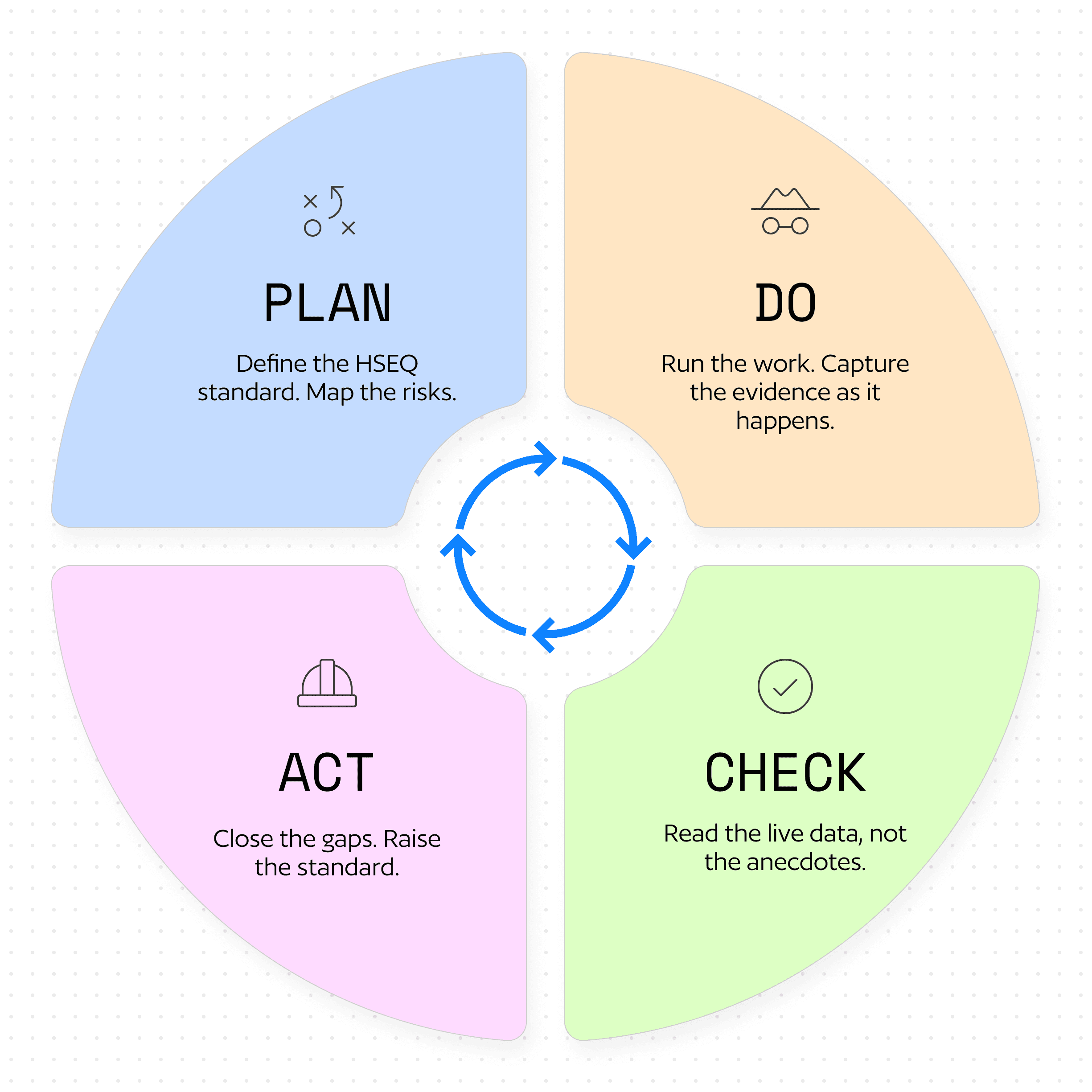
It also makes continuous improvement something the system actually supports. The Plan-Do-Check-Act loop at the heart of every ISO standard needs data to act on. When the records are connected, the loop runs on real numbers, not a spreadsheet rebuilt for the next steering committee.
The Plan-Do-Check-Act (PDCA) Cycle
To maintain ISO compliance, effective HSEQ management follows the Plan-Do-Check-Act loop:
Plan: Establish objectives (e.g., a Construction Quality Plan).
Do: Implement processes on-site (Toolbox talks and ITPs).
Check: Monitor results against the plan (Internal audits and inspections).
Act: Take corrective actions to improve the system.
What an integrated HSEQ system changes in practice:
Inductions, permits, and licences tracked with automatic expiry alerts
Incidents trigger investigation, corrective action, and close-out workflows automatically
Safety Data Sheets, hazard registers, and environmental controls live alongside safety records
ITPs and ITCs link directly to inspections, defects, and quality registers
One audit pack assembles from records already in the system
HSEQ Managers spend more time on site, less time at a keyboard
Where Plexa fits
The structural reason most HSEQ programmes underperform is not effort. It is fragmentation: four pillars, six tools, no single view.
Plexa's Site Management and Safety module consolidates the entire HSEQ surface area into one workspace. Inductions, sign-ons (across seven methods), permit-to-work, SDS and hazard management, incident reporting, observations and corrective actions, and Inspection and Test Plans all live inside the same system. Every record is linked, version-controlled, and visible at project and portfolio level.
That project engineer staring at the tender requirement on a Tuesday morning? Her HSEQ evidence is one filter away.
For the safety and quality angle in more depth, see our posts on Corrective Action Plans in Construction and Construction Quality Plans: ITC and ITP. For the methodology that sits beneath the H, S and E pillars, read our guide to risk assessment in construction.
See how Plexa runs HSEQ in one place → Book a demo
Sources
International Labour Organization. (2023). World Statistic on Safety and Health at Work. ILO. ilo.org/topics/safety-and-health-work
International Organization for Standardization. ISO 45001, ISO 14001, ISO 9001 management system standards. iso.org
BSI Group. Integrated Management Systems: Combining ISO 9001, ISO 14001 and ISO 45001. bsigroup.com
Get It Right Initiative. (2018). Improving Value by Eliminating Error. getitright.uk.com
Construction Industry Institute. Integrated HSE Management Systems. construction-institute.org
Related Articles


The AI Construction Operating System
One platform, one data model, every project. Built in Australia, for the world.
YOUR DATA, PROTECTED
Hosted on AWS Sydney with Australian data residency.

GET THE MOBILE APP
Platform
Solutions
© 2026 Plexa Pro Pty Ltd. ABN 63 668 433 136