Ask your projects data anything. Get answers in seconds. Plexa MCP Connector is live. See it in action


Seven Ways Construction Teams Sign In to Site (And Why It Matters)
The evacuation alarm sounds and nobody can say who is on site. That gap is a construction site attendance management problem, and it decides how exposed a builder is when something goes wrong.
Select Hub
Site Safety & Quality
The alarm goes off at 10:40 on a Tuesday. Everyone walks to the muster point, hi-vis bright against the gravel, and the supervisor counts heads against the sheet on the clipboard. The trouble is the sheet says fifty-three and there are forty-eight people standing in front of him. He does not know whether five workers left at smoko, never signed in, or are still inside. For the next twenty minutes, construction site attendance management stops being a compliance box and becomes the only thing that matters.
This is not a rare scenario. It is the predictable result of a sign-in process that nobody fully trusts. The register at the gate is a record of intention, not reality. People sign in and forget to sign out. Subcontractors wave through their crew on one signature. By mid-afternoon, the only honest answer to "who is on site right now" is a shrug.
The villain here is not the supervisor and it is not the workers. It is the paper register itself: a document that looks like accountability but delivers none. It cannot tell you who is current on their induction, who has signed the relevant SWMS, or who walked out the back gate an hour ago. When the alarm sounds, that gap is exposed in front of everyone.
Why site attendance is a safety problem, not an admin one
Under the model Work Health and Safety laws, a person conducting a business or undertaking has a primary duty to ensure, so far as is reasonably practicable, the health and safety of workers. Knowing who is on site, that they are inducted, and that they are accounted for in an emergency sits at the centre of that duty. A register you cannot rely on is a duty you cannot evidence.
The stakes are not theoretical. Construction is one of Australia's most dangerous industries to work in.
45 fatalities The Construction industry recorded 45 worker fatalities in 2023, 36% higher than its own five-year average of 33. Safe Work Australia, Key Work Health and Safety Statistics Australia 2024
When something goes wrong on a construction site, the first questions are always the same. Who was here. Were they inducted. Did they sign the right safe work method statement. Was anyone unaccounted for. A sign-in system that cannot answer those questions in seconds is not a workforce management tool. It is a liability waiting for an incident.
The seven ways teams sign in to site
There is no single correct method. Different sites, budgets, and risk profiles land on different tools. What matters is understanding what each one gets right, what it leaves exposed, and where the attendance data ends up. Here are the seven you will see on Australian projects, roughly in order of maturity.
1. The paper register
The clipboard at the gate. Cheap, instant, and requires no setup, which is exactly why it survives. It also fails on every count that matters. Sign-outs are routinely skipped, handwriting is illegible, and the data lives on a sheet that nobody types up until there is a problem. You cannot search it, cannot cross-check an induction against it, and cannot produce it quickly when a regulator asks. In an evacuation it is the worst possible tool: a static list that was already wrong by morning tea.
2. The spreadsheet
A step up in legibility, a step sideways in reliability. Someone transcribes the register, or trades email through their crew lists, and a coordinator maintains a master sheet. It is searchable and it can be shared, but it is only as current as the last person who updated it. The reporting lag between what happened at the gate and what the spreadsheet shows can run to days. For construction site safety compliance, a workforce record that is days behind the site is a record that cannot be trusted in the moment you actually need it.
3. The standalone sign-in app
This is where most sites modernise first, often with a dedicated sign-on-site tool. Workers check in on their phone, the data is timestamped, and the headcount is live. It is a genuine improvement: legible, searchable, and current. The limitation is that it is an island. The app knows someone signed in, but it does not necessarily know whether that person's white card is current, whether their induction has lapsed, or whether they have signed the SWMS for today's high-risk work. Attendance lives in one tool while compliance lives in another, and the two only meet when someone manually reconciles them.
4. The QR code
A poster at the gate, a phone camera, and a worker is signed in. QR codes are fast, low-cost, and scale well across multiple gates and large crews. They are excellent for visitors and for inducting non-regular personnel quickly via a scan. The weakness is verification. A QR code confirms that a phone scanned a poster, not that the right person stood at the gate. Without it being tied to an approved worker profile and an induction record, it can become a faster way to produce the same unreliable headcount.
5. The kiosk or tablet
A fixed tablet at the site entrance, often running in kiosk mode, where workers tap in against their profile. This brings a degree of control the phone-based methods lack: it can prompt for an induction check, surface a daily pre-start, or block a worker whose licence has expired. It anchors sign-in to a physical point of entry, which suits gated commercial sites. The trade-off is throughput. A single kiosk at shift change can create a queue, and a queue is where workers start tapping each other through.
6. Biometric and facial recognition
Facial recognition removes the weakest link in every method above: the assumption that the person signing in is who they say they are. The system matches a face to an approved, inducted worker profile, with no card to share, no PIN to pass on, and no phone to scan on a mate's behalf. Paired with turnstiles, it physically controls who passes the gate and produces an attendance record that is genuinely trustworthy. We cover how this works in practice in our guide to facial access control turnstiles for construction sites. The considerations are cost, privacy handling, and the infrastructure to run hardware at the gate, which is why it tends to appear on larger or higher-risk projects first.
7. The integrated platform
The seventh method is not really a seventh device. It is the decision to stop treating sign-in as a standalone function and connect it to everything else the site already tracks. Here, attendance is captured by whichever method suits the gate, QR, kiosk, facial recognition, geofencing, or PIN, and every check-in is tied to a worker profile that already holds the induction status, the signed SWMS, the licences, and the permits. The headcount is not just a number. It is a live, verified picture of exactly who is on site and whether each of them is cleared to be there.
"Construction accounted for the second highest number of worker fatalities of any industry in 2023, with the toll well above its own five-year average."
Safe Work Australia, Key Work Health and Safety Statistics Australia 2024
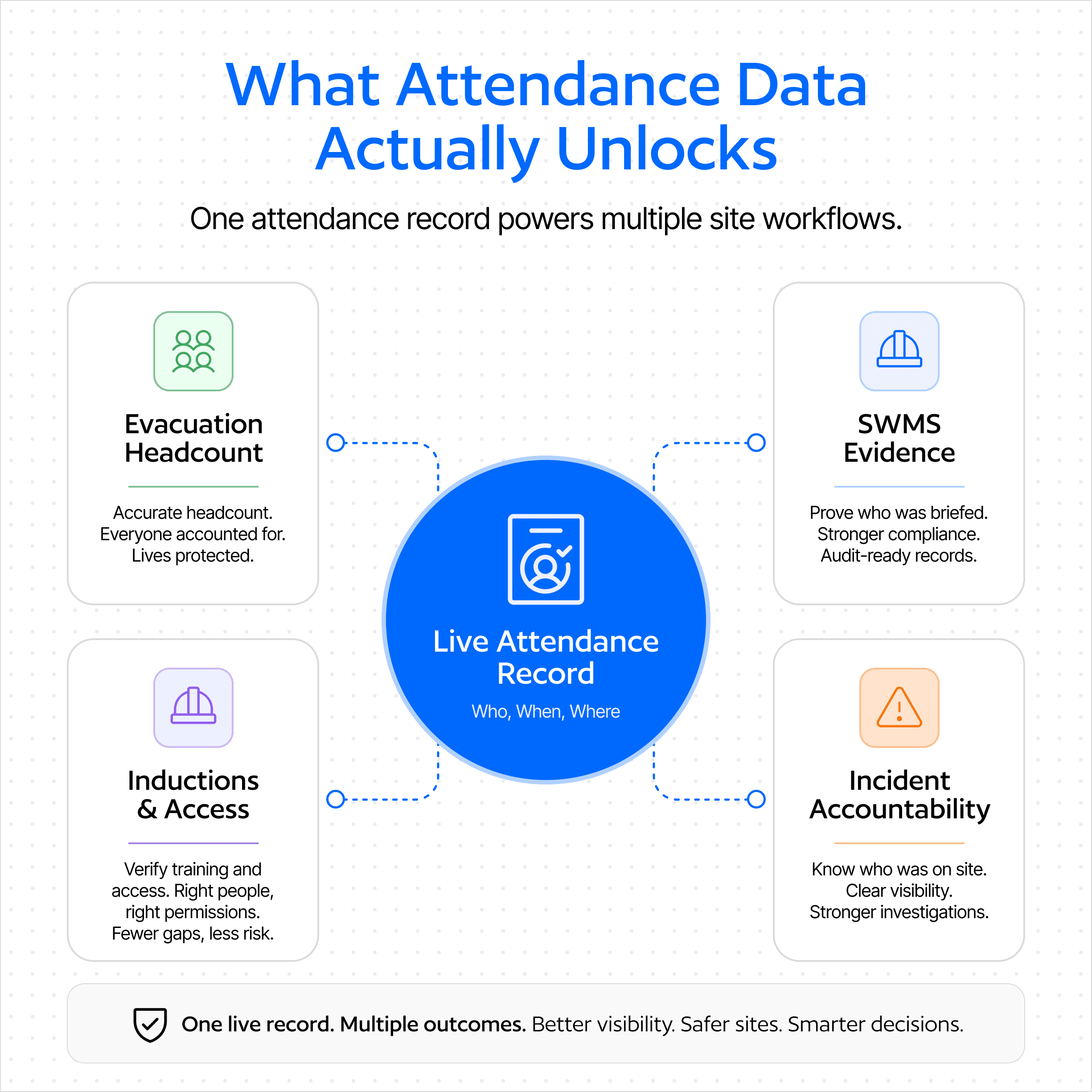
What reliable attendance data actually unlocks
The reason method seven matters is that site attendance is never just attendance. The same record drives four things that decide how exposed a builder is.
Evacuation and emergency response. A live, accurate count at the muster point is the difference between knowing everyone is out and sending people back into an unsafe structure to look for someone who left at smoko.
Inductions and access control. When attendance is tied to worker profiles, the system simply does not let an un-inducted or expired worker through the gate, instead of discovering the lapse after an incident.
SWMS and high-risk work. High-risk construction work requires a safe work method statement, and the workers doing it need to have signed it. Linking the SWMS to the sign-in record turns a paper formality into evidence. Our explainer on what a SWMS is and when you need one covers why that link matters.
Incident accountability. When something goes wrong, an investigation needs a time-stamped record of who was on site, who was inducted, and who signed what. That record is also what a WHS manager relies on to demonstrate the business met its duty, a responsibility we unpack in our piece on the role of WHS managers in construction.
diagraThe Australian context
Australian sites carry a heavier compliance load than most. White card requirements, state-based WHS regulators, principal contractor duties, and the documentation expected after any notifiable incident all assume the builder can produce a clear, current record of who was on site and what they were cleared to do.
8.8 serious claims Construction recorded 8.8 serious workers' compensation claims per million hours worked, among the higher frequency rates of any Australian industry. Safe Work Australia, Key Work Health and Safety Statistics Australia 2024
On a busy commercial build with dozens of subcontractors cycling through, the volume alone defeats a paper process. This is the same coordination challenge that plays out across trades, and it connects directly to how a builder manages its subcontractors day to day, which we explore in our piece on the real cost of subcontractor management failure.
Where Plexa fits
Plexa's Site Management and Safety module treats sign-in as the front door to the whole compliance picture, not a sheet at the gate. It supports all seven approaches, QR codes, kiosk mode, the mobile app, facial recognition, turnstile integration, geofencing with auto sign-out, and PIN, so each site can choose the method that suits its gate and risk profile.
What makes the difference is what sits behind the check-in. Every sign-in is tied to a worker profile that already holds the induction status, signed SWMS, licences, white card expiry, and permits. Workers move through an approval workflow before access is granted, expiring licences trigger reminders, and visitors and non-inducted personnel are captured separately with a full record.
So when the alarm sounds at 10:40 on a Tuesday, the supervisor is not counting heads against a clipboard that was wrong by morning tea. The muster screen shows exactly who signed in, who has already signed out, and who is still unaccounted for, in real time. The headcount is not a guess. It is the one thing on site that everyone can finally trust.
Related Articles


The AI Construction Operating System
One platform, one data model, every project. Built in Australia, for the world.
YOUR DATA, PROTECTED
Hosted on AWS Sydney with Australian data residency.


GET THE MOBILE APP
Platform
Solutions
© 2026 Plexa Pro Pty Ltd. ABN 63 668 433 136