Ask your projects data anything. Get answers in seconds. Plexa MCP Connector is live. See it in action


What Is a SWMS? Safe Work Method Statements, Explained
A SWMS is a Safe Work Method Statement required before high-risk construction work begins. Here is what it covers, when you legally need one, and why a generic template is not enough.
Select Hub
Safety & Quality
It is 6:40am and the formwork crew is ready to start a tilt-up panel lift. The crane is set, the riggers are briefed, and the supervisor is holding a folder. Before anyone touches the panels, he needs the right document in front of the crew, signed, current, and matched to the job actually happening on this slab today. What he is reaching for is a SWMS.
A SWMS, or Safe Work Method Statement, is one of the most common documents on an Australian construction site and one of the most misunderstood. People treat it as paperwork. It is closer to a pre-flight check: a written agreement on how a high-risk task will be done safely, who is exposed, and what stops it going wrong.
What a SWMS is
A SWMS is a document that sets out the high-risk construction work activities being carried out, the hazards those activities create, and the control measures that will be used to manage the risks. It also describes how those controls will be implemented, monitored, and reviewed.
It is required under the Work Health and Safety Regulations, which apply in every state and territory except Victoria, where equivalent rules sit under the OHS Regulations. The legal trigger is specific. A SWMS is mandatory when the work is one of the 18 categories of high-risk construction work defined in the regulations. Not every task on site needs one. The high-risk ones do, and the list is not a matter of opinion.
37 workers were killed in the Australian construction industry in 2024, making it the third most fatal industry in the country. Safe Work Australia, Key Work Health and Safety Statistics 2024
The 18 high-risk construction work activities
A SWMS is legally required before work begins if the task involves any of the following:
a risk of a person falling more than 2 metres
work on a telecommunications tower
demolition of a load-bearing element, or one related to a structure’s physical integrity
disturbing, or likely disturbing, asbestos
structural alteration or repair requiring temporary support to prevent collapse
work in or near a confined space
work in or near a shaft or trench deeper than 1.5 metres, or a tunnel
the use of explosives
work on or near pressurised gas mains or piping
work on or near chemical, fuel, or refrigerant lines
work on or near energised electrical installations or services
work in an area that may have a contaminated or flammable atmosphere
tilt-up or precast concrete
work on or near a road, railway, or other traffic corridor in use
work in an area with movement of powered mobile plant
work in artificial extremes of temperature
work in or near water with a risk of drowning
diving work
If the job touches one of these, the SWMS is not optional, and it must exist before the work starts.
What goes inside one
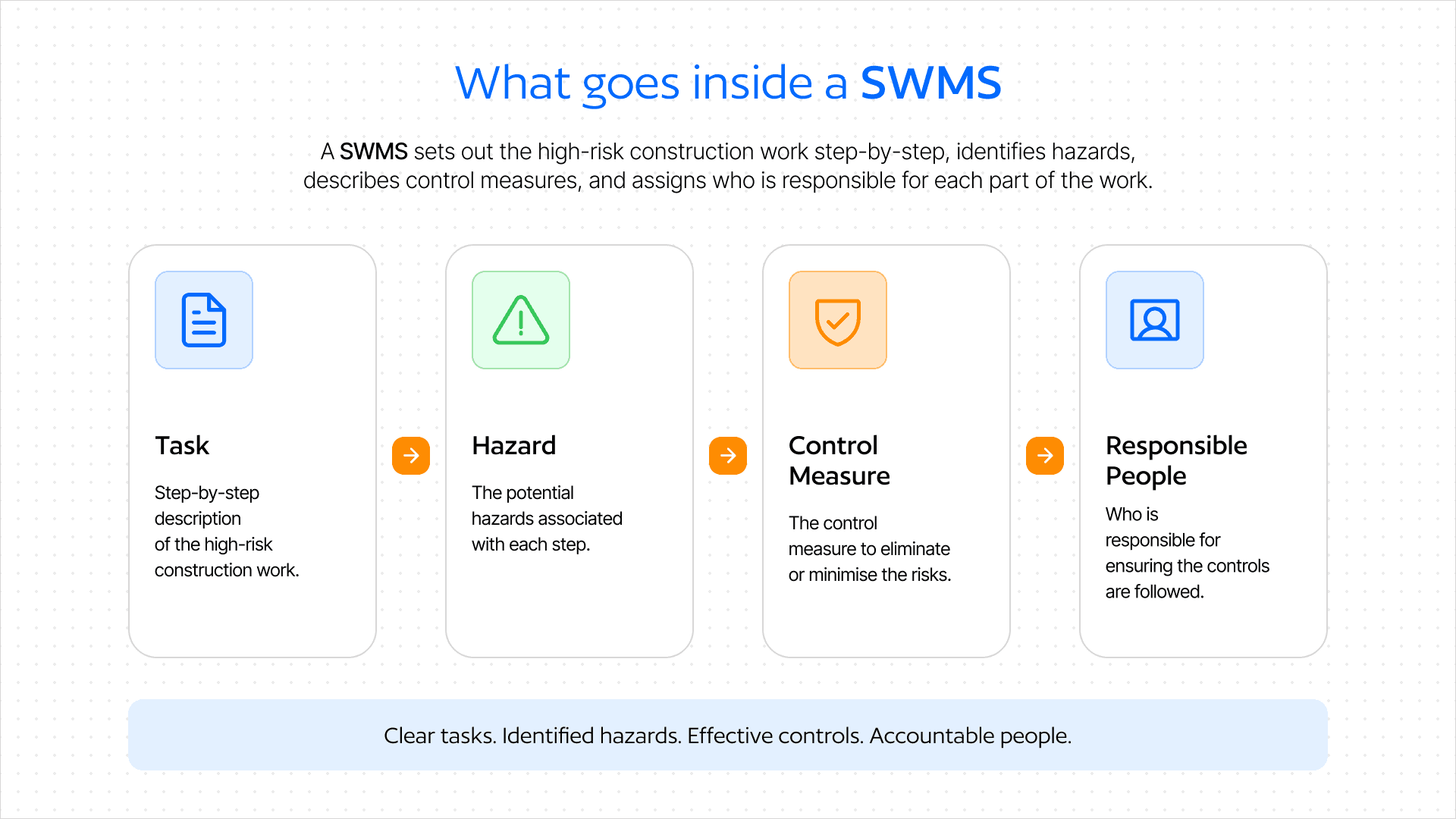
A useful SWMS is short and specific. It names the high-risk activity, breaks it into the steps of the job, lists the hazards at each step, and states the control measures that bring the risk down. It is built on the standard risk assessment logic that runs through all of construction safety, applying the hierarchy of controls so the strongest practical control is chosen, not the easiest one to write down.
The regulator is also clear that it must be readable. A SWMS has to be set out so the people doing the work can actually understand it, including workers who have English as a second language or who have difficulty reading dense text. A statement that no one on the crew can follow does not control anything.
“A generic SWMS used at different workplaces may not meet the requirements of the WHS laws unless it has first been reviewed to take into account the hazards and risks at the specific workplace.”
Safe Work Australia, Safe Work Method Statement information sheet
Why the generic template is the real trap
Here is where most SWMS go wrong, and it is rarely a lack of effort. A subcontractor downloads a template, fills in the company name, and reuses it across every job. It looks complete. It satisfies a folder. It does almost nothing for the crew on the ground.
The villain is not the worker. It is the generic SWMS treated as a tick-box, because the hazards on a trench job in clay next to a live road are not the hazards in the template’s example. Safe Work Australia’s position is direct: a generic SWMS does not meet the law unless it has been reviewed and amended for the specific workplace. The whole point of the document is that it reflects this site, this task, this crew, today.
That gap is also where accountability lives. The person carrying out the high-risk work is best placed to prepare the SWMS, in consultation with the workers who will do the job. Usually that means the subcontractor writes their own, and provides a copy to the principal contractor before they start. When that consultation does not happen, the document drifts from reality, and reality is where people get hurt.
24 workers died from a fall from height in 2024, around 13% of all worker fatalities. Falls are the single most common reason a SWMS is legally required. Safe Work Australia, Key Work Health and Safety Statistics 2024
A SWMS is a live document, not a one-off
The most missed requirement is what happens after the SWMS is signed. The PCBU has to put arrangements in place to make sure the work is actually being done the way the SWMS describes, through site checks and supervision.
If the work is not being carried out in line with the SWMS, the high-risk work must stop immediately, or as soon as it is safe to do so. It cannot resume until the work complies again, or the SWMS is reviewed and, if needed, revised. The same applies when the method changes, a new hazard appears, or an incident happens. The document is meant to move with the job, not sit in a folder from the day the contract was signed.
Before work starts A SWMS must be prepared, consulted on, and provided to the principal contractor before high-risk construction work begins, not written up afterwards to fill a file. Work Health and Safety Regulations, reg 299
What good SWMS management looks like
A SWMS does its job when it is current, specific, signed by the right people, and checked against the work in progress. On a well-run site, that is not a heroic effort. It is a system.
Each high-risk task has a SWMS that names this site, not a template’s example
The crew doing the work helped build it, and has signed onto the current version
The principal contractor holds a copy before work starts
Supervisors can confirm at a glance who is signed onto what
A method change, new hazard, or incident triggers a review, not a reprint
Expired inductions and licences are caught before a worker reaches a high-risk task
The Australian context
Construction remains one of the most dangerous industries in the country. With 37 worker deaths in 2024 and falls from height the leading cause requiring a SWMS, the document is not bureaucratic overhead. It is the written control between a crew and the work most likely to kill them.
The pressure is real too. Sites run on thin margins and tight programmes, and safety paperwork is easy to treat as a cost rather than a control. That is exactly why the system around the SWMS matters as much as the document itself. The same discipline shows up across the wider HSEQ picture and in the work of the WHS managers who carry it.
Where Plexa fits
The reason SWMS compliance slips is rarely intent. It is fragmentation: SWMS in one folder, sign-ons in an app, inductions in a spreadsheet, permits somewhere else. By the time anyone reconciles them, the high-risk work has already happened.
Plexa’s Site Management and Safety module keeps the whole surface in one place. Each worker record shows induction status, the SWMS they have signed, the permits they hold, and licence expiry, linked to site sign-on across multiple methods. Permit-to-work and high-risk activities route through approval before they start, and observations or incidents trigger review and corrective-action workflows automatically.
That supervisor holding the folder at 6:40am should be able to confirm, in one view, that every person about to lift those panels is signed onto the current SWMS. Not hope so. Know so.
Sources
Safe Work Australia. High risk construction work requiring a SWMS. safeworkaustralia.gov.au/duties-tool/construction/hazards-information/high-risk-construction-work-requiring-swms
Safe Work Australia. Safe Work Method Statement for High Risk Construction Work (information sheet). safeworkaustralia.gov.au
SafeWork NSW. Prepare a safe work method statement. safework.nsw.gov.au
Safe Work Australia. (2024). Key Work Health and Safety Statistics, Australia 2024. safeworkaustralia.gov.au
WorkSafe Victoria. Safe Work Method Statements (SWMS). worksafe.vic.gov.au
Related Articles


The AI Construction Operating System
One platform, one data model, every project. Built in Australia, for the world.
YOUR DATA, PROTECTED
Hosted on AWS Sydney with Australian data residency.


GET THE MOBILE APP
Platform
Solutions
© 2026 Plexa Pro Pty Ltd. ABN 63 668 433 136