Ask your projects data anything. Get answers in seconds. Plexa MCP Connector is live. See it in action

What is a Dilapidation Report? A Builder's Complete Guide
Professional dilapidation reports, built into your construction platform. Fast to complete on site. Branded. Legally defensible. Ready to go.
HSEQ
Site Operations
The call comes in on a Thursday afternoon, six months after practical completion. A neighbour is claiming a crack in their lounge room wall appeared during excavation. They want the builder to pay for repairs.
The builder knows the crack was there before a single machine rolled onto the site. The problem is they cannot prove it. There is no pre-construction condition record for that property, no photographs, no independent sign-off. Just the builder’s word against the neighbour’s.
That is the moment a dilapidation report is designed to prevent.
What is a Dilapidation Report?
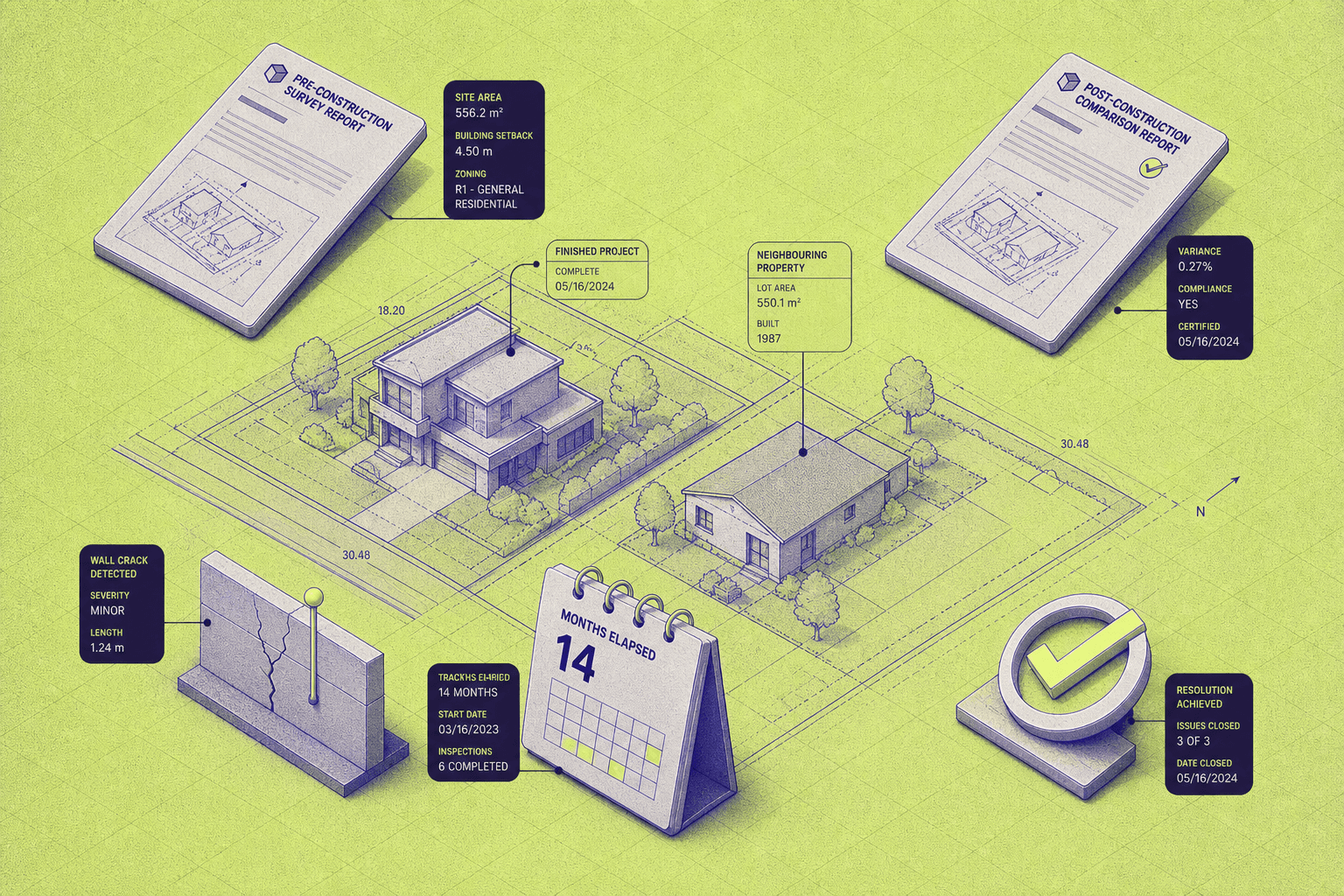
A dilapidation report is an independent, documented record of the condition of a property at a specific point in time. In construction, it is used to establish a baseline of neighbouring properties before works begin, so that any subsequent damage claims can be assessed against documented facts rather than competing recollections.
It is sometimes called a condition report or a pre-construction survey. The terminology varies, but the purpose does not: create a defensible record before the first machine rolls onto site.
For builders and head contractors, a dilapidation report is primarily a liability management tool. It does not prevent damage from occurring. What it does is protect you when a claim is made, by showing exactly what condition the neighbouring property was in before your works began.
When Do Builders Need a Dilapidation Report?
Most commercial, civil, and residential projects involving excavation, piling, demolition, or significant vibration require a pre-construction condition survey of neighbouring properties. In many cases this is not optional. Councils across Australia routinely include dilapidation surveys as a condition of Development Approval (DA) for anything from a residential extension to a major urban infill project.
Beyond council requirements, any project where works could reasonably affect adjoining structures warrants a survey. Common scenarios include:
Residential construction coming close to a boundary, particularly basement excavation or underpinning work beneath an existing slab.
Commercial and mixed-use development in urban environments where adjacent tenancies are occupied and neighbouring owners are alert to any changes in their building.
Civil and infrastructure projects involving road works, pipe-laying, or utility installation across large property portfolios, where surveys may cover dozens of addresses.
Demolition projects, where vibration and wall removal can affect adjoining structures that share boundary walls, common footings, or party walls.
The general rule: if the zone of influence of your works extends to a neighbouring structure, survey it before works commence.
2 to 6 hours is the typical staff time required to compile a single dilapidation report manually, covering inspection, photo management, formatting, and distribution to all parties. Plexa platform data
What Goes Into a Dilapidation Report?
A well-prepared dilapidation report covers both the external and internal condition of each property surveyed. The content varies by project type and proximity, but a thorough survey typically documents the following.
External condition: Cracks in brickwork, render, or concrete. Condition of roofing, gutters, fences, and retaining walls. Driveways, paving, and pathways. Any visible ground movement or settlement at the boundary.
Internal condition: Wall and ceiling cracks. Door and window alignment. Floor levelness. Tile condition in wet areas. Skirting, architrave, and cornice alignment. Sticking doors or windows that indicate differential movement.
Photographic evidence: Timestamped, geotagged photographs of every observation, tagged to their specific location within the property and ordered so the report reads as a coherent record rather than a folder of unrelated images.
Condition ratings: Each defect classified using a standardised system covering crack width categories (hairline under 0.1mm through to wide cracks exceeding 1mm), a structural versus cosmetic distinction applied to each observation, and an overall condition grade for the property.
Inspector sign-off: The completed report is signed by the independent surveyor, with copies distributed to the property owner and the builder or developer.
What separates a legally defensible report from one that will not hold up in dispute is rigour and independence. The survey must be conducted by someone with no interest in the outcome of any future claim.
“The absence of a pre-construction condition record does not just weaken a builder’s position in a dispute. In many cases, it eliminates it entirely. The question moves from ‘was this damage pre-existing?’ to ‘can you prove it was?’”
Housing Industry Association, Construction Risk Management Guidance
Who Pays for a Dilapidation Report?
The builder or developer commissions and pays for the dilapidation survey. This is standard practice across Australian construction contracts and is typically treated as a project preliminary cost alongside other pre-construction obligations.
Some property owners choose to commission their own independent survey for additional assurance. This is their right, and in practice it rarely creates complications. Two independent records of the same property condition provide more evidence, not less.
The cost of a dilapidation survey is modest relative to the cost of a single undefended claim. In Australian residential construction, disputes over alleged construction damage can escalate quickly through council mediation processes and, where they are not resolved, into formal proceedings. A survey that prevents one meritless dispute from proceeding to mediation or litigation returns its cost many times over.
<!-- DATA CALLOUT 2 Type: Typographic stat block Position: After ‘Who Pays’ -->
120 hours potential staff time saved on report compilation for a project with 20 neighbouring properties, when digital dilapidation reporting replaces manual Word-document assembly. Plexa benchmark analysis
The Dilapidation Report Process
Before construction: Surveys are completed after DA approval and before any works commence on site. For projects with a large number of neighbouring properties, surveys are prioritised by proximity to the works and the nature of the activities planned. Access is coordinated with property owners directly, and records of access requests, responses, and agreed inspection dates are documented throughout. If access is refused, that refusal is itself recorded, which carries legal significance when a claim is later made.
During construction: For longer projects or those involving staged excavation or demolition, interim surveys may be conducted between major phases of work. This is particularly relevant for deep excavation or tunnelling projects where the risk profile changes as works progress and new zones of influence emerge.
After construction: A post-construction comparison survey is completed once works are finalised. The post-construction inspection is compared against the pre-construction baseline to identify any changes. Where new damage is identified, the documentation supports a clear and objective conversation about responsibility, grounded in the original record rather than memory.
52% of construction rework and disputes trace back to poor documentation and miscommunication, both of which structured pre-construction surveys directly address. PlanRadar QA/QC Impact Report, 2025
Why Digital Dilapidation Reporting Matters
The typical manual process for dilapidation reports creates <strong>evidence fragmentation</strong> at exactly the moment evidence quality matters most. Photos taken on a phone get emailed to the office days after the inspection. Someone reassembles them into a Word document, matching images to observations from memory. The report is printed, signed, scanned, and filed in a folder that nobody can locate three months later when a neighbour makes a claim.
On a project with 20 neighbouring properties, the manual process across inspection, photo management, report assembly, and distribution runs to as much as 120 hours of staff time. The output is a set of documents stored inconsistently, with no searchable record and no audit trail of when reports were issued or acknowledged.
Digital dilapidation reporting, built into the construction platform your team already uses, addresses this at every stage. Photos are captured on site with automatic geotags and timestamps, attached directly to the observation they document. Report generation is automated from the inspection data. Completed reports are stored against the project record and retrievable in seconds. When a claim arrives months later, the evidence is there, intact, and ordered.
This is the same shift that has happened with Inspection and Test Plans and Inspection Test Checklists across the quality management function: paper-based, ad hoc processes replaced by structured, digital ones that are faster to complete and more defensible when it counts.
Where Plexa Fits
Dilapidation reports sit inside the broader HSEQ framework that governs how builders manage risk before, during, and after construction. The documentation obligations are real, the liability exposure is real, and the process for managing both has historically been slow and inconsistent.
Plexa’s dilapidation report capability is built into the same platform construction teams use for document control, task management, site safety, and project correspondence. Surveys are conducted on mobile. Reports are generated automatically from captured inspection data, branded to the company, and distributed to property owners with digital acknowledgement and read receipts. Completed reports are stored against the project record alongside drawings, ITPs, and RFIs.
For head contractors managing multiple active projects, Plexa provides portfolio-level visibility of dilapidation survey completion status across all sites, making it straightforward to confirm that pre-construction surveys are in place before works commence.
The builder who received that Thursday afternoon call? With Plexa, they open the project record, pull up the pre-construction survey for that property, and show the neighbour the timestamped photograph of the crack that was already there before excavation began. Conversation over.
Frequently Asked Questions
What is a dilapidation report? A dilapidation report is an independent, documented record of a property’s condition before nearby construction works begin. It establishes a baseline against which any subsequent damage claims can be assessed objectively.
When is a dilapidation report required in Australia? In many Australian jurisdictions, dilapidation surveys are required as a condition of Development Approval for projects involving excavation, demolition, piling, or works close to existing structures. Even where not mandated, they are strongly recommended as standard risk management practice.
Who pays for a dilapidation report? The builder or developer commissions and pays for the survey. It is treated as a project preliminary cost. Property owners may also commission their own independent surveys separately.
What is the difference between a dilapidation report and a building inspection? A building inspection identifies defects for the purpose of a property transaction. A dilapidation report documents existing conditions before nearby construction begins, for the purpose of protecting both parties if a damage claim arises later. The two are not interchangeable.
Can a dilapidation report be used as legal evidence? Yes. A properly prepared report with geotagged, timestamped photographic evidence, standardised condition ratings, and independent sign-off is legally defensible documentation in Australian mediation and dispute processes.
What happens if access to a neighbouring property is refused? Refused access is itself documented and recorded. In Australian construction practice, a documented record of an access request and refusal provides meaningful protection for the builder, since it demonstrates that a reasonable attempt to conduct the survey was made.
For more on the risk management framework that dilapidation reports sit within, read our guide to What HSEQ Actually Means on a Construction Site. If you are looking at how inspection documentation works across the construction phase more broadly, our post on Inspection and Test Plans and Checklists covers that in depth.
See how Plexa manages dilapidation reports on live projects. Book a demo.
Sources
Housing Industry Association. Contracts and Risk Management Guidance. hia.com.au/resources/business/contracts
NSW Planning Portal. Development Applications and Conditions of Consent. planningportal.nsw.gov.au
PlanRadar. (2025). Cost of Rework in Construction: Causes, Data and Prevention. planradar.com/us/cost-of-rework-construction/
Construction Industry Institute. Risk Management in Construction. construction-institute.org
Australian Institute of Quantity Surveyors. Construction Cost Data. aiqs.com.au
Related Articles

The AI Construction Operating System
One platform, one data model, every project. Built in Australia, for the world.
YOUR DATA, PROTECTED
Hosted on AWS Sydney with Australian data residency.


GET THE MOBILE APP
Platform
Solutions
© 2026 Plexa Pro Pty Ltd. ABN 63 668 433 136