Ask your projects data anything. Get answers in seconds. Plexa MCP Connector is live. See it in action


Why Construction Invoices Take Six Weeks to Approve
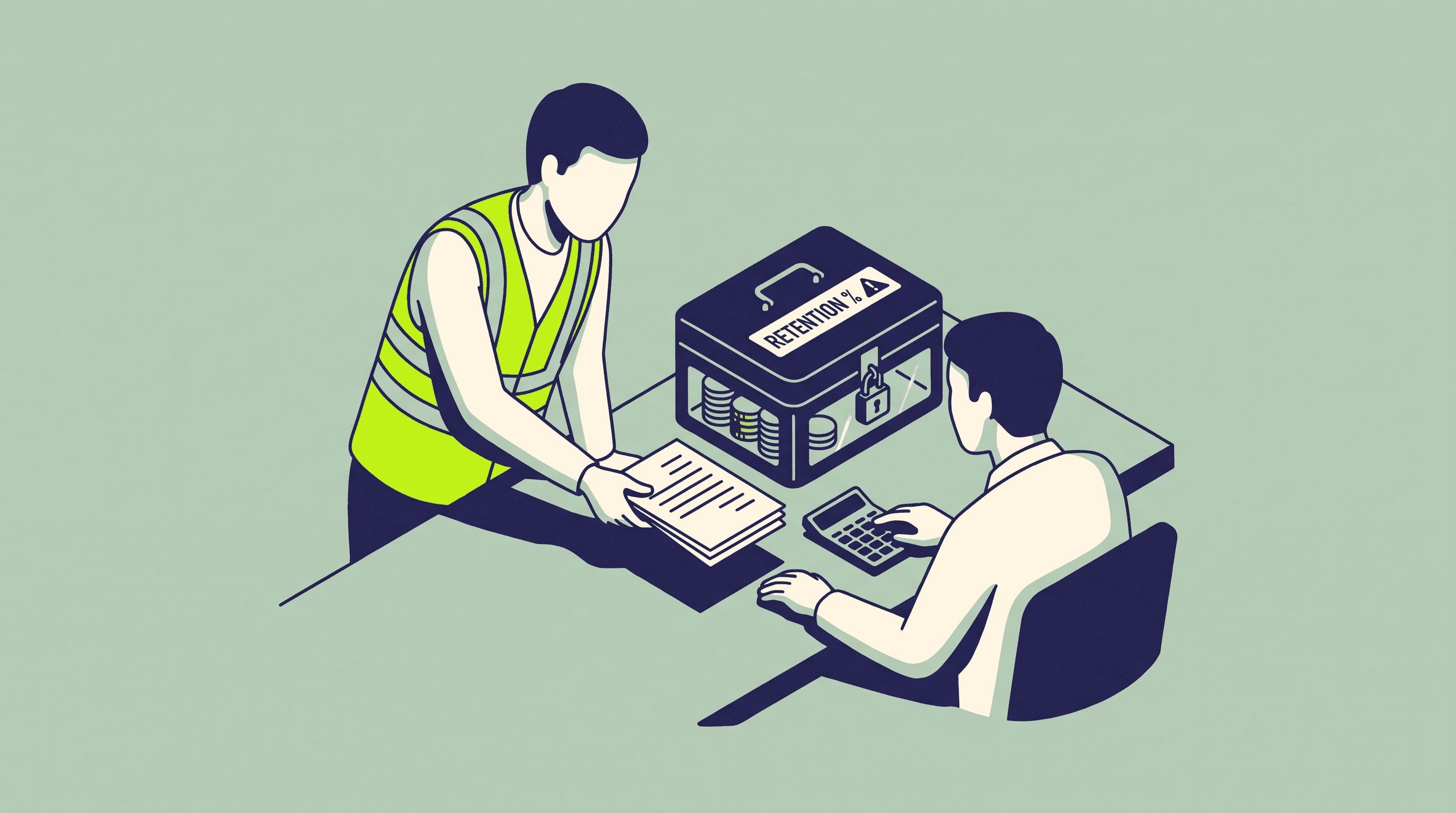
A subcontractor invoice enters a manual approval chain, paper, email, mismatched cost codes, and does not resurface for six weeks. That gap strains subcontractor relationships and hides true committed cost from the budget.
It is 4:15pm on a Thursday and the contracts administrator has fourteen subcontractor invoices spread across two inboxes and one physical tray. Three arrived as photographed paper dockets. Two are PDFs a supplier sent twice because “the first one probably went to spam.” Four list a cost code that does not match anything in the current budget. The formworker who submitted claim seven three weeks ago has called twice asking when he will get paid, and the honest answer is nobody knows, because nobody has finished checking it yet. This is construction accounts payable on a live project: not a finance function, a queue that grows faster than anyone can clear it.
It is not a rare Thursday. It is how invoice approval works on most Australian construction projects that still run this process by hand, and it is why a claim that should take days routinely takes six weeks.
What six weeks actually means
The Building and Construction Industry Security of Payment Act sets a legislated backstop for exactly this scenario. Under the NSW Government’s guidance on making a payment claim, a respondent has a maximum of 10 business days to issue a payment schedule once a claim is served, and the default due date for a subcontractor’s claim on non-residential work is 20 business days after the claim is made, unless the contract sets an earlier date.[1] Twenty business days is four calendar weeks. That is the outer limit the Act assumes for a claim moving through one clean approval step: received, assessed, scheduled.
On a live project the same claim moves through five steps, not one. It arrives in an inbox, gets printed or forwarded, is manually keyed against the budget, gets kicked back for a cost code that does not reconcile, and finally reaches the person with authority to approve it. Add a week for the resubmission cycle and the four-week statutory maximum quietly becomes six. By the time anyone notices, the clock the Act relies on has already lapsed.
7.15%
Share of Australian construction industry invoices more than 60 days overdue, the highest level recorded in six years.
CreditorWatch, 2026[2]
Why construction accounts payable stalls in the approval chain
The villain here is not the contracts administrator working through the tray, and it is not the subcontractor chasing a call back. It is a chain with no single owner and no shared record. A paper docket, a PDF, and an emailed approval all describe the same claim, but none of them talk to the budget, the cost code register, or each other.
Mismatched cost codes are the most common failure point. A subcontractor invoices against a trade package description that made sense on their own job costing sheet, and it does not map cleanly to the builder’s cost code structure. That single mismatch is enough to bounce the claim back out of the queue, and it usually happens after the invoice has already sat unread for several days.
The relationship cost compounds quietly. Payapps’ 2026 survey of 754 subcontractors across Australia and New Zealand found 57% had increased rates or added a risk margin specifically because of slow or unreliable payment, and 77% said a builder’s payment reputation shapes whether they bid on future work at all.[3] A slow approval chain is not neutral. It is priced into the next tender before the builder ever sees it.
“It is not uncommon for subcontractors to wait 60-90 days for payments, all in an environment where staff wages, supplier accounts and general overheads all need to be paid.”
Worrells, Insolvency in the Construction Sector, 2025[4]
The cost of a six-week queue
A manual approval chain does not just delay payment. It hides the truth about what the project has actually spent. Every invoice sitting unprocessed in a tray or an inbox is a real, committed cost the budget does not yet reflect. A cost-to-complete forecast built on approved invoices alone, while six weeks of claims sit unprocessed, is not a forecast. It is a snapshot of last month.
Ardent Partners’ research, cited in Ramp’s analysis of invoice processing benchmarks, found teams running manual accounts payable take an average of 17 days to process and approve a single invoice, against roughly 3 days for teams running automated workflows.[5] The same research puts the fully loaded cost of a manually processed invoice at $12.88, compared with $2.78 once the process is automated. Multiply either figure by the invoice volume on a $30M commercial build and the queue itself becomes a line item nobody budgeted for.
27%
Share of all company insolvencies reported by ASIC in 2024 that came from the construction sector, with construction-related insolvencies rising a further 24% in the first three quarters of FY2025.
Worrells, 2025, citing ASIC data[4]
What good accounts payable looks like on a live project
The builders who have solved this do not have bigger finance teams. They have removed the steps that cause the delay. Invoices arrive in one place instead of three. Line items, vendor details, and cost codes are read off the document automatically instead of typed in by hand. A claim that matches the budget is routed for approval the same day it lands, not the same week.
AP automation construction workflows built this way change what a contracts administrator’s afternoon actually looks like. Instead of reconciling a stack of documents against a spreadsheet, they are reviewing a short list of claims the system has already matched to a cost code and a commitment. Subcontractor invoice approval stops being a queue that grows and starts being a task that clears.
The outcomes look like this in practice:
Invoices are captured and coded the day they arrive, not the week someone gets to them
Cost code mismatches are flagged automatically, before the claim enters a human queue
Approvers see the invoice against the live budget and commitment, not a static spreadsheet
Progress claim approval status is visible to every project stakeholder, not just the person holding the file
Committed cost updates in real time, so the cost-to-complete forecast reflects what has actually been spent
Subcontractors get a clear, trackable approval status instead of a phone call that goes to voicemail
Payment runs land inside the statutory window, not two weeks past it
The Australian context
Every state and territory now runs a version of the Security of Payment Act, and the timeframes it sets, 10 business days to respond, 20 business days to pay a subcontractor’s claim, are not guidance. They are the legislated minimum a builder is exposed against if a claim goes unpaid and moves to adjudication. A process that structurally runs past those windows is not an efficiency problem. It is a legal exposure sitting inside the finance function.
That exposure is landing at a difficult moment for margin. Hubexo’s Australia Construction Outlook 2026 points to labour as the tightest constraint builders face heading into 2026, alongside persistent pressure from inflation, financing costs, and rising supply costs on project feasibility.[6] A subcontractor market already pricing in payment risk, per Payapps’ findings, is not a market a builder wants to be slow with.
Where Plexa fits
Plexa’s AI-Powered Accounts Payable feature, part of the Finance & Cost Control module, is built to close exactly this gap. Every invoice and claim is captured in one central location, whether it arrives by email or upload, with no manual re-keying required. AI extracts the line items, vendor details, project codes, and values directly from the document, matching them against the live budget and commitment automatically.
Claims that reconcile cleanly are approved immediately. Anything that does not gets forwarded to the right person on the project team, with the mismatch already flagged rather than discovered three days later. Every approval, rejection, and outstanding assessment sits in a single log, visible across every project and entity, so a payment limit set at the role level is enforced automatically instead of relying on memory.
Return to that Thursday afternoon. The fourteen invoices never sit in a tray, because they never needed a tray. Ten reconciled against the budget on arrival and were approved before lunch. Four flagged a cost code mismatch the moment they landed, routed straight to the estimator who set up the code, resolved by Friday morning. The formworker gets a status update instead of a guess, and the true committed cost on the project is what the dashboard says it is, not what the tray eventually reveals.
Related reading
The invoice queue is one symptom of a wider finance and contracts problem. We cover the fuller picture in Plexa’s guide to construction finance and contracts administration. Hidden committed cost is one of the quiet ways margin erodes before anyone notices, a pattern we unpack in why construction profit margins are tighter than they should be. Because a slow approval chain is ultimately a subcontractor relationship problem wearing a finance costume, it connects directly to the real cost of subcontractor management failure.
If you want to see how AI-powered accounts payable clears a claim queue on a live project, book a 30-minute demo with the Plexa team.
Sources
1. NSW Government, Building Commission NSW. Making a payment claim under Security of Payment laws. nsw.gov.au. https://www.nsw.gov.au/housing-and-construction/compliance-and-regulation/security-of-payment/making-a-payment-claim
2. CreditorWatch. (2026). Late Payments Hit Six-Year High in Australia. creditorwatch.com.au. https://creditorwatch.com.au/blog/late-payments-hit-six-year-high-in-australia
3. Payapps. (2026). More than half of subcontractors add a risk margin for slow payments, as Payapps launches Early Payment feature. PR Newswire. https://www.prnewswire.com/apac/news-releases/more-than-half-of-subcontractors-add-a-risk-margin-for-slow-payments-as-payapps-launches-early-payment-feature-302737761.html
4. Worrells. (2025). Insolvency in the Construction Sector: Financial Red Flags and Risk Mitigation for Accountants. worrells.net.au. https://worrells.net.au/resources/news/insolvency-in-the-construction-sector-financial-red-flags-and-risk-mitigation-for-accountants
5. Ramp. (2026). How Long Does an Invoice Take to Process? ramp.com, citing Ardent Partners research. https://ramp.com/blog/accounts-payable/reduce-invoice-processing-time
6. Hubexo Asia Pacific. (2025). Australia’s Construction Outlook 2026. apac.hubexo.com. https://apac.hubexo.com/press-release/australia-construction-outlook-for-2026/
Related Articles



The AI Construction Operating System
One platform, one data model, every project. Built in Australia, for the world.
YOUR DATA, PROTECTED
Hosted on AWS Sydney with Australian data residency.


GET THE MOBILE APP
Platform
Solutions
© 2026 Plexa Pro Pty Ltd. ABN 63 668 433 136