Ask your projects data anything. Get answers in seconds. Plexa MCP Connector is live. See it in action


What Does an HSEQ Manager Actually Do? Inside the Role on a Construction Site
The job description says monitor compliance and support a strong safety culture. The job is being everywhere at once, all week, with records that live in six different places. Here is what the role actually looks like.
It is Friday afternoon at 3pm. The HSEQ Manager has walked the site twice, signed off three permits, chased six expired inductions, closed out two corrective actions from last week's toolbox talk, and still has not started the weekly safety report her operations manager asked for on Monday. The job description said "monitor compliance and support a strong safety culture." The job is being everywhere at once.
She is not behind because she is disorganised. She is behind because the induction records are in one app, the permit register is in a shared drive, the corrective actions are in a spreadsheet, and the SDS library is in an email folder nobody fully owns. Six tools, one person, no connection between them.
That is the real job of an HSEQ Manager on an Australian construction site.
What an HSEQ Manager is actually responsible for
HSEQ stands for Health, Safety, Environment and Quality. For a full breakdown of the acronym, see What HSEQ Actually Means on a Construction Site. What matters here is what each pillar looks like when someone owns it on an active build.
Health covers fatigue management, heat exposure protocols, silica dust monitoring, mental health, and fitness-for-work assessments. It is the ongoing record that proves the employer took reasonable steps.
Safety is the largest part of the role by volume. Inductions, permits to work, Safe Work Method Statements (SWMS) review and approval, toolbox talks, site walks, hazard reporting, and incident investigation all fall here. Under the Work Health and Safety Act 2011, the principal contractor holds Person Conducting a Business or Undertaking (PCBU) duties across all subcontractors on site. The HSEQ Manager is the person who makes the evidence exist.
Under the Act, company officers hold personal liability for due diligence, a point covered in the WHS and WSE Officers guide. A lapsed induction or an unsigned SWMS is not a paperwork problem. It is a legal exposure.
Environment covers waste management, spill prevention, EPA obligations, erosion controls, and noise and water quality monitoring. On a build near a waterway, compliance records are required before, during and after each pour, not just at the final EPA inspection.
Quality covers Inspection and Test Plans (ITPs), Inspection and Test Checklists (ITCs), non-conformance reports, defect close-out, and materials traceability. The HSEQ Manager sits at the centre of the evidence chain that quality depends on.
37 construction workers were killed in Australia in 2024, representing 20% of all workplace fatalities nationally. Safe Work Australia, Work-related Traumatic Injury Fatalities 2025 [1]
A real week in the role
The week starts on Monday with a 7am pre-start meeting and toolbox talk on working-at-heights risks for the week ahead. During the site walk that follows, the HSEQ Manager finds that three workers from the new scaffolding subcontractor arrived on Friday with no induction on file. Scaffold work goes on hold until the inductions are completed and recorded.
Tuesday brings the electrical subcontractor's SWMS for the new switchboard installation. It does not correctly cover the isolation procedure, so it goes back with specific comments. Before lunch, a call comes in about a chemical spill in the laydown area. The HSEQ Manager inspects, contains, completes the environmental incident report, notifies the site manager, and updates the hazard register: four records across three systems.
On Wednesday, five new workers from two different trades need site inductions. After the inductions are done, the HSEQ Manager inspects the slab pour completed the day before against the ITP hold points. The curing compound was not applied within the specified window, so a non-conformance report (NCR) is raised and the superintendent is notified. One corrective action from two weeks ago is still open: the civil subcontractor needs a follow-up call. For more on how corrective actions work, see Corrective Action Plans in Construction.
Thursday is data day. The HSEQ Manager pulls the week's leading indicators: three near-miss reports filed, 14 observations across six site walks, seven of nine open corrective actions closed on time. That data needs to be compiled for the Friday report. The SDS for a new sealant product arriving next week supersedes the current library version: the record is updated, and the affected trades are notified.
Friday is when everything that has not been connected all week needs to become a report. The weekly safety report takes three hours because the data lives in four different places. The site close-out inspection surfaces a non-conformance on edge protection from the formwork subcontractor. Two insurance renewal chasers from earlier in the week are still sitting in the inbox, unanswered.
The three things that quietly eat the role
The first is chasing expiring credentials. Across 30 active subcontractor trades, something lapses on almost every project. The check happened at onboarding and nobody reviewed it since. A public liability policy that lapses mid-project creates exposure from the day it expires. The HSEQ Manager ends up running a manual calendar of dates that should be an automated alert.
The second is reconciling disconnected systems. The sign-on app, safety platform, shared drive, email threads, and spreadsheets each hold part of the picture. Connecting them for an audit, a report, or an incident investigation takes days. The WHS Manager role faces the same structural problem, explored in the WHS Managers in Construction blog.
The third is rebuilding evidence packs at audit time. Permits, inductions, incident reports, corrective actions, and training logs all sit in different locations and require separate exports. What should take half a day takes a week.
Organisations that track proactive leading safety indicators achieve an average 77% reduction in incidents compared to those relying only on lagging data. Voxel AI, Safety Performance Data Report [3]
What a good HSEQ Manager actually moves the needle on
The industry conversation about safety performance has shifted from lagging indicators (incident counts, lost-time injury frequency rates) to leading indicators: near-miss reports, induction currency, observation rates, and corrective action close-out speed. Industry guidance recommends an 80% leading, 20% lagging weighting. Most teams invert this because lagging data is what their tools make easy to produce.
The coaching role is where a skilled HSEQ Manager has the most impact. Walking the site, engaging with trades, raising observations before they become incidents: this is the first thing that disappears when administration grows.
The PDCA loop (Plan, Do, Check, Act) at the heart of ISO 45001 [2] needs connected data to run on. When records are fragmented, the loop runs on a spreadsheet rebuilt for the next steering committee. The improvement is theoretical. The hazards are real.
"The HSEQ Manager's role changes most visibly when the system does the chasing. Time on site goes up. Time at a keyboard goes down. Leading indicator scores improve, and the incident rate follows."
What changes when the systems do the chasing
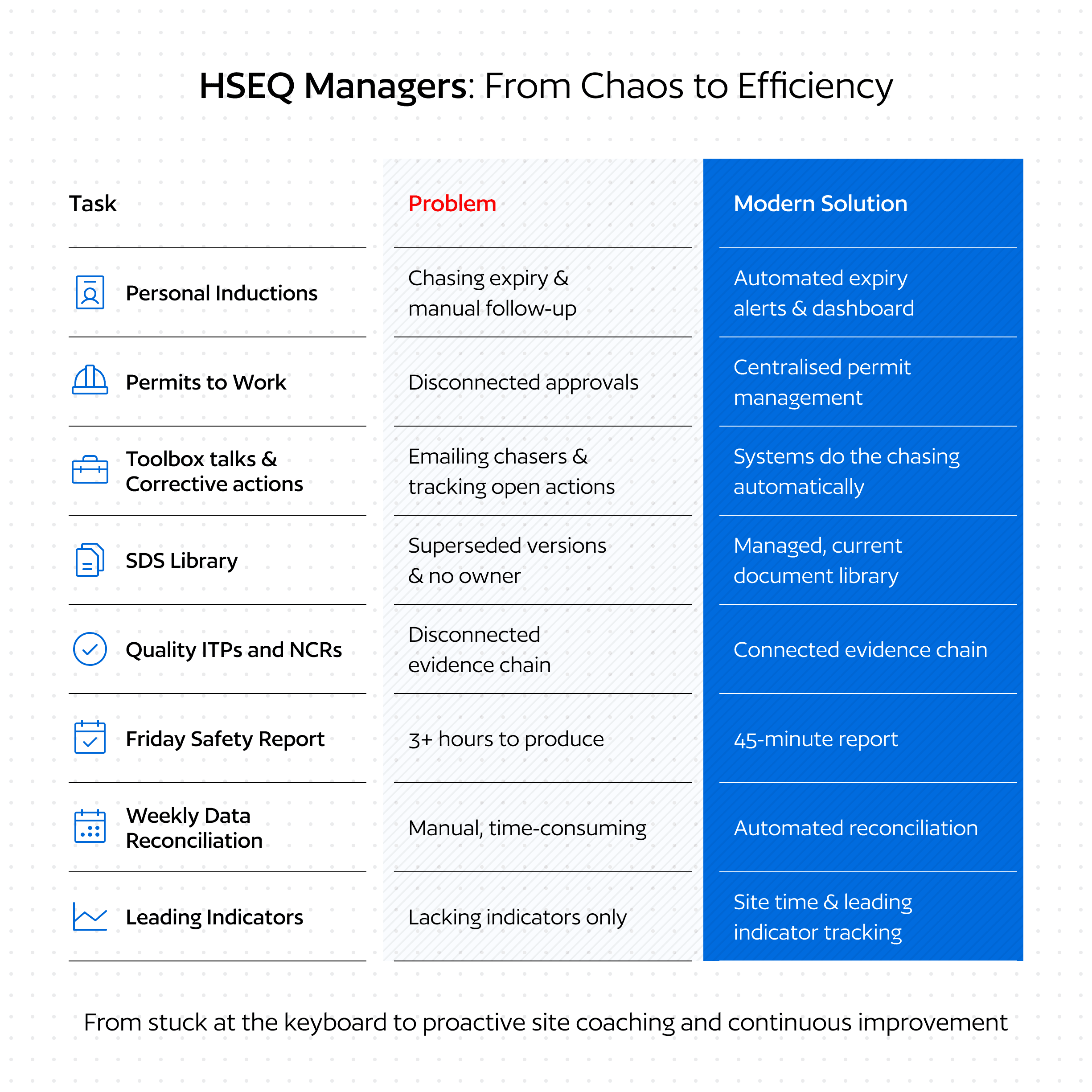
When induction expiry alerts fire automatically, the HSEQ Manager stops being the tracking system. When SDS supersession is tracked in-platform, version questions stop being a Thursday afternoon task. When corrective actions live on a dashboard, open items are visible without an email chase. When the audit pack assembles from records already in the system, the audit becomes a review, not a reconstruction.
The week changes shape. Monday through Thursday has more site time, more observations raised, more coaching conversations. The Friday safety report takes 45 minutes instead of three hours. That shift is not about working harder. It is about the system doing the work the HSEQ Manager should never have been doing.
Where Plexa fits
Plexa's Site Management and Safety module brings the full HSEQ workflow into one place. Personnel Inductions and Access Control handles inductions with automatic expiry alerts, so lapsed credentials flag on Monday morning, not Friday afternoon. Observations and Corrective Actions gives a live dashboard across all active projects. Permit to Work routes approvals through a configurable workflow, with sign-off tracked in the system.
Meetings and Inspections covers Toolbox Talks, Pre-Start meetings, and Site Safety Inspections, all templated. Incident and Injury Reporting triggers investigation and close-out workflows automatically. The Site Diary means most of the weekly report is already written before Friday arrives.
Back to Friday afternoon. The report is mostly done. The corrective actions updated automatically as they were closed. The scaffolding inductions flagged on Monday morning, before anyone touched a scaffold. She has been on site for three hours today. That is what the role is supposed to look like.
For a deeper look at what HSEQ covers as a discipline, start with What HSEQ Actually Means on a Construction Site.
See how Plexa gives HSEQ Managers their week back. Book a demo.
Sources
Safe Work Australia. (2025). Work-related Traumatic Injury Fatalities Australia 2024. safeworkaustralia.gov.au
International Organization for Standardization. ISO 45001: Occupational Health and Safety Management Systems. iso.org
Voxel AI. Safety Performance Data Report. voxelai.com
BSI Group. Integrated Management Systems: Combining ISO 9001, ISO 14001 and ISO 45001. bsigroup.com
Safe Work Australia. Code of Practice: Safe Work Method Statements. safeworkaustralia.gov.au
Related Articles


The AI Construction Operating System
One platform, one data model, every project. Built in Australia, for the world.
YOUR DATA, PROTECTED
Hosted on AWS Sydney with Australian data residency.


GET THE MOBILE APP
Platform
Solutions
© 2026 Plexa Pro Pty Ltd. ABN 63 668 433 136