Ask your projects data anything. Get answers in seconds. Plexa MCP Connector is live. See it in action


HSEQ, HSE, QHSE, HSSE: What Each Acronym Means in Construction
Four acronyms. One underlying set of records. Here is what HSEQ, HSE, QHSE, and HSSE each mean, why the letters differ, and which one your Australian construction project actually needs.
Two RFTs land on the same desk in the same week. The first asks for "HSEQ documentation." The second asks for "QHSE compliance evidence." Same building type, same risk profile, same trades scheduled on site. A project coordinator spends most of Thursday afternoon working out whether the two clients are asking for different things, or the same thing rearranged into different letters.
The answer is the same underlying records. Nobody told her that. That lost Thursday is the cost of a labelling problem that has persisted across the industry for two decades, and it creates genuine compliance uncertainty when submission deadlines do not move.
This post explains what HSEQ, HSE, QHSE, and HSSE each mean, why the letters vary by sector and region, and which acronym applies to Australian construction tendering and regulatory compliance.
Why there are four different acronyms for the same discipline
The acronym started with two letters. HSE is shorthand borrowed directly from the UK Health and Safety Executive, the British regulator that shaped construction safety practice across English-speaking markets from the 1970s onward. In Australian and international construction, HSE became the common shorthand for the combined discipline long before the letters formally expanded.
Two things changed the label. ISO quality management (ISO 9001) and environmental management (ISO 14001) matured as structured disciplines alongside occupational health and safety, so as contractors integrated all three into one management system, the Q and E joined the initialism. Different sectors then adopted the expanded acronym in different letter orders based on their own operational priorities.
Australian construction landed on HSEQ. Manufacturing and oil and gas prefer QHSE, with Quality leading because product conformance is the primary driver. Resources, mining, and remote infrastructure often specify HSSE, adding Security as a fourth pillar to address access control and threat management on remote sites.
The core insight is straightforward: the acronym changes, the underlying evidence does not. For more on what that evidence set actually covers, see What HSEQ Actually Means on a Construction Site.
The four acronyms, side by side
Each acronym is a reordering or extension of the same core pillars. The table below shows what each stands for, what is added relative to the HSE baseline, and where each is most commonly used.
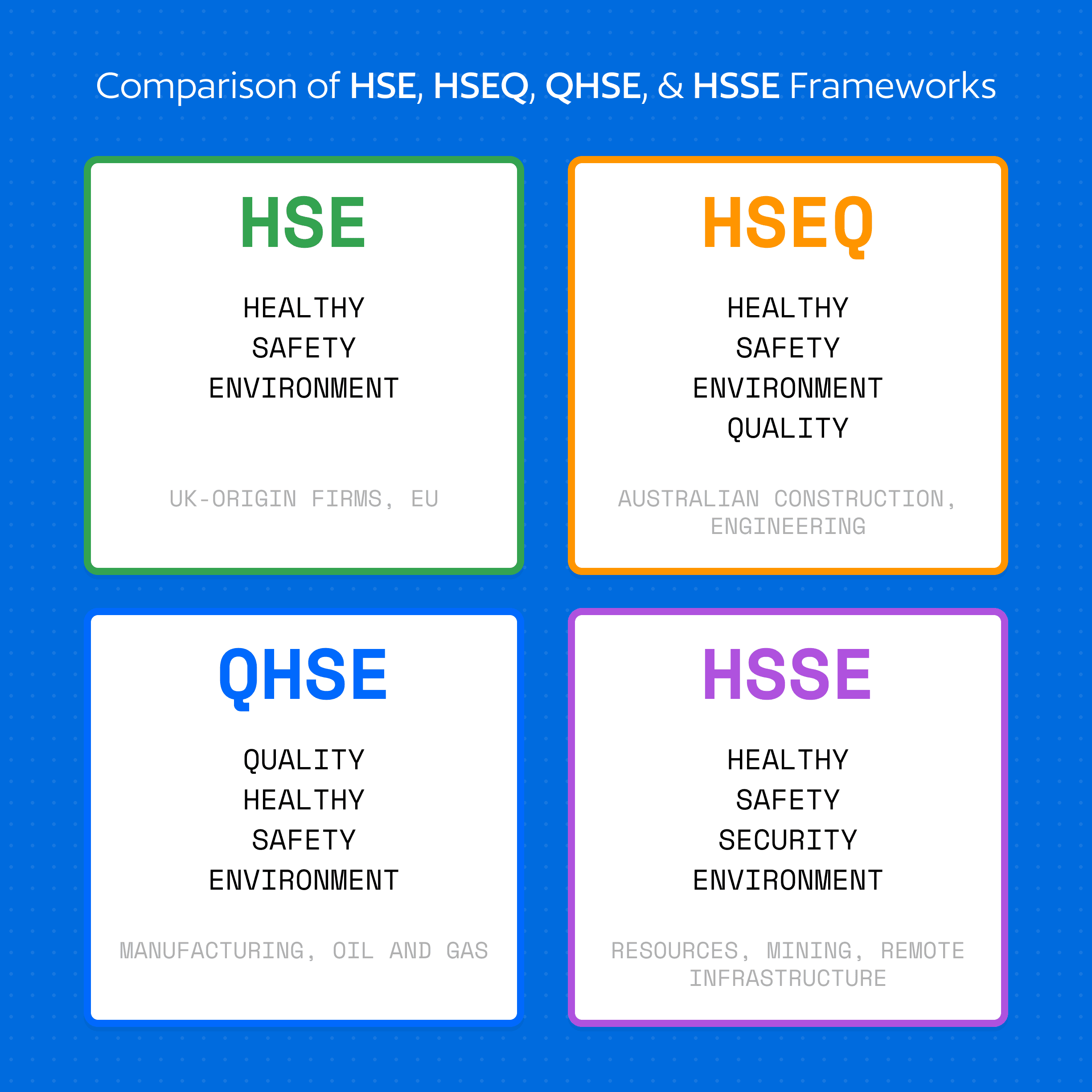
Acronym | Full name | Added vs HSE | Common in |
|---|---|---|---|
HSE | Health, Safety, Environment | Baseline | UK-origin firms, EU |
HSEQ | Health, Safety, Environment, Quality | + Quality (ISO 9001) | Australian construction, engineering |
QHSE | Quality, Health, Safety, Environment | Same letters, Quality leads | Manufacturing, oil and gas |
HSSE | Health, Safety, Security, Environment | + Security | Resources, mining, remote infrastructure |
The letter order reflects organisational priority, not a different set of obligations. QHSE leads with Quality because manufacturing runs on product conformance: a defective batch is the primary risk event. HSEQ leads with Health because on a construction site, the person comes before the product. The records required under both frameworks are the same. The reporting lens is different.
Which acronym Australian construction uses and why
HSEQ is the dominant framework in Australian builder tenders, head contracts, and government prequalification schemes. When a state government procurement team or a Tier 1 head contractor specifies a compliance framework, they are almost always referring to HSEQ aligned with three international standards: ISO 45001 for occupational health and safety, ISO 14001 for environmental management, and ISO 9001 for quality management.
The regulatory backbone for the H and S pillars comes from the Work Health and Safety Act 2011 and the associated Safe Work Australia codes of practice. One element that distinguishes the Australian construction context from the global generic frameworks is the Safe Work Method Statement. Under the WHS Regulations, a SWMS is a legal requirement for all high-risk construction work. Managing SWMS sits squarely inside HSEQ on Australian sites. Internationally standardised frameworks do not carry this obligation in the same form.
For the roles responsible for HSEQ on site, see Construction WHS and WSE Officers: What Is the Difference? and The Role and Responsibilities of WHS Managers in Construction.
The tender implication is direct. For government and Tier 1 head contractor work in Australia, ISO 9001, 14001, and 45001 certification is a hard prequalification requirement, not a differentiator. The acronym in the tender document signals which certification framework the client expects. Submitting a QHSE register when the RFT asks for HSEQ documentation creates a compliance question that should not exist.
Up to 40% reduction in audit and reporting workload reported by organisations adopting integrated Health, Safety, Environment and Quality management systems. BSI Group, Integrated Management Systems research [3]
What actually changes between the acronyms (and what does not)
The underlying compliance records are identical across all four frameworks. Inductions, permits to work, Safety Data Sheets, SWMS, Inspection and Test Plans, incident reports, and corrective actions exist under every label. A contractor holding ISO 9001, 14001, and 45001 certifications has the records to respond to an HSE, HSEQ, QHSE, or HSSE request.
What changes is the plan structure, the reporting lens, and which ISO standard leads the management system audit. A QHSE audit opens on quality conformance. An HSEQ audit opens on health and safety. The same evidence is reviewed in a different sequence under a different priority framework.
HSSE introduces a genuine structural difference. The Security pillar adds access control, worker tracking, and threat assessment protocols that do not appear in the other three frameworks. On remote Australian construction and infrastructure sites (mine accommodation camps, pipeline corridors, remote energy projects), Security is a live compliance obligation, not a theoretical addition to the acronym.
"Health, safety, environment and quality are not four separate management systems. They are four lenses on the same set of decisions made at the same time on the same job."
Construction Industry Institute, Integrated HSE Management Systems [4]
A practical decision rule for identifying the right framework: if the client is an Australian government body or Tier 1 head contractor, expect HSEQ. If the project is in resources, mining, or remote infrastructure, check whether the client requires HSSE. If the client is in manufacturing or oil and gas, they specify QHSE: same records, different reporting order.
Where Plexa fits
The project coordinator who lost Thursday comparing two RFTs has a records problem, not a knowledge problem. The records are spread across systems that do not talk to each other, so answering each client requires a manual assembly exercise.
Plexa's Site Management and Safety module stores the underlying evidence once. Inductions, permits to work, SDS, ITPs, incident reports, and corrective actions all live in one place, linked and version-controlled. The same records are presentable under any framework the client requires: HSEQ, QHSE, or HSSE.
With a single source of truth, the answer to both RFTs is one filter away. Not Thursday afternoon.
For a deeper look at the full HSEQ discipline and what each pillar covers on site, read What HSEQ Actually Means on a Construction Site.
See how Plexa stores HSEQ evidence in one place. Book a demo.
Sources
International Labour Organization. (2023). World Statistics on Safety and Health at Work. ILO. ilo.org
International Organization for Standardization. ISO 45001, ISO 14001, ISO 9001 management system standards. iso.org
BSI Group. Integrated Management Systems: Combining ISO 9001, ISO 14001 and ISO 45001. bsigroup.com
Construction Industry Institute. Integrated HSE Management Systems. construction-institute.org
Safe Work Australia. Code of Practice: Safe Work Method Statements. safeworkaustralia.gov.au
Related Articles


The AI Construction Operating System
One platform, one data model, every project. Built in Australia, for the world.
YOUR DATA, PROTECTED
Hosted on AWS Sydney with Australian data residency.


GET THE MOBILE APP
Platform
Solutions
© 2026 Plexa Pro Pty Ltd. ABN 63 668 433 136