Ask your projects data anything. Get answers in seconds. Plexa MCP Connector is live. See it in action

Preliminaries in Construction: What They Are, How to Price Them, and Why They Matter
Preliminaries are the indirect, project-wide costs of running a construction site (management, temporary facilities, compliance, mobilisation). They typically account for 5–15% of contract value, sit in their own section of the bill of quantities, and split into time-related and fixed components.
Site Management
Pre-Construction
In the world of construction, success depends on much more than just materials and labor. Behind every well-executed project lies thorough planning, proper site setup, and effective project management. These elements are collectively known as preliminaries, or prelims.
While often overlooked in discussions about construction costs, preliminaries can account for 5–15% of a project's budget and play a crucial role in determining whether a project runs smoothly or encounters costly delays and complications.
This comprehensive guide explores everything you need to know about preliminaries in construction: what they are, what they include, how they're priced, and why they're essential to every successful construction project.
What Are Preliminaries in Construction?
Preliminaries are the costs associated with setting up, managing, and running a construction site that aren't directly tied to specific work activities or building elements. These costs cover the foundational and operational expenses needed to keep the project moving efficiently from the initial site setup to final handover.
Think of preliminaries as everything that supports the construction process but doesn't physically end up in the finished structure.
In contract documentation, preliminaries are typically found in a separate section of the bill of quantities or schedule of rates, often appearing before the main construction works. This placement reflects their nature as preparatory and supporting elements that enable the primary construction activities.
Direct vs indirect costs: where prelims fit
Every line in a construction contract is either a direct cost or an indirect cost.
Direct cost: tied to a specific work section. Concrete, reinforcement, formwork labour, plasterboard, plumbing hours on a particular level.
Indirect cost: supports the project as a whole. Site manager's salary, crane standing time, temporary fencing, compliance documentation.
Preliminaries are the indirect costs that are project-specific, as opposed to overheads, which are business-wide. More on that distinction later in the guide.
Why Preliminaries Matter More Than Ever
The construction industry has evolved significantly in recent years, with several factors increasing the importance of well-planned preliminaries:
1. Increased Regulatory Requirements
Today's construction projects face more stringent:
Environmental compliance standards
Worker safety regulations
Documentation requirements
Community impact considerations
Each of these areas requires specific preliminary provisions to ensure compliance.
2. Technology Integration
Modern construction sites rely heavily on:
Digital connectivity infrastructure
Data management systems
Power for electronic tools and equipment
Security for technology assets
These technological needs must be addressed in preliminary planning and budgeting.
3. Supply Chain Complexity
With global supply chains still experiencing periodic disruptions, preliminaries now often include:
Expanded storage facilities for stockpiling critical materials
Advanced logistics planning and management
Alternative supplier contingencies
Material tracking systems
4. Climate Considerations
As extreme weather events become more common, preliminaries increasingly cover:
Enhanced site drainage systems
Weather protection measures
Temperature control for sensitive materials
Backup power systems
What Do Preliminaries Include?
Preliminaries vary depending on project type, location, size, and complexity, but typically fall into several key categories.
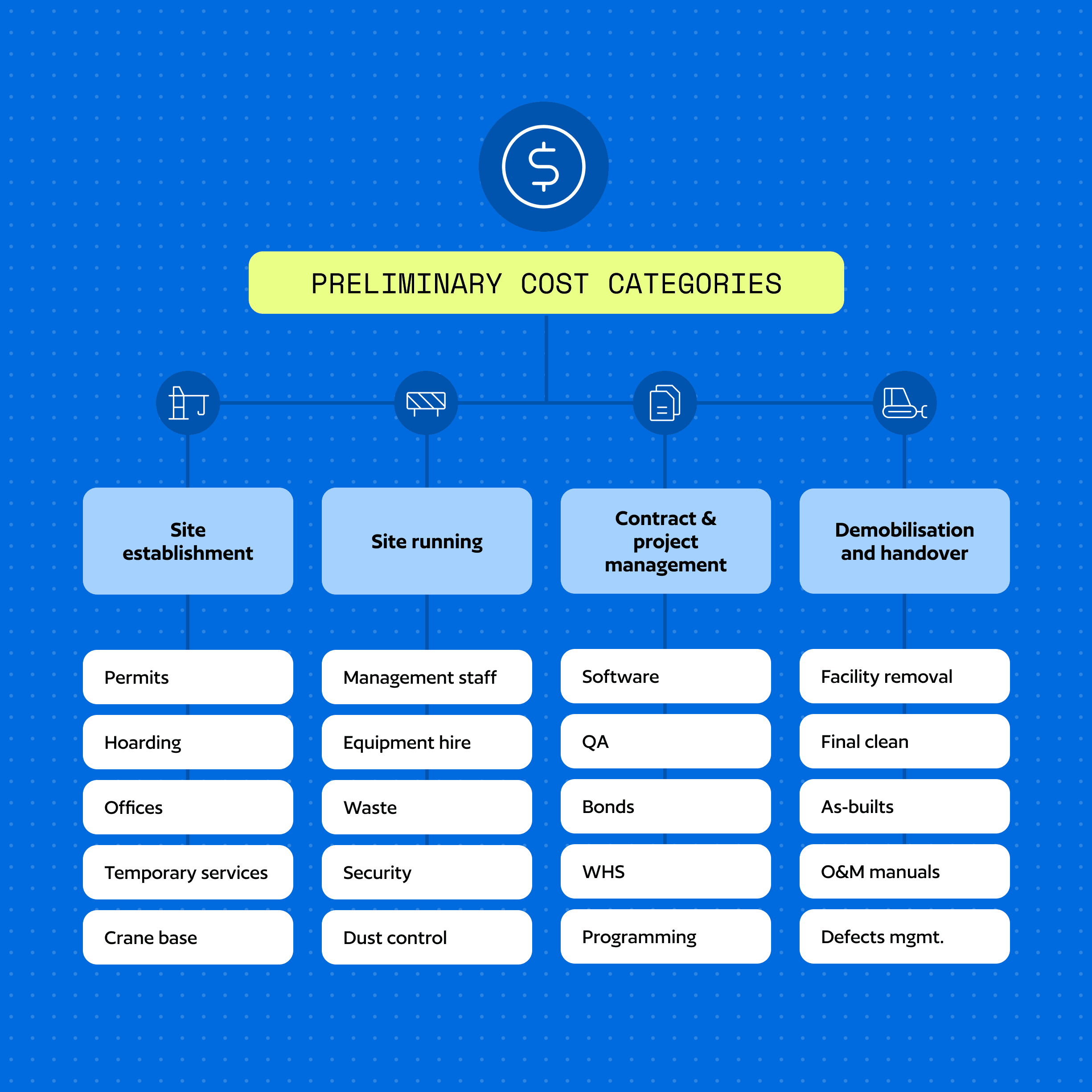
1. Site Establishment Costs
These are one-time expenses required to set up the construction site:
Site Access and Preparation
Permits and licenses
Land take or temporary use of adjacent land
Site clearance and preparation
Access roads and hardstanding areas
Temporary Facilities
Site offices and meeting spaces
Worker welfare facilities (toilets, wash stations, rest areas)
Secure storage containers and yards
First aid stations
Site Security and Safety Setup
Perimeter fencing and hoarding
Security systems installation
Safety signage and emergency equipment
Traffic management systems
2. Site Management and Running Costs
These ongoing expenses keep the site operational throughout the project:
Utilities and Services
Site electricity and generators
Water supply and drainage
Internet and communications systems
Heating, ventilation, or cooling systems
Personnel and Management
Site management staff salaries
Security personnel
Safety officers
Administrative support
Equipment and Maintenance
Tower crane base installation and rental
Hoists and lifts
Scaffolding and temporary works
Equipment maintenance and inspections
Ongoing Site Operations
Waste management and disposal
Regular site cleaning
Dust and noise control measures
Environmental protection systems
3. Contract and Project Management Costs
These expenses relate to the administrative and coordination aspects of the project:
Documentation and Control
Project management software
Quality assurance programs
Document control systems
Progress reporting systems
Coordination and Planning
Design coordination meetings
Subcontractor coordination
Scheduling and program management
Logistics planning
Compliance Management
Health and safety management
Environmental compliance monitoring
Regulatory inspections and certifications
Quality control testing
4. Site Closeout and Demobilization
These final-stage costs cover the transition from active construction to project handover:
Site Restoration
Removal of temporary facilities
Disconnection of temporary services
Restoration of affected areas
Final cleaning
Handover Documentation
As-built drawings compilation
Operation and maintenance manuals
Health and safety files
Warranty documentation
Final Compliance
Final inspections and certifications
Regulatory sign-offs
Client acceptance testing
Defect identification and resolution
How prelim drivers shift across project types
The same four categories apply to every job, but the cost weight inside each category swings hard depending on what you're building. The table below shows where the money tends to go on three common project archetypes.
Cost driver | Commercial high-rise | Residential (suburban) | Infrastructure / civil |
|---|---|---|---|
Typical prelims as % of contract | 8–12% | 5–8% | 12–18% |
Site management staff | Heavy: PM, site manager, foremen, WHS officer, site engineer | Lean: PM/SM combined, foreman | Heavy: multiple SMs, engineers, surveyors |
Temporary works | Tower crane, hoist, perimeter scaffold, gantries | Mobile crane, scaffold, perimeter fence | Traffic management, haul roads, dewatering, environmental controls |
Site facilities | Multi-storey shed in restricted footprint | Standard demountable on lot | Multiple compounds, often remote |
Compliance & WHS | High: public proximity, after-hours work, neighbour consultation | Standard residential WHS, occasional acoustic | Very high: environmental approvals, public safety, traffic |
Demob complexity | High: occupied surrounds, careful staged handover | Low: clean and hand to client | High: environmental restoration, asset handover documentation |
The takeaway: don't price a residential prelim using a commercial template, and never price civil work using either. The category structure is portable; the dollar weighting is not.
Specific Examples of Preliminary Items
To provide a more concrete understanding, here are specific examples of preliminary items commonly found in construction projects:
Staff and Labor-Related Items
Project manager salary allocation
Site supervisor costs
Health and safety officer
Security personnel
Administrative support staff
Quality control inspectors
Temporary Facilities
Site office setup and maintenance
Meeting room facilities
Worker rest areas and canteens
Toilet and washing facilities
Changing rooms and lockers
First aid facilities
Temporary parking areas
Equipment and Tools
Tower crane base and operational costs
Hoists and material lifts
Scaffolding systems
Temporary power distribution
Lighting systems
Protection equipment
Survey equipment
Site Protection and Security
Perimeter fencing and gates
CCTV systems and monitoring
Access control systems
Security patrols
Alarm systems
Weather protection measures
Fire protection systems
Administrative and Documentation
Bonds and insurance premiums
Permits and fees
Progress photography
Project management software
Quality assurance documentation
Environmental monitoring
Health and safety documentation
Preliminaries vs. Overheads: Understanding the Difference
Preliminaries are often confused with overhead costs, but they serve different purposes in construction budgeting.
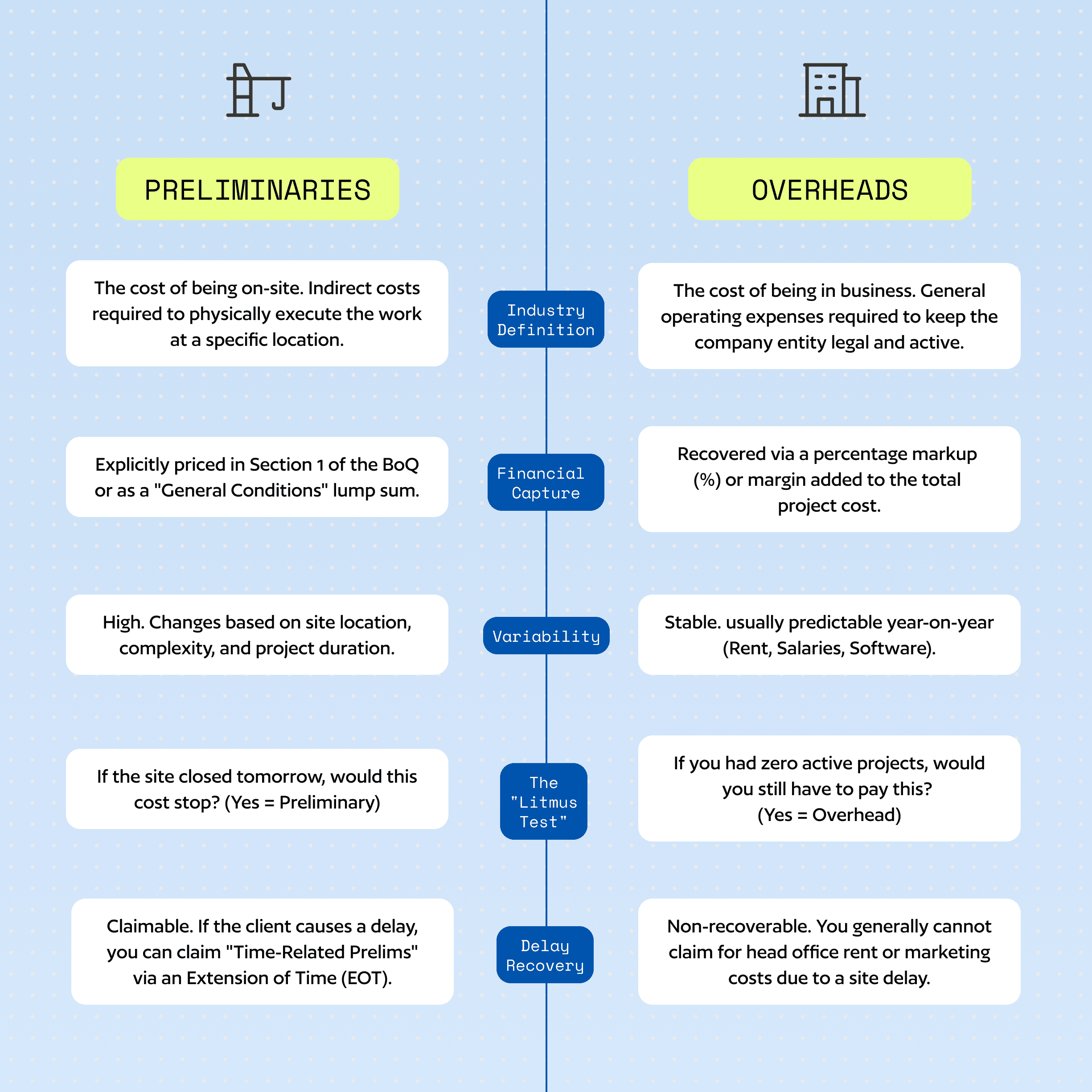
Preliminaries | Overheads |
|---|---|
Project-specific costs | Business-wide costs |
Directly attributable to a single project | Spread across all company operations |
Listed specifically in the contract | Generally not itemized in project contracts |
Vary significantly between projects | Relatively consistent across all projects |
Examples: site office, project-specific staff | Examples: head office rent, executive salaries |
The key distinction is that preliminaries are tied directly to a specific project and would not exist without that project, while overheads are the ongoing costs of running the construction business regardless of individual projects.
A note on preambles
There's a third term that often gets confused with preliminaries: preambles. Preambles aren't costs at all. They're the explanatory text at the top of a bill of quantities or specification: definitions, measurement rules, abbreviations, standards referenced. Preambles tell you how to read the BoQ; preliminaries tell you what the project's running costs are.
Pro tip: When a client asks why your prelims are higher than a competitor's, it's almost always because the competitor has hidden some of those costs inside trade rates or buried them in their head-office overhead recovery. Transparent prelims look more expensive but expose less margin risk over the life of the contract.
How Are Preliminaries Priced?
There are several methods for pricing preliminaries in construction contracts, each with advantages in different scenarios.
1. Line-Item Pricing
This approach involves listing each preliminary item separately in the bill of quantities with its own cost.
Advantages:
Provides full transparency for clients
Allows for precise adjustment if project duration changes
Creates clear accountability for each cost element
Simplifies variation claims if circumstances change
Best for: Complex projects with high risk of changes or extensions.
2. Percentage-Based Pricing
Preliminaries are calculated as a percentage of the total construction cost, typically ranging from 5% for simple projects to 15% or more for complex or high-risk projects.
Advantages:
Simplifies the bidding process
Automatically scales with project size
Requires less detailed pre-contract planning
Easier to administer for smaller projects
Best for: Straightforward projects with well-understood scopes.
3. Time-Related vs. Fixed Preliminaries
Many contracts further divide preliminaries into time-related and fixed components.
Time-Related Preliminaries:
Costs that accumulate over the project duration
Examples: site management salaries, equipment rentals, site office costs
These increase proportionally if the project extends beyond the planned duration
Fixed Preliminaries:
One-time costs regardless of project duration
Examples: site setup, mobilization, demobilization
These remain constant even if the project timeline changes
This distinction becomes particularly important when assessing the cost impact of project delays or acceleration.
Pro tip: Always present time-related prelims as a weekly rate in your tender, not a lump sum. Most standard form contracts entitle you to recover delay costs at agreed rates, but only if those rates are clearly set out. A weekly rate next to each time-related item is the cleanest way to do this. In the Australian context, AS 4000 clause 34.9 and AS 2124 clause 36 both work this way.
What Percentage of Contract Value Should Preliminaries Be?
Industry benchmarks vary by project type, complexity, and market.
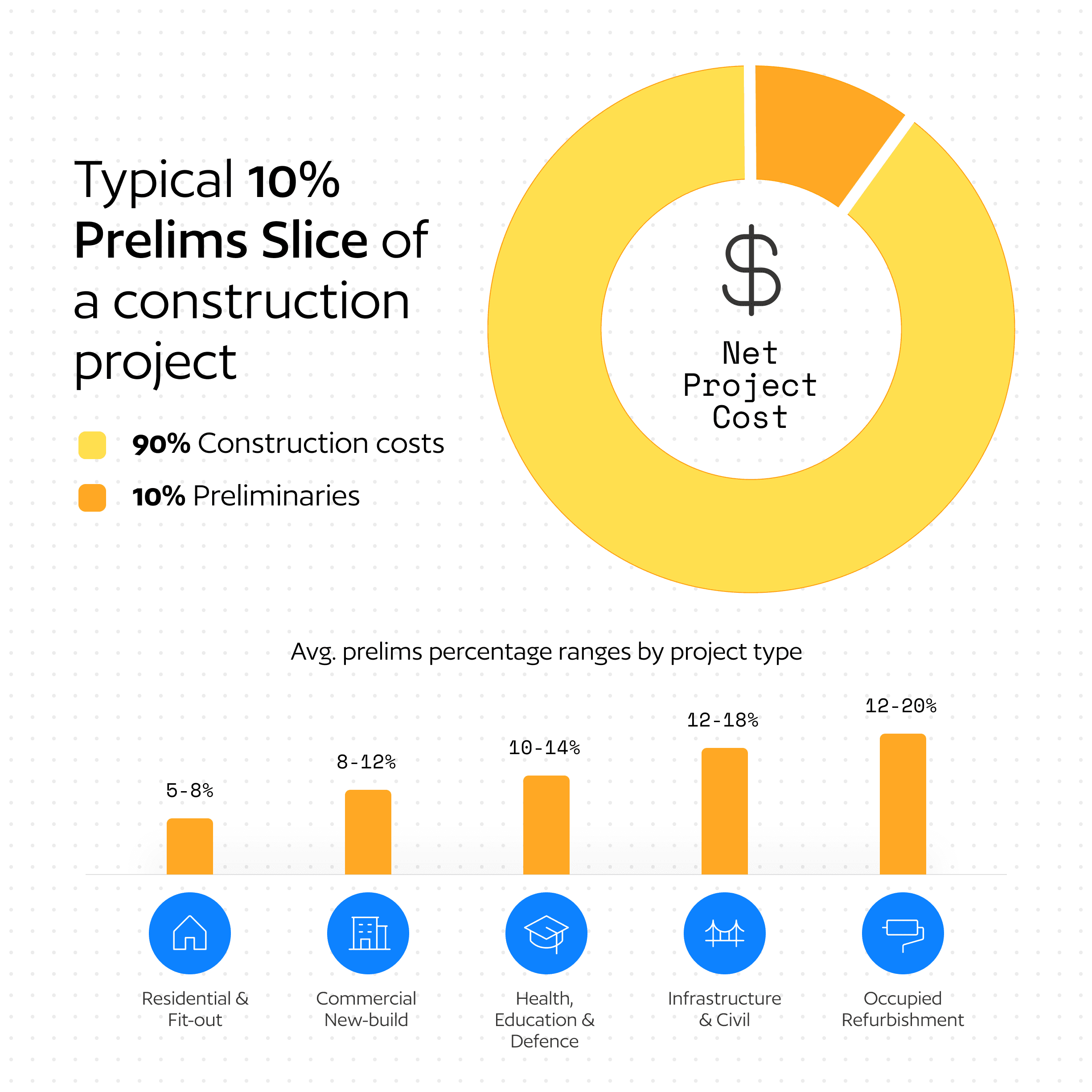
Residential / small fit-out: 5–8%
Commercial new-build: 8–12%
Health, education, defence: 10–14%
Infrastructure and civil: 12–18%
Refurbishment of occupied buildings: 12–20% (the occupied premises premium is real)
These are starting points, not targets. The right number for your project depends on duration, site constraints, regulatory load, and how much risk the contract pushes onto you.
Worked example: a $25M mid-rise apartment build over 24 months
Mid-rise apartments straddle residential and commercial. They need a tower crane, a hoist, and a real management team, so prelims usually land around 10%, sitting above the typical residential range. On a $25M contract over 24 months, that's a prelims budget of about $2.5M. The breakdown below shows how it might be allocated.
Category | Key items | Type | $ (AUD) |
|---|---|---|---|
Site establishment | Mobilisation, hoarding, offices, temp services, crane base | Fixed | 420,000 |
Site management staff | PM, site manager, foreman, WHS officer, site engineer | Time | 780,000 |
Equipment standing time | Tower crane, hoist, scaffold (24-month hire) | Time | 540,000 |
Site running | Power, water, cleaning, waste, security, traffic, dust | Time | 240,000 |
Bonds & insurances | Contract works, public liability, workers comp, performance bond | Fixed | 230,000 |
Compliance & QA | WHS plan, ITPs, environmental management, doc control | Time | 180,000 |
PM systems & reporting | Software, programming, design coordination | Time | 90,000 |
Demob & handover | Final clean, restoration, as-builts, O&M, DLP management | Fixed | 20,000 |
Total prelims | 2,500,000 |
Note the split: about $1.83M (73%) is time-related, and only $670K (27%) is fixed. The time-related component works out to roughly $17,600 per week, so an 8-week program slip costs about $140,000 of unrecovered prelims if the EOT mechanism doesn't trigger delay costs, and a 16-week slip costs over $280,000. The lesson isn't "build a bigger contingency", it's "make sure every time-related line in your tender has a weekly rate next to it".
How Preliminaries Appear in Australian Standard Form Contracts
For Australian contractors, the two most common head contracts handle prelims slightly differently.
AS 4000–1997 (General conditions of contract) doesn't define "preliminaries" as a term, but Annexure Part A and the contract sum schedule expect you to identify the time-related component separately. Clause 34.9 (delay costs) and clause 36 (variations) both reference rates that should be drawn from your priced prelims, so a vague lump sum here will hurt you in any extension of time claim.
AS 2124–1992 is older and still common in government civil work. It uses similar logic: the schedule of rates in Annexure Part A typically separates establishment, time-related, and demobilisation costs. Clause 36 (extension of time) and clause 47 (delay damages) lean on these rates.
Modified contracts (the reality on most jobs). Australian principals modify AS contracts heavily. Read the special conditions before pricing prelims. Common amendments include caps on time-related recovery, exclusions for "concurrent delay," and shifted obligations on insurances. A prelim priced for the unamended standard form can leave you exposed.
Structuring Preliminaries Using NBS Uniclass
The NBS Uniclass 2015 classification system gives a consistent numbering structure that quantity surveyors and clients expect. The relevant codes for prelims sit in tables 00-05-70 through 00-80-70:
00-05-70Project location and constraints00-10-70Works contract conditions00-30-70Procurement00-40-70Site establishment00-50-70Site management00-60-70Verification and quality00-70-70Administration00-80-70Completion
Public projects increasingly require Uniclass alignment. Even on private work, using the structure makes your tender easier to compare against others, which usually plays in favour of the contractor who's done a thorough job.
Factors Affecting Preliminary Costs
Several key factors influence the extent and cost of preliminaries.
Project Complexity and Size. More complex projects require more extensive site management, coordination, and temporary works, increasing preliminary costs as a percentage of the total budget.
Project Duration. Longer projects have higher time-related preliminary costs for site operations, equipment rentals, and management staff.
Site Location and Conditions. Urban locations or sites with restricted access require more sophisticated logistics planning and potentially expensive traffic management systems.
Regulatory Environment. Projects in highly regulated environments need more extensive compliance measures and documentation systems.
Weather and Seasonal Factors. Projects spanning extreme seasons may require additional temporary facilities for weather protection and climate control.
Phasing Requirements. Projects delivered in multiple phases often have higher preliminaries due to repeated mobilization and demobilization activities.
Common Pricing Mistakes to Avoid
Underestimating Project Duration. One of the most common errors is underestimating how long time-related preliminaries will be needed, leading to budget overruns if the project extends beyond the planned completion date. If your time-related prelims run at $40,000 per week and the program slips 12 weeks beyond what you priced, that's $480,000 of unrecovered cost, usually more than your entire contingency.
Pricing prelims as a percentage on a complex job. A flat 10% across a hospital project with three occupied wings, after-hours work, and IPS-rated medical gas certification will not cover what's actually required.
Missing the occupied premises premium. Working in a live retail centre, hospital, or school adds 15–30% to most prelim items because of access restrictions, after-hours requirements, and the dust/noise/odour controls that come with operating around the public.
Overlooking Site-Specific Requirements. Every site has unique challenges that affect preliminaries. Failing to account for these can lead to significant additional costs during execution.
Inadequate Risk Allowances. Preliminaries should include allowances for potential risks such as weather delays, access restrictions, or regulatory changes.
Forgetting demobilisation. Site restoration, final clean, and defect liability period management are real costs that frequently get omitted because they happen long after the original tender was priced.
Using Standard Percentages Without Analysis. Applying standard percentage rates without analyzing the specific project requirements can lead to either over or under-budgeting for preliminaries.
Who Is Responsible for Calculating Preliminaries?
In most construction projects, several parties have roles in defining and pricing preliminaries.
Main Contractor
The primary responsibility typically falls to the main contractor, who must:
Assess site requirements
Determine necessary temporary facilities
Estimate management resources needed
Calculate equipment and setup costs
Price these elements competitively while ensuring sufficient coverage
Quantity Surveyor
Quantity surveyors often play a critical role in:
Advising on appropriate preliminary items
Benchmarking costs against similar projects
Reviewing preliminary submissions for completeness
Assessing value for money
Negotiating preliminary costs with contractors
Project Manager
The client's project manager typically:
Reviews preliminary provisions for adequacy
Ensures all project requirements are addressed
Validates that costs are reasonable
Monitors preliminary expenses during execution
The Impact of Technology on Preliminaries
Digital transformation is significantly changing how preliminaries are planned, managed, and executed.
Digital Planning and Modeling
BIM and digital twins now enable more precise planning of site layouts, temporary works, and logistics, optimizing preliminary elements before execution begins.
Integrated Management Platforms
Modern construction management platforms allow for:
Real-time tracking of preliminary costs
Digital documentation of compliance activities
Mobile inspection and verification
Automated reporting on preliminary items
These systems reduce administrative overhead while improving visibility and control.
Remote Monitoring Technologies
Advanced technologies now enable:
Remote security monitoring reducing security personnel costs
Automated environmental monitoring systems
Equipment utilization tracking
Predictive maintenance for temporary systems
These innovations can significantly reduce certain preliminary costs while improving effectiveness.
Data-Driven Decision Making
Historical data analytics now help contractors:
Benchmark preliminary costs against similar projects
Optimize resource allocation
Predict potential issues before they impact costs
Justify preliminary provisions with objective data
Best Practices for Managing Preliminaries
1. Comprehensive Pre-Construction Planning
Invest time in thorough site analysis and planning before finalizing preliminaries:
Conduct detailed site surveys
Analyze access constraints
Assess utility availability
Identify potential environmental issues
Review regulatory requirements
Digital planning tools allow teams to model different site layout scenarios and optimize preliminary elements before execution.
2. Clear Documentation and Transparency
Ensure all preliminary items are clearly documented:
Provide detailed descriptions of each item
Specify what is included and excluded
Define responsibility boundaries with subcontractors
Establish measurement and payment methods
Document assumptions made during pricing
This clarity helps prevent disputes and ensures all parties have aligned expectations.
3. Regular Review and Adjustment
Preliminaries should be actively managed throughout the project:
Schedule regular reviews of preliminary provisions
Adjust resources based on current and upcoming needs
Track expenditure against budget
Forecast preliminary costs to completion
Document changes and their justifications
Integrated management platforms provide real-time visibility into preliminary utilization and costs, enabling proactive management.
4. Knowledge Capture and Application
Learn from each project to improve future preliminary planning:
Document effective preliminary strategies
Record challenges and solutions
Analyze cost variations and their causes
Create benchmarks for similar future projects
Update standard preliminary templates based on lessons learned
Digital knowledge management systems help capture and distribute these insights across the organization.
5. The Tactical Playbook: Managing Prelims Through the Project Lifecycle
Pricing prelims well is only half the battle. The other half is tracking them.
Set up a prelims register on day one. Each line in your priced prelims becomes a row, with budget, committed cost, actual cost, and forecast to complete.
Review monthly with the project manager and contracts administrator. Time-related items drift first. Catch them early and you can claim variations or restructure resourcing while there's time to act.
Document every prelim variation as it happens. If the principal extends the program, requires after-hours work, or adds a stakeholder coordination meeting, capture the cost impact in writing the same week. Six months later, your contract administrator will not be able to reconstruct it from memory.
Close out prelims before the trade close-out. Demob costs are the most commonly forgotten line in final accounts. Schedule them as a discrete handover task, not an afterthought.
Pro tip: Build your prelims register inside the same tool you use for progress claims and variations. When the prelims data lives in a separate spreadsheet from the contract admin data, reconciliation at month-end becomes a manual exercise that nobody has time for.
The Cost of Getting Preliminaries Wrong
Inadequate preliminary planning and budgeting can have severe consequences.
Financial Impact
Budget overruns due to unplanned preliminary costs
Cash flow issues from unexpected expenses
Reduced profit margins when preliminaries exceed allowances
Claims and disputes over responsibility for preliminary items
Schedule Impact
Delays from inadequate site setup or facilities
Productivity losses due to insufficient resources
Rework when quality control systems are inadequate
Extended project duration increasing time-related preliminaries
Quality and Compliance Impact
Non-compliance with regulations when systems are insufficient
Quality issues from inadequate control processes
Documentation gaps creating handover problems
Reputation damage from preventable incidents
Case Study: The High Cost of Inadequate Preliminaries
A 2024 industry study examined 50 failed or severely delayed construction projects and found that inadequate preliminaries were a contributing factor in 68% of cases. The most common preliminary-related failures included:
Insufficient site investigation leading to unexpected ground conditions
Inadequate temporary works design causing safety incidents
Underestimated site management resources resulting in coordination failures
Insufficient logistics planning creating material delays and storage problems
Inadequate compliance systems leading to regulatory interventions
The average financial impact of these preliminary failures was 12% of the total project value, far exceeding what adequate preliminaries would have cost initially.
Streamlining Preliminaries Management with Integrated Platforms
Modern construction management platforms have transformed how preliminaries are managed by connecting all aspects of site operations.
Unified Digital Environment
Central repository for all preliminary documentation
Real-time tracking of preliminary costs and utilization
Mobile access to plans and specifications in the field
Digital verification of compliance activities
Automated notification of issues or risks
Streamlined Processes
Digital site inspections and verifications
Automated reporting and documentation
Integrated compliance management
Real-time coordination between office and field
Data-driven resource allocation
Enhanced Visibility and Control
Executive dashboards showing preliminary status
Early warning indicators for potential issues
Cost forecasting based on current utilization
Performance benchmarking against standards
Historical data for future project planning
These platforms eliminate the information silos that traditionally complicated preliminaries management, creating a single source of truth that enhances decision-making and control.
Frequently Asked Questions About Construction Preliminaries
When should preliminaries be planned in the project lifecycle?
Preliminary planning should begin during the pre-construction phase, ideally as soon as the project scope is reasonably defined. Early planning allows for:
More accurate budgeting
Better site utilization
Identification of potential issues
Integration with the overall project strategy
Optimization of resources and approaches
Can subcontractors include preliminaries in their quotes?
Yes, subcontractors often include their own preliminaries for:
Specialized equipment or temporary works
Trade-specific supervision
Special protection requirements
Specialized testing or compliance activities
However, it's essential to clearly define which preliminaries are the main contractor's responsibility versus the subcontractors' to avoid duplication or gaps. Read every subcontractor's prelims line before signing.
How do preliminaries change for different types of construction?
Different project types have varying preliminary requirements:
Residential Projects: Generally lower preliminary percentages (5–8%), simpler site setups and management structures, less extensive compliance documentation.
Commercial Projects: Medium preliminary percentages (8–12%), more complex logistics and site management, higher safety and quality requirements.
Infrastructure Projects: Higher preliminary percentages (12–18%), extensive temporary works and site facilities, complex environmental and community considerations, sophisticated traffic and public safety measures.
How are preliminaries affected if a project runs over schedule?
When projects extend beyond their planned duration:
Time-related preliminaries continue to accrue costs (site management, rentals, facilities)
The contractor typically has grounds to claim additional preliminary costs
The extent of recovery depends on the contract terms and reason for delay
Proper documentation of preliminary costs is essential for successful claims
In Australia, AS 4000 clause 34.9 is the typical recovery mechanism. Document everything as it happens.
Should preliminaries include a profit element?
Yes, preliminaries typically include a profit component for the contractor, as they represent real costs and risks. However, this should be transparent in the pricing structure, either as:
A separate markup clearly indicated in the preliminaries section
Part of the individual rates for each preliminary item
A disclosed percentage applied to direct preliminary costs
What's the difference between preliminaries and a contingency?
Preliminaries are known indirect costs. Contingency is an allowance for unknown costs: scope changes, latent conditions, design errors. They sit in different sections of the cost plan and shouldn't be conflated.
Are preliminaries claimable as a progress payment?
Yes. Establishment costs are typically claimed in the first one or two progress claims; time-related prelims are claimed monthly in proportion to the program; demobilisation is claimed at practical completion. Set this out in your payment schedule before the first claim.
Conclusion: Prioritizing Preliminaries for Project Success
Preliminaries might operate behind the scenes, but they form the essential foundation upon which successful construction projects are built. When overlooked or underpriced, they can erode profit margins and cause major delays. When properly planned and managed, they pave the way for smooth execution and successful delivery.
As construction projects become increasingly complex and technology-dependent, the importance of comprehensive preliminary planning only grows. The most successful construction organizations recognize that investments in proper site setup, management systems, and supporting infrastructure pay dividends throughout the project lifecycle.
The contractors who consistently make margin do three things differently: they price prelims line-by-line, they split time-related from fixed at the tender stage, and they manage prelims through a register from mobilisation to demob. None of it is glamorous. All of it is the difference between a healthy margin and a thin one.
Whether you're working on a residential development or a billion-dollar infrastructure project, understanding and properly accounting for preliminaries is a non-negotiable part of professional construction management. It can make the difference between project success and failure.
Related Articles


The AI Construction Operating System
One platform, one data model, every project. Built in Australia, for the world.
YOUR DATA, PROTECTED
Hosted on AWS Sydney with Australian data residency.


GET THE MOBILE APP
Platform
Solutions
© 2026 Plexa Pro Pty Ltd. ABN 63 668 433 136