Ask your projects data anything. Get answers in seconds. Plexa MCP Connector is live. See it in action


AI in Construction: What's Actually Working Today
A practitioner's view of where AI is already running on construction sites in 2026, the places it isn't, and what the early adopters got right.
Select Hub
Construction Management
For the last three years, every construction conference has had the same closing keynote: "AI is going to change everything." In 2026, we finally have enough deployments at scale to separate the slide deck from the site trailer.
Two numbers frame the picture. On one side, 38% of contractors now report measurable business impact from AI, more than double the 17% reported in 2025, and AI adoption tripled among ENR Top 400 contractors in just 18 months (ServiceTitan / For Construction Pros). On the other, an MIT study cited across the industry found that 95% of enterprise AI pilots fail to create measurable financial impact, and roughly a third of construction firms are stuck in proof-of-concept purgatory (The Access Group).
Both can be true. The work below is what the winners are actually doing.
Where AI is working right now
1. Preconstruction is the beachhead
Preconstruction is the single most common entry point for AI, and it is no accident. Estimating, document review, and scope generation are document-heavy, repetitive, and bounded enough that an LLM can add value without touching a hammer. Cost estimating and budgeting (24%) and bid management (22%) lead the use-case list (ServiceTitan / For Construction Pros).
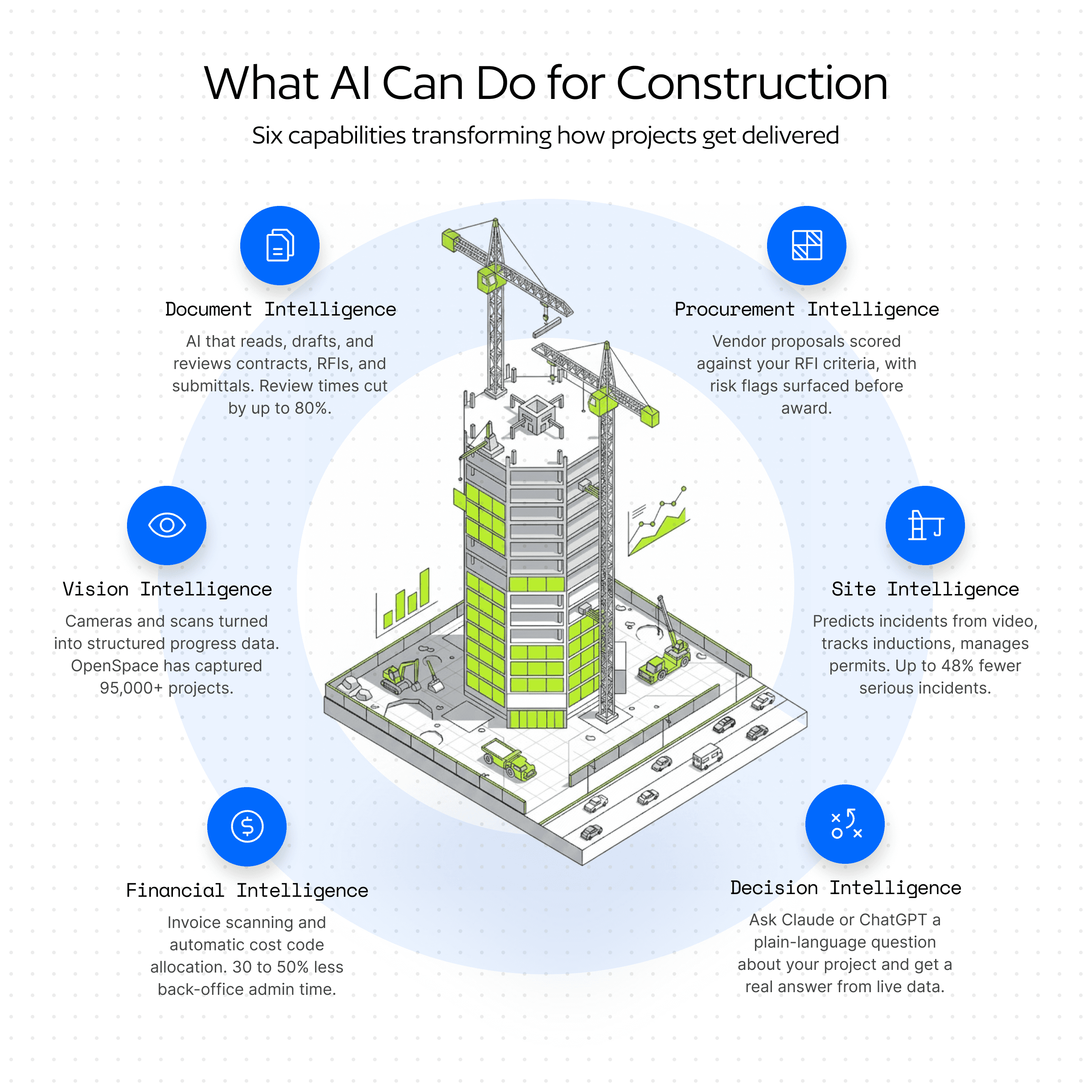
Document Crunch, an AI contract review tool built for construction, says users cut review times by up to 80%, and at $200/month "pays for itself with a single caught risk" (Document Crunch).
2. Submittals and RFIs
This is the workflow where ROI shows up first on the operations side. Cleveland Construction reported more than 790 hours saved and over $60,000 in cost reduction across four projects using Trunk Tools alongside Autodesk Forma, with submittal review cycles compressing from multiple days to same-day (TipRanks).
Suffolk Construction signed an enterprise agreement with Trunk Tools in March 2026 and rolled the platform out to more than 1,500 field users nationwide. A Suffolk senior project manager described the impact in plain numbers: the time savings "probably saves days or weeks" per person, and across a 20-person team it adds up to "man-months of time" that can be spent on real problems in the field (GlobeNewswire).
3. Progress monitoring with computer vision
OpenSpace is now deployed on 95,000+ projects, capturing site conditions with 360-degree hardhat cameras, drones, and laser scanners, then tracking 700+ components across trades to compare planned versus actual progress in near real time. In September 2025 the company launched its Visual Intelligence Platform, turning reality-capture data into workflows for punch lists and issue logging (OpenSpace).
Buildots and Doxel occupy similar ground. Doxel uses AI, LiDAR, and computer vision, deployed via autonomous robots or handheld devices, to give teams real-time feedback on cost, progress, and productivity against the BIM model (Dan Cumberland Labs).
4. Jobsite safety
Fyld, which analyzes short jobsite video clips to flag safety risks and quality issues, reported 82% year-over-year growth in 2025, with customers reporting reductions in serious workplace incidents of up to 48% (ServiceTitan / For Construction Pros).
A note of caution: safety gains industry-wide have not kept pace with the technology. Fatal injuries in construction remain stubbornly high, and AI safety tools work best when they augment, not replace, human oversight (Autodesk).
5. Back-office automation
The quiet winner. Pilot firms applying AI to field reports, invoice processing, and dispatching are seeing 30% to 50% reductions in admin hours (ServiceTitan / For Construction Pros). No fancy site hardware required.
Where AI still isn't working
McKinsey's broader 2025 State of AI data shows 88% of organizations now use AI in at least one business function, but only 5.5% see real financial returns (McKinsey). Construction sits firmly in that gap. Three reasons keep showing up.
The pilot problem. Roughly half of construction organizations have no AI in place, and about a third are stuck in proof-of-concept purgatory that never scales beyond one process. Fewer than 1% report AI embedded organization-wide (The Access Group).
People, integration, and data, in that order. A shortage of skilled people to run AI (46%), integration with existing systems (37%), and data quality and availability (30%) are the top barriers, not cost (ASCE).
Documentation volume. Bechtel has flagged the sheer weight of equipment documentation, hundreds of pieces of equipment per site, each with thousands of pages of manuals, as a real bottleneck for keeping AI systems trained on current operating and maintenance protocols (Frontiers in Built Environment).
What the early adopters got right
A few patterns separate the contractors generating real ROI from the ones still demoing pilots.
They started where the document is the product. Preconstruction, contracts, submittals, RFIs. These workflows have a clean input, a clean output, and a measurable cycle time.
They picked one workflow and rolled it out wide. Suffolk's Trunk Tools deployment to 1,500+ field users is the model. A tool used by twenty people on one job is a pilot. A tool used by everyone on every job is infrastructure.
They funded the data work first. McKinsey's analysis says AI can lift construction productivity by up to 20%, cut costs by up to 15%, and improve delivery times by up to 30%, but those gains only show up when the underlying data is clean and connected (McKinsey).
They measured in hours and dollars, not adoption. Cleveland Construction's 790 hours and $60,000 across four projects is the kind of receipt that ends an internal debate (TipRanks).
The four stages of AI maturity in construction
Every contractor sits somewhere on the same curve. The early adopters did not invent a new use case. They moved one step further along it.
Stage 1 is Reactive. Bolt-on AI tools, one app per task, manual data entry between them. This is where most pilots die.
Stage 2 is Augmented. AI lives inside the workflow it serves. Invoice scanning runs in the AP module. Vendor scoring runs in procurement. Scope generation runs in document control. This is where most of the leaders quoted in this article sit today.
Stage 3 is Automated. AI actions trigger on events, not on someone remembering to press a button. Invoices route themselves. Variations flag themselves. Permit renewals fire themselves. Humans review exceptions, not routine cases.
Stage 4 is Autonomous. AI agents plan, decide, and act end-to-end across modules with minimal human intervention. This is the destination, not the starting line.
The contractors winning today are not at Stage 4. They are at Stage 2, scaled. The point is to keep moving up the curve, not to leap to the top of it.
Where Plexa fits
Every failed pilot in this article has the same root cause. The AI is smart. The data it can reach is not. A contract review tool that cannot see the budget. A vision platform that cannot see the schedule. An invoice scanner that cannot see the commitment it should be matched against. Smart software, sitting on top of fragmented systems, ends up doing fast work on the wrong picture.
Plexa is built the other way around. Document control, procurement, finance, site management, safety, and correspondence run on a single platform. When AI sits inside that platform, it sees the whole project at once. That context is the entire advantage.
What Plexa AI does today
Invoice scanning and smart allocation. Plexa AI reads incoming invoices, extracts line items and vendor details, and allocates them directly to the right cost codes in the finance module. Because the budget, the commitments, and the AP queue all live in the same place, the allocation is matched against the actual contract, not guessed.
Procurement assistance. When vendor proposals come in, Plexa AI scores them against the RFI requirements you set, weighing price competitiveness, compliance, and completeness, and surfaces a recommendation with the risk flags called out. The scoring uses the procurement data already in the system.
Scope of works generation. Trade-specific scopes drafted in seconds, drawn from your project data and templates rather than a blank page. Ready to review, edit, and issue.
Document control assistance. AI-powered autocomplete on document uploads, plus change management built into the workflow. Less manual data entry, fewer wrong revisions in the field.
What's coming next
Plexa is launching MCP (Model Context Protocol) integration, connecting your project data directly to the LLM of your choice, ChatGPT, Claude, or Gemini. Ask Claude for the health of a project this week, including outstanding approvals and overdue permits, and it answers from your live Plexa data. No exports. No dashboards. No prompt engineering against a generic model that has never seen your job.
After that the roadmap moves into automation and autonomous agents. The principle stays the same: every step assumes the AI already has the full project context, because it does.
The outcome
Less admin. Fewer errors. Faster decisions. Software spend cut by over 30% versus a stack of point solutions. Implementation in 6 to 8 weeks, not multi-quarter rollouts.
If you want to see how a connected platform changes what AI can actually do on a project, book a 30-minute walkthrough with the Plexa team.
The bottom line
AI in construction in 2026 is not a futures bet. It is a procurement decision. The tools work. The case studies have receipts. The contractors winning with AI did not chase the most ambitious use case. They picked the one that paid back in a quarter, scaled it across every project, and used the time it freed up to attack the next workflow.
The window is still open, but it is narrowing fast. The ENR Top 400 already tripled their AI adoption in 18 months (ServiceTitan / For Construction Pros). The contractors still treating AI as a 2027 problem are about to find out what catching up costs.
After that the roadmap moves into automation and autonomous agents. The principle stays the same: every step assumes the AI already has the full project context, because it does.
Sources
McKinsey & Company, Delivering on construction productivity is no longer optional (31% productivity uplift figure)
Dodge Construction Network, contractor AI sentiment survey (87% expect impact, 19% have adapted workflows)
ServiceTitan, 2026 Commercial Specialty Contractor Industry Report (38% reporting measurable AI results, up from 17%)
Bluebeam, AEC AI Adoption Survey of 1,000 professionals (27% AI usage, paper still in design and planning)
KPMG, Global Construction Survey 2025/2026 (55% cite skills and capability gaps as a top concern)
Deloitte, 2026 Engineering and Construction Industry Outlook (499,000 worker shortfall, 41% retirement by 2031)
Master Builders Australia, Industry leaders and Standards Australia partner on productivity (AU shortages context)
Related Articles


The AI Construction Operating System
One platform, one data model, every project. Built in Australia, for the world.
YOUR DATA, PROTECTED
Hosted on AWS Sydney with Australian data residency.


GET THE MOBILE APP
Platform
Solutions
© 2026 Plexa Pro Pty Ltd. ABN 63 668 433 136